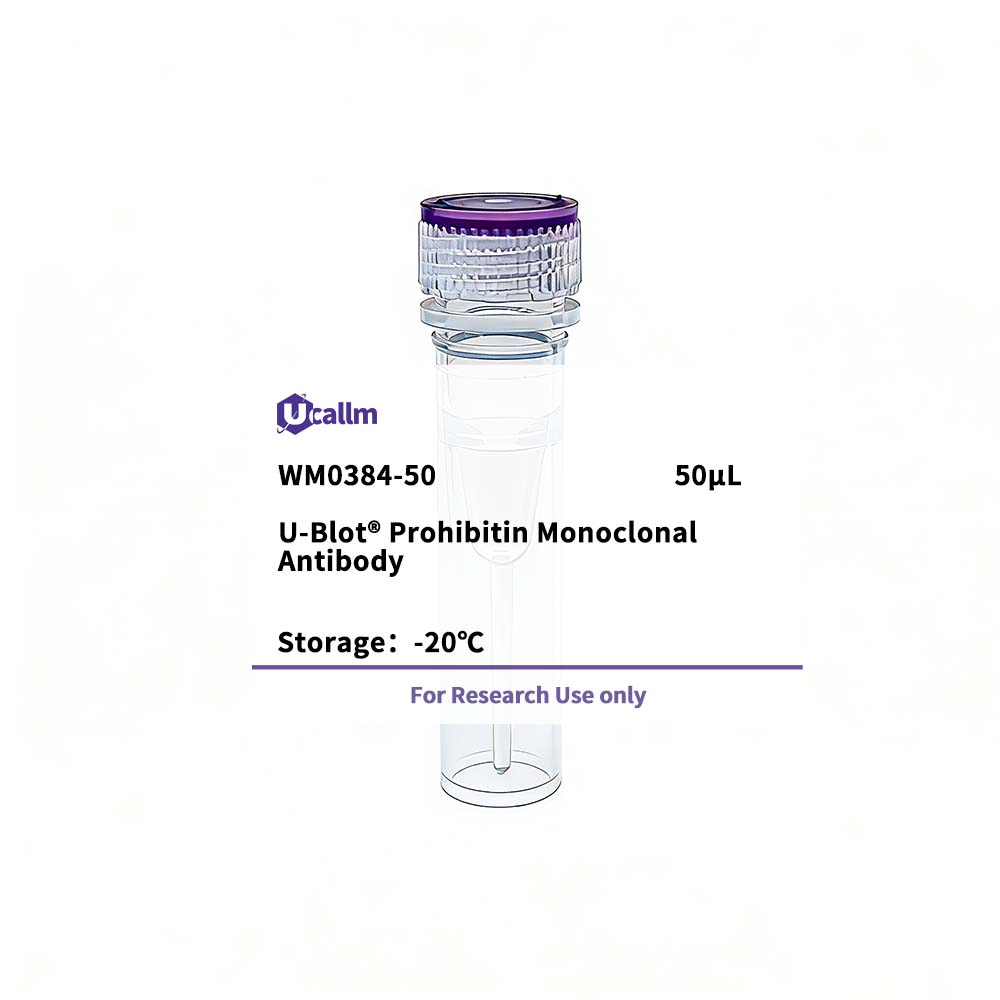
SKU: WM0384 Categories: ,

Prohibitin Monoclonal Antibody

Price range: $268.00 through $328.00

SKU: WM0384-50
Enter the quantity you would like, or drag the panel to find the quantity and price that best for you
Bulk QuoteAuthorize OEM & ODM

Product details

Background:
prohibitin(PHB) Homo sapiens This gene is evolutionarily conserved, and its product is proposed to play a role in human cellular senescence and tumor suppression. Antiproliferative activity is reported to be localized to the 3' UTR, which is proposed to function as a trans-acting regulatory RNA. Several pseudogenes of this gene have been identified. Alternative splicing results in multiple transcript variants. [provided by RefSeq, Jul 2013],


Specifications

Size50μL/100μL
TargetProhibitin
ReactivityHuman, Mouse, Rat, Monkey
ApplicationsWB, IHC, IF, FC, ELISA
MW(Calculated)30kD
MW(Observed)
Host SpeciesMouse
Isotype
Conjugate/ModificationUnmodified
Recommended Dilution RatioWB 1:500-1:2000; IHC 1:200-1:1000; IF 1:200-1:1000; Flow Cyt 1:200-1:400; ELISA 1:10000; Not yet tested in other applications. / Note: For IHC, we suggest antigen retrieval with TE buffer pH 9.0 (Cat#WT1004)
FormulationLiquid in PBS containing 50% glycerol, 0.5% BSA and 0.02% sodium azide.
PurificationAffinity purification
Storage-15°C to -25°C/1 year(Do not lower than -25°C)
Concentration
ClonalityMonoclonal
Clone Number1E2
ImmunogenPurified recombinant fragment of human Prohibitin expressed in E. Coli.
SpecificityProhibitin Monoclonal Antibody detects endogenous levels of Prohibitin protein.
Gene NamePHB
Protein NameProhibitin
Other NamePHB; / Prohibitin
SpeciesHuman
Gene ID5245
UniprotP35232,
Species.1Mouse
Gene ID.118673
Uniprot.1P67778,
Species.2Rat
Gene ID.225344
Uniprot.2P67779
Cellular LocalizationMitochondrion inner membrane . Nucleus . Cytoplasm . Cell membrane .
Tissue ExpressionWidely expressed in different tissues.
Signaling_pathway
Research Areas
Functiondevelopmental stage:Levels of expression in fibroblasts decrease heterogeneously during cellular aging.,Disease:Mutated in sporadic breast cancer.,Function:Prohibitin inhibits DNA synthesis. It has a role in regulating proliferation. As yet it is unclear if the protein or the mRNA exhibits this effect. May play a role in regulating mitochondrial respiration activity and in aging.,induction:Expression increases approximately 3-fold upon entry into G1 phase compared with other phases of the cell cycle. Also induced following inhibition of mitochondrial protein synthesis by thiamphenicol.,similarity:Belongs to the prohibitin family.,subunit:Interacts with PHB2.,tissue specificity:Widely expressed in different tissues.,
Please login to post questions
Back to Top
Product has been added to your cart
