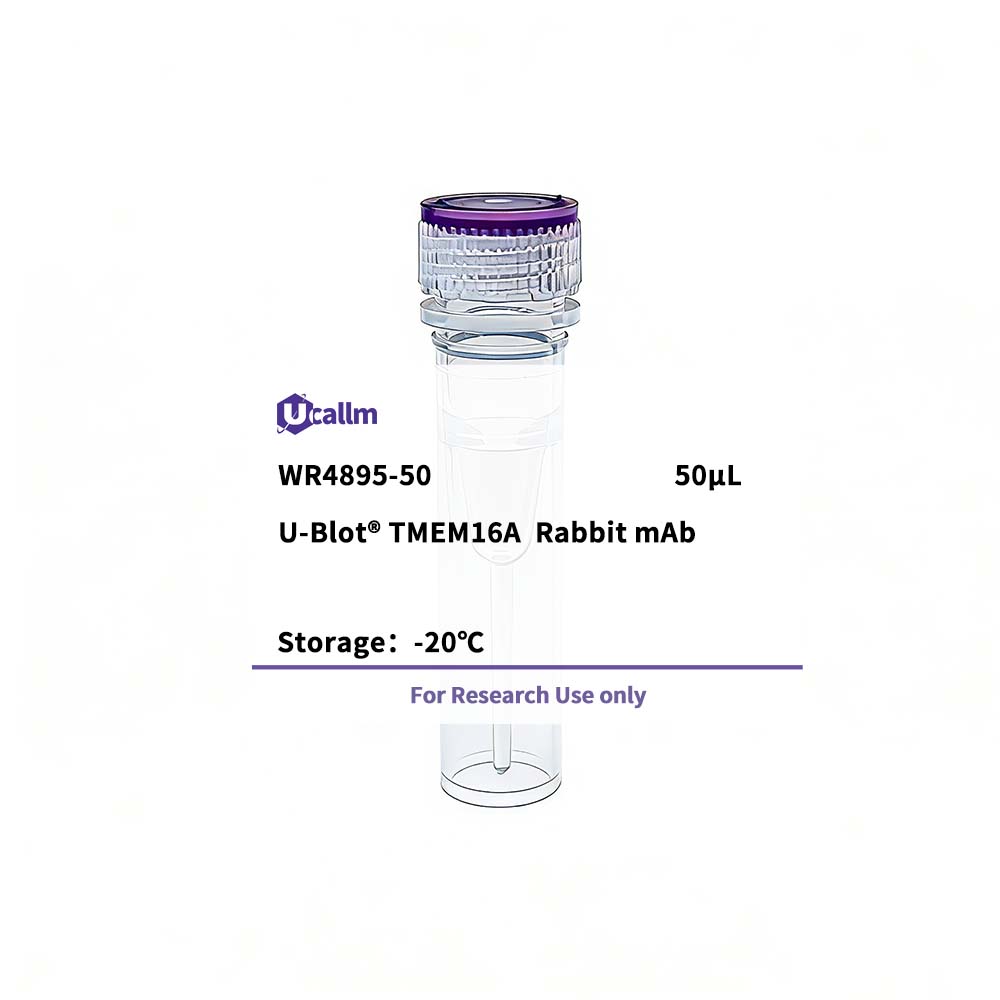
SKU: WR4895 Categories: ,

U-Blot® TMEM16A Rabbit mAb

Price range: $268.00 through $328.00

SKU: WR4895-50
Enter the quantity you would like, or drag the panel to find the quantity and price that best for you
Bulk QuoteAuthorize OEM & ODM

Product details

Background:domain:The region spanning the fifth and sixth transmembrane domains probably forms the pore-forming region.,function:Acts as a calcium-activated chloride channel. Required for normal tracheal development.,similarity:Belongs to the anoctamin family.,tissue specificity:Broadly expressed with higher levels in liver and skeletal muscle.,

Specifications

Size50μL/100μL
TargetTMEM16A
ReactivityHuman
ApplicationsWB, IHC, IF, ELISA
MW(Calculated)114kD
MW(Observed)130kD
Host SpeciesRabbit
IsotypeIgG,Kappa
Conjugate/ModificationUnmodified
Recommended Dilution RatioIHC 1:200-1:1000; WB 1:2000-1:10000; IF 1:200-1:1000; ELISA 1:5000-1:20000; / Note: For IHC, we suggest antigen retrieval with TE buffer pH 9.0 (Cat#WT1004)
FormulationPBS, 50% glycerol, 0.05% Proclin 300, 0.05%BSA
PurificationRecombinant Antibody expressed in animal component-free (ACF) media, purified via Protein A affinity chromatography.
Storage-15°C to -25°C/1 year(Do not lower than -25°C)
Concentration
ClonalityMonoclonal
Clone NumberRM1068R
ImmunogenThe specific immunogen used to produce this antibody is proprietary information.
SpecificityEndogenous
Gene NameANO1
Protein NameAnoctamin-1
Other NameANO1; / DOG1; / ORAOV2; / TAOS2; / TMEM16A; / Anoctamin-1; / Discovered on gastrointestinal stromal tumors protein 1; / Oral cancer overexpressed protein 2; / Transmembrane protein 16A; / Tumor-amplified and overexpressed sequence 2
SpeciesHuman
Gene ID55107
UniprotQ5XXA6
Species.1
Gene ID.1
Uniprot.1
Species.2
Gene ID.2
Uniprot.2
Cellular LocalizationCell membrane; Multi-pass membrane protein . Cytoplasm . Cytoplasmic localization seen in neoplastic cells of head and neck squamous cell carcinoma (HNSCC) tumors. .
Tissue ExpressionBroadly expressed with higher levels in liver, skeletal muscle and gastrointestinal muscles.
Signaling_pathway
Research Areas
FunctionDomain:The region spanning the fifth and sixth transmembrane domains probably forms the pore-forming region.,Function:Acts as a calcium-activated chloride channel. Required for normal tracheal development.,similarity:Belongs to the anoctamin family.,tissue specificity:Broadly expressed with higher levels in liver and skeletal muscle.,

Please login to post questions
Back to Top
Product has been added to your cart