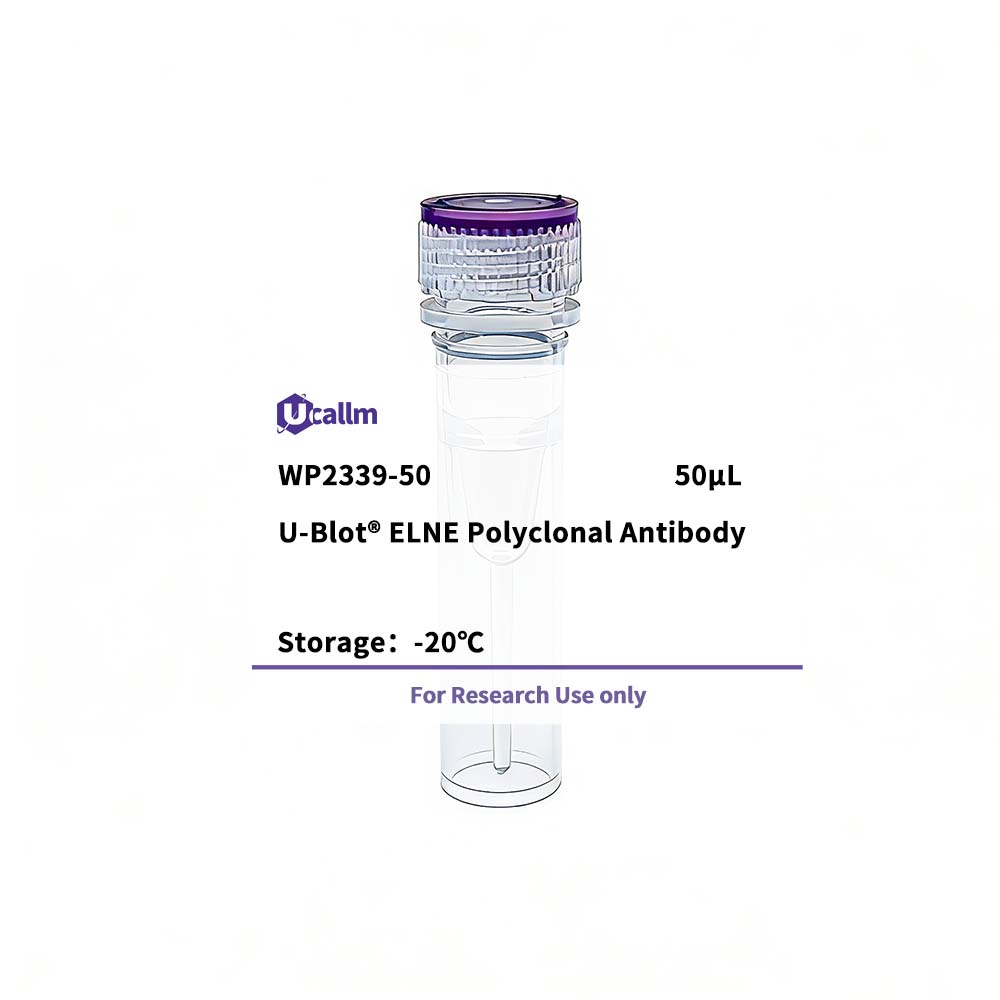
SKU: WP2339 Categories: ,

ELNE Polyclonal Antibody

Price range: $268.00 through $328.00

SKU: WP2339-100
Enter the quantity you would like, or drag the panel to find the quantity and price that best for you
Bulk QuoteAuthorize OEM & ODM

Product details

Background:

Elastases form a subfamily of serine proteases that hydrolyze many proteins in addition to elastin. Humans have six elastase genes which encode structurally similar proteins. The encoded preproprotein is proteolytically processed to generate the active protease. Following activation, this protease hydrolyzes proteins within specialized neutrophil lysosomes, called azurophil granules, as well as proteins of the extracellular matrix. The enzyme may play a role in degenerative and inflammatory diseases through proteolysis of collagen-IV and elastin. This protein also degrades the outer membrane protein A (OmpA) of E. coli as well as the virulence factors of such bacteria as Shigella, Salmonella and Yersinia. Mutations in this gene are associated with cyclic neutropenia and severe congenital neutropenia (SCN). This gene is present in a gene cluster on chromosome 19. [provided by RefSeq, Jan 2016

Specifications

Size50μL/100μL
TargetELNE
ReactivityHuman, Mouse, Bovine
ApplicationsWB, ELISA
MW(Calculated)
MW(Observed)29kD
Host SpeciesRabbit
IsotypeIgG
Conjugate/ModificationUnmodified
Recommended Dilution RatioWB 1:500-2000; ELISA 1:5000-20000
FormulationLiquid in PBS containing 50% glycerol,0.5% BSA and 0.02% sodium azide.
PurificationThe antibody was affinity-purified from rabbit antiserum by affinity-chromatography using epitope-specific immunogen.
Storage-15°C to -25°C/1 year(Do not lower than -25°C)
Concentration1 mg/ml
ClonalityPolyclonal
Clone Number
ImmunogenSynthesized peptide derived from part region of human protein
SpecificityELNE Polyclonal Antibody detects endogenous levels of protein.
Gene NameELANE ELA2
Protein NameNeutrophil elastase (Bone marrow serine protease) (Elastase-2) (Human leukocyte elastase) (HLE) (Medullasin) (PMN elastase)
Other Name
SpeciesHuman
Gene ID1991
UniprotP08246,
Species.1Mouse
Gene ID.1
Uniprot.1Q3UP87
Species.2
Gene ID.2
Uniprot.2
Cellular LocalizationCytoplasmic vesicle, phagosome . Localized in phagolysosomes following ingestion of E.coli by neutrophils. .
Tissue ExpressionBone marrow cells. Neutrophil (PubMed:10947984).
Signaling_pathwayOrganismal Systems >> Immune system >> Neutrophil extracellular trap formation;Human Diseases >> Cancer: overview >> Transcriptional misregulation in cancer;Human Diseases >> Immune disease >> Systemic lupus erythematosus
Research Areas>>Neutrophil extracellular trap formation; / >>Transcriptional misregulation in cancer; / >>Systemic lupus erythematosus
FunctionCatalytic activity:Hydrolysis of proteins, including elastin. Preferential cleavage: Val-|-Xaa > Ala-|-Xaa.,Disease:Defects in ELA2 are a cause of cyclic haematopoiesis (CH) [MIM:162800]; also known as cyclic neutropenia. CH is an autosomal dominant disease in which blood-cell production from the bone marrow oscillates with 21-day periodicity. Circulating neutrophils vary between almost normal numbers and zero. During intervals of neutropenia, affected individuals are at risk for opportunistic infection. Monocytes, platelets, lymphocytes and reticulocytes also cycle with the same frequency.,Disease:Defects in ELA2 are the cause of autosomal dominant severe congenital neutropenia type 1 (SCN1) [MIM:202700]. Severe congenital neutropenia is a heterogeneous disorder of hematopoiesis characterized by a maturation arrest of granulopoiesis at the level of promyelocytes with peripheral blood absolute neutrophil counts below 0.5 x 10(9)/l and early onset of severe bacterial infections.,Function:Modifies the functions of natural killer cells, monocytes and granulocytes. Inhibits C5a-dependent neutrophil enzyme release and chemotaxis.,online information:ELA2 mutation db,online information:Elastase entry,similarity:Belongs to the peptidase S1 family. Elastase subfamily.,similarity:Contains 1 peptidase S1 domain.,subunit:Interacts with NOTCH2NL.,tissue specificity:Bone marrow cells.,
Please login to post questions
Back to Top
Product has been added to your cart
