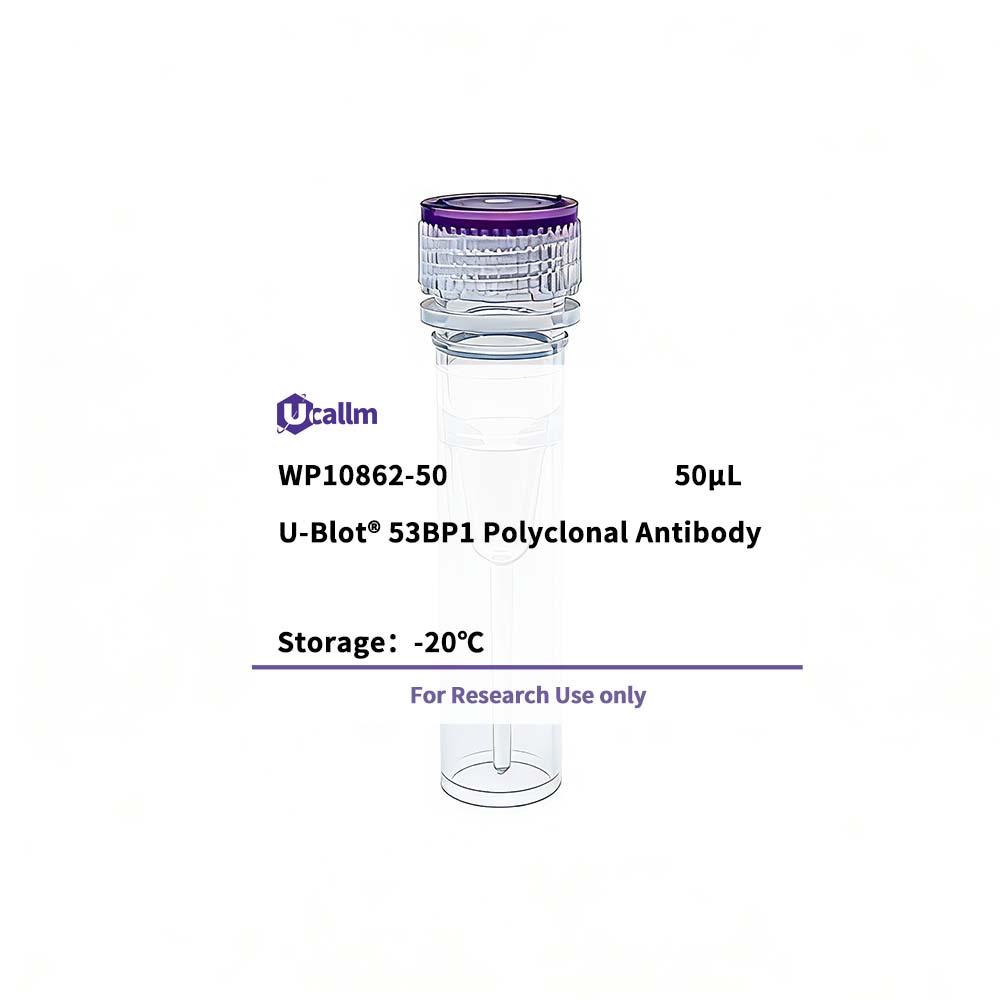
SKU: WP10862 Categories: ,

53BP1 Polyclonal Antibody

Price range: $268.00 through $328.00

SKU: WP10862-100
Enter the quantity you would like, or drag the panel to find the quantity and price that best for you
Bulk QuoteAuthorize OEM & ODM

Product details

Background:

function:May have a role in checkpoint signaling during mitosis (By similarity). Enhances TP53-mediated transcriptional activation. Plays a role in the response to DNA damage., PTM:Asymmetrically dimethylated on Arg residues by PRMT1. Methylation is required for DNA binding., PTM:Phosphorylated at basal level in the absence of DNA damage. Hyper-phosphorylated in an ATM-dependent manner in response to DNA damage induced by ionizing radiation. Hyper-phosphorylated in an ATR-dependent manner in response to DNA damage induced by UV irradiation., similarity:Contains 2 BRCT domains., subcellular location:Associated with kinetochores. Both nuclear and cytoplasmic in some cells. Recruited to sites of DNA damage, such as double stand breaks. Methylation of histone H4 at ‘Lys-20’ is required for efficient localization to double strand breaks., subunit:Interacts with IFI202A (By similarity). Binds to the central domain of TP53/p53. May form homo-oligomers. Interacts with DCLRE1C. Interacts with histone H2AFX and this requires phosphorylation of H2AFX on ‘Ser-139’. Interacts with histone H4 that has been dimethylated at ‘Lys-20’. Has low affinity for histone H4 containing monomethylated ‘Lys-20’. Does not bind histone H4 containing unmethylated or trimethylated ‘Lys-20’. Has low affinity for histone H3 that has been dimethylated on ‘Lys-79’. Has very low affinity for histone H3 that has been monomethylated on ‘Lys-79’ (in vitro). Does not bind unmethylated histone H3.,


Specifications

Size50μL/100μL
Target53BP1
ReactivityHuman, Mouse
ApplicationsWB, IHC, IF, ELISA
MW(Calculated)214kD
MW(Observed)
Host SpeciesRabbit
IsotypeIgG
Conjugate/ModificationUnmodified
Recommended Dilution RatioWB 1:500-1:2000; IHC 1:100-1:300; IF 1:200-1:1000; ELISA 1:10000; Not yet tested in other applications. / Note: For IHC, we suggest antigen retrieval with TE buffer pH 9.0 (Cat#WT1004)
FormulationLiquid in PBS containing 50% glycerol, 0.5% BSA and 0.02% sodium azide.
PurificationThe antibody was affinity-purified from rabbit antiserum by affinity-chromatography using epitope-specific immunogen.
Storage-15°C to -25°C/1 year(Do not lower than -25°C)
Concentration1 mg/ml
ClonalityPolyclonal
Clone Number
ImmunogenThe antiserum was produced against synthesized peptide derived from human TP53BP1. AA range:1744-1793
Specificity53BP1 Polyclonal Antibody detects endogenous levels of 53BP1 protein.
Gene NameTP53BP1
Protein NameTumor suppressor p53-binding protein 1
Other NameTP53BP1; / Tumor suppressor p53-binding protein 1; / 53BP1; / p53-binding protein 1; / p53BP1
SpeciesHuman
Gene ID7158
UniprotQ12888,
Species.1Mouse
Gene ID.127223
Uniprot.1P70399
Species.2
Gene ID.2
Uniprot.2
Cellular LocalizationNucleus
Tissue ExpressionCerebellum,Cervix,Epithelium,Myeloid leukemia cell,Skeletal muscle,
Signaling_pathwayOrganismal Systems >> Immune system >> NOD-like receptor signaling pathway
Research Areas>>NOD-like receptor signaling pathway
FunctionFunction:May have a role in checkpoint signaling during mitosis (By similarity). Enhances TP53-mediated transcriptional activation. Plays a role in the response to DNA damage.,PTM:Asymmetrically dimethylated on Arg residues by PRMT1. Methylation is required for DNA binding.,PTM:Phosphorylated at basal level in the absence of DNA damage. Hyper-phosphorylated in an ATM-dependent manner in response to DNA damage induced by ionizing radiation. Hyper-phosphorylated in an ATR-dependent manner in response to DNA damage induced by UV irradiation.,similarity:Contains 2 BRCT domains.,subcellular location:Associated with kinetochores. Both nuclear and cytoplasmic in some cells. Recruited to sites of DNA damage, such as double stand breaks. Methylation of histone H4 at 'Lys-20' is required for efficient localization to double strand breaks.,subunit:Interacts with IFI202A (By similarity). Binds to the central domain of TP53/p53. May form homo-oligomers. Interacts with DCLRE1C. Interacts with histone H2AFX and this requires phosphorylation of H2AFX on 'Ser-139'. Interacts with histone H4 that has been dimethylated at 'Lys-20'. Has low affinity for histone H4 containing monomethylated 'Lys-20'. Does not bind histone H4 containing unmethylated or trimethylated 'Lys-20'. Has low affinity for histone H3 that has been dimethylated on 'Lys-79'. Has very low affinity for histone H3 that has been monomethylated on 'Lys-79' (in vitro). Does not bind unmethylated histone H3.,
Please login to post questions
Back to Top
Product has been added to your cart

