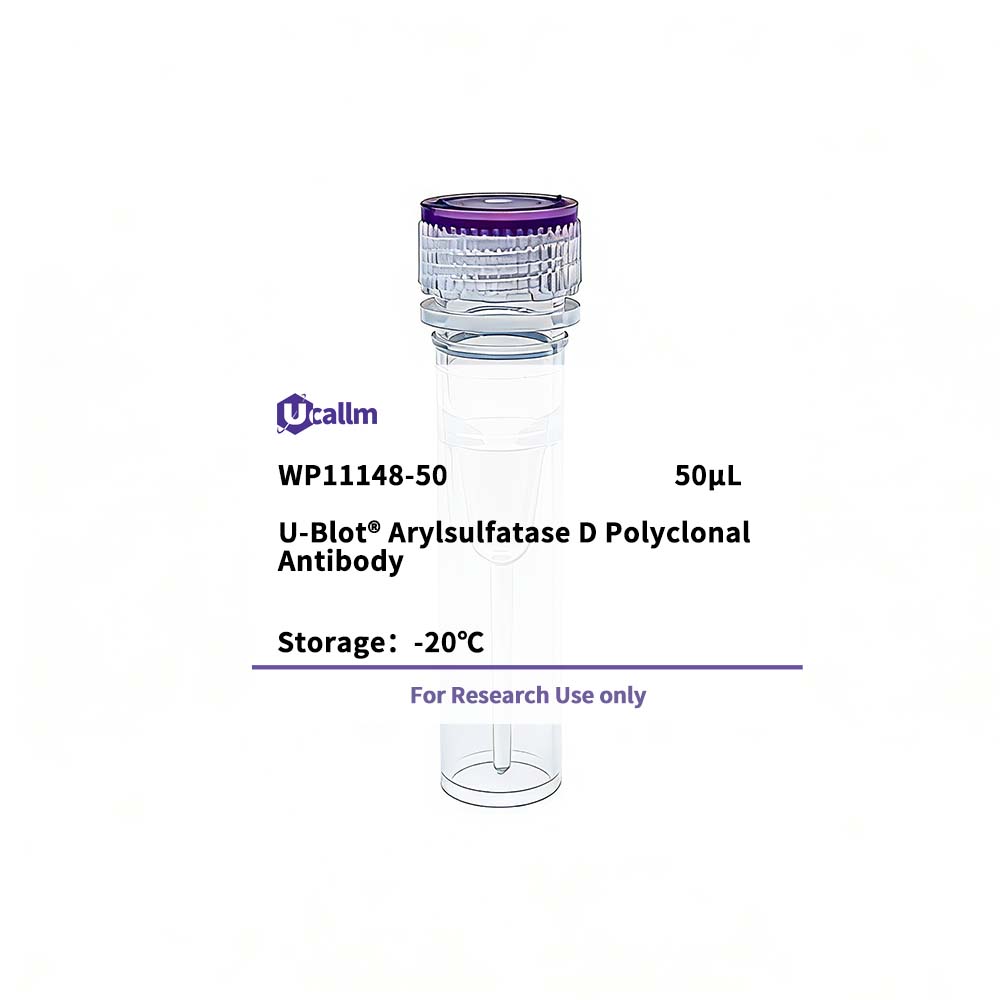
SKU: WP11148 Categories: ,

Arylsulfatase D Polyclonal Antibody

Price range: $268.00 through $328.00

SKU: WP11148-100
Enter the quantity you would like, or drag the panel to find the quantity and price that best for you
Bulk QuoteAuthorize OEM & ODM

Product details

Background:

The protein encoded by this gene is a member of the sulfatase family. Sulfatases are essential for the correct composition of bone and cartilage matrix. The encoded protein is postranslationally glycosylated and localized to the lysosome. This gene is located within a cluster of similar arylsulfatase genes on chromosome X. A related pseudogene has been identified in the pseudoautosomal region of chromosome Y. [provided by RefSeq, Jul 2011],

Specifications

Size50μL/100μL
TargetArylsulfatase D
ReactivityHuman
ApplicationsIHC, IF, ELISA
MW(Calculated)
MW(Observed)70kD
Host SpeciesRabbit
IsotypeIgG
Conjugate/ModificationUnmodified
Recommended Dilution RatioIHC 1:100-1:300; IF 1:200-1:1000; ELISA 1:20000; Not yet tested in other applications. / Note: For IHC, we suggest antigen retrieval with TE buffer pH 9.0 (Cat#WT1004)
FormulationLiquid in PBS containing 50% glycerol, 0.5% BSA and 0.02% sodium azide.
PurificationThe antibody was affinity-purified from rabbit antiserum by affinity-chromatography using epitope-specific immunogen.
Storage-15°C to -25°C/1 year(Do not lower than -25°C)
Concentration1 mg/ml
ClonalityPolyclonal
Clone Number
ImmunogenThe antiserum was produced against synthesized peptide derived from human ARSD. AA range:331-380
SpecificityArylsulfatase D Polyclonal Antibody detects endogenous levels of Arylsulfatase D protein.
Gene NameARSD
Protein NameArylsulfatase D
Other NameARSD; / Arylsulfatase D; / ASD
SpeciesHuman
Gene ID414
UniprotP51689
Species.1
Gene ID.1
Uniprot.1
Species.2
Gene ID.2
Uniprot.2
Cellular LocalizationLysosome .
Tissue ExpressionExpressed in the pancreas, kidney, liver, lung, placenta, brain and heart.
Signaling_pathway
Research Areas
Functioncofactor:Binds 1 calcium ion per subunit.,PTM:The conversion to 3-oxoalanine (also known as C-formylglycine, FGly), of a serine or cysteine residue in prokaryotes and of a cysteine residue in eukaryotes, is critical for catalytic activity.,similarity:Belongs to the sulfatase family.,tissue specificity:Expressed in the pancreas, kidney, liver, lung, placenta, brain and heart.,
Please login to post questions
Back to Top
Product has been added to your cart
