

Product details
Background:
DIRAS1 belongs to a distinct branch of the functionally diverse Ras (see HRAS; MIM 190020) superfamily of monomeric GTPases.[supplied by OMIM, Apr 2004],
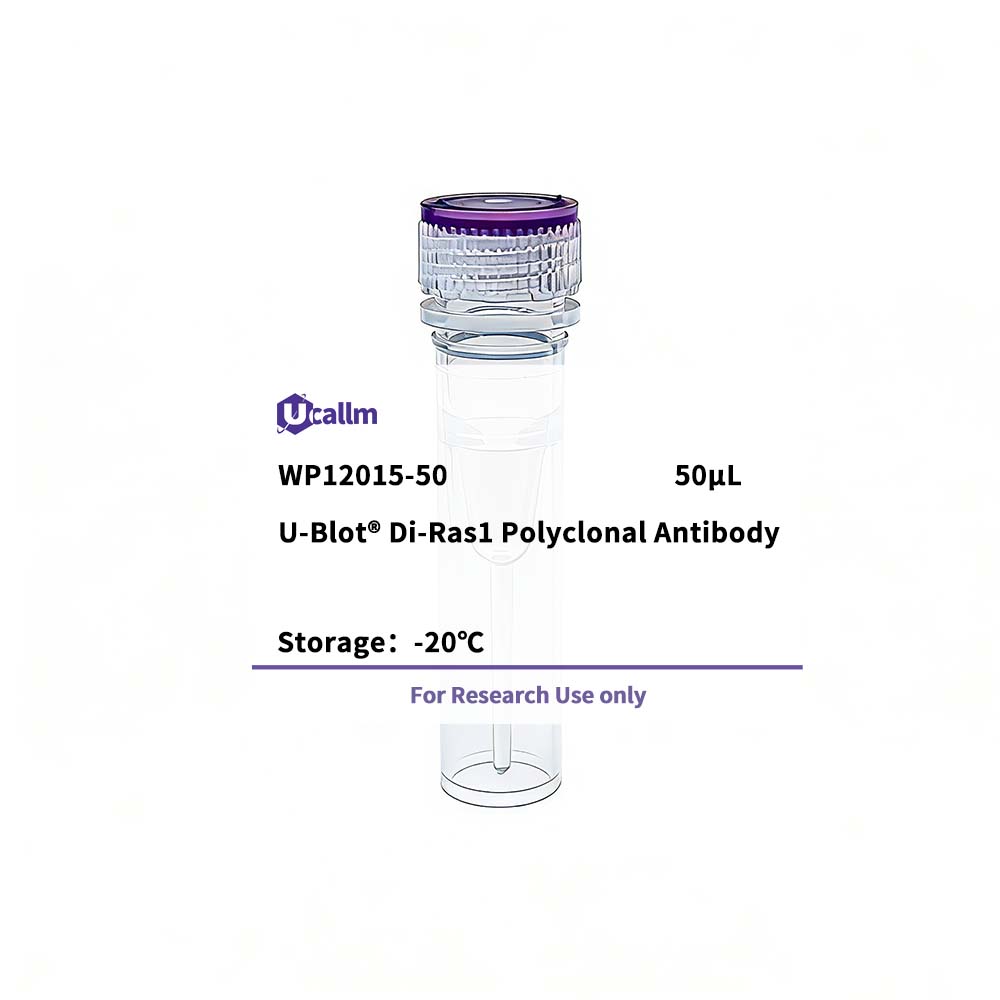
Price range: $268.00 through $328.00
Background:
DIRAS1 belongs to a distinct branch of the functionally diverse Ras (see HRAS; MIM 190020) superfamily of monomeric GTPases.[supplied by OMIM, Apr 2004],
| Size | 50μL/100μL |
| Target | Di-Ras1 |
| Reactivity | Human, Mouse |
| Applications | WB, IHC, IF, ELISA |
| MW(Calculated) | |
| MW(Observed) | 22kD |
| Host Species | Rabbit |
| Isotype | IgG |
| Conjugate/Modification | Unmodified |
| Recommended Dilution Ratio | WB 1:500-1:2000; IHC 1:100-1:300; IF 1:200-1:1000; ELISA 1:20000; Not yet tested in other applications. / Note: For IHC, we suggest antigen retrieval with TE buffer pH 9.0 (Cat#WT1004) |
| Formulation | Liquid in PBS containing 50% glycerol, 0.5% BSA and 0.02% sodium azide. |
| Purification | The antibody was affinity-purified from rabbit antiserum by affinity-chromatography using epitope-specific immunogen. |
| Storage | -15°C to -25°C/1 year(Do not lower than -25°C) |
| Concentration | 1 mg/ml |
| Clonality | Polyclonal |
| Clone Number | |
| Immunogen | The antiserum was produced against synthesized peptide derived from human DIRA1. AA range:149-198 |
| Specificity | Di-Ras1 Polyclonal Antibody detects endogenous levels of Di-Ras1 protein. |
| Gene Name | DIRAS1 |
| Protein Name | GTP-binding protein Di-Ras1 |
| Other Name | DIRAS1; / GBTS1; / RIG; / GTP-binding protein Di-Ras1; / Distinct subgroup of the Ras family member 1; / Ras-related inhibitor of cell growth; / Rig; / Small GTP-binding tumor suppressor 1 |
| Species | Human |
| Gene ID | 148252 |
| Uniprot | O95057, |
| Species.1 | Mouse |
| Gene ID.1 | |
| Uniprot.1 | Q91Z61 |
| Species.2 | |
| Gene ID.2 | |
| Uniprot.2 | |
| Cellular Localization | Cell membrane; Lipid-anchor; Cytoplasmic side . |
| Tissue Expression | Highly expressed in heart and brain. |
| Signaling_pathway | |
| Research Areas | |
| Function | Function:Displays low GTPase activity and exist predominantly in the GTP-bound form.,similarity:Belongs to the small GTPase superfamily. Di-Ras family.,tissue specificity:Highly expressed in heart and brain., |





