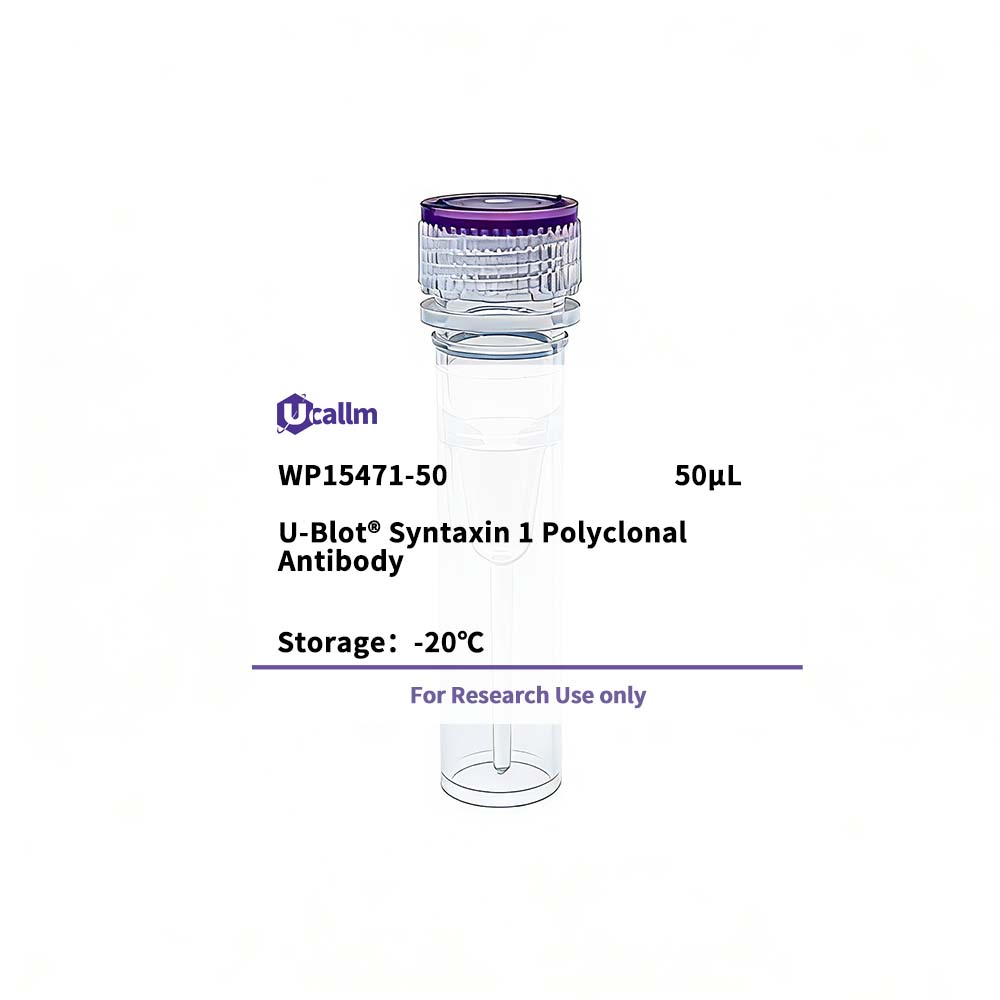
SKU: WP15471 Categories: ,

Syntaxin 1 Polyclonal Antibody

Price range: $268.00 through $328.00

SKU: WP15471-100
Enter the quantity you would like, or drag the panel to find the quantity and price that best for you
Bulk QuoteAuthorize OEM & ODM

Product details

Background:

This gene encodes a member of the syntaxin superfamily. Syntaxins are nervous system-specific proteins implicated in the docking of synaptic vesicles with the presynaptic plasma membrane. Syntaxins possess a single C-terminal transmembrane domain, a SNARE [Soluble NSF (N-ethylmaleimide-sensitive fusion protein)-Attachment protein REceptor] domain (known as H3), and an N-terminal regulatory domain (Habc). Syntaxins bind synaptotagmin in a calcium-dependent fashion and interact with voltage dependent calcium and potassium channels via the C-terminal H3 domain. This gene product is a key molecule in ion channel regulation and synaptic exocytosis. Alternatively spliced transcript variants encoding different isoforms have been found for this gene.[provided by RefSeq, Sep 2009],


Specifications

Size50μL/100μL
TargetSyntaxin 1A
ReactivityHuman, Mouse, Rat
ApplicationsWB, IHC, IF, ELISA
MW(Calculated)
MW(Observed)30kD
Host SpeciesRabbit
IsotypeIgG
Conjugate/ModificationUnmodified
Recommended Dilution RatioWB 1:500-1:2000; IHC: 1:100-1:300; ELISA 1:20000; IF 1:50-200 / Note: For IHC, we suggest antigen retrieval with TE buffer pH 9.0 (Cat#WT1004)
FormulationLiquid in PBS containing 50% glycerol, 0.5% BSA and 0.02% sodium azide.
PurificationThe antibody was affinity-purified from rabbit antiserum by affinity-chromatography using epitope-specific immunogen.
Storage-15°C to -25°C/1 year(Do not lower than -25°C)
Concentration1 mg/ml
ClonalityPolyclonal
Clone Number
ImmunogenThe antiserum was produced against synthesized peptide derived from the Internal region of human Syntaxin 1A. AA range:31-80
SpecificitySyntaxin 1A Polyclonal Antibody detects endogenous levels of Syntaxin 1 protein.
Gene NameSTX1A
Protein NameSyntaxin-1A
Other NameSTX1A; / STX1; / Syntaxin-1A; / Neuron-specific antigen HPC-1
SpeciesHuman
Gene ID6804
UniprotQ16623,
Species.1Mouse
Gene ID.120907
Uniprot.1O35526,
Species.2Rat
Gene ID.2116470
Uniprot.2P32851
Cellular LocalizationCytoplasmic vesicle, secretory vesicle, synaptic vesicle membrane; Single-pass type IV membrane protein . Cell junction, synapse, synaptosome . Cell membrane . Colocalizes with KCNB1 at the cell membrane. .; [Isoform 2]: Secreted .
Tissue Expression[Isoform 1]: Highly expressed in embryonic spinal cord and ganglia and in adult cerebellum and cerebral cortex.; [Isoform 2]: Expressed in heart, liver, fat, skeletal muscle, kidney and brain.
Signaling_pathwayOrganismal Systems >> Endocrine system >> Insulin secretion;Organismal Systems >> Nervous system >> Synaptic vesicle cycle;Human Diseases >> Neurodegenerative disease >> Huntington disease;Human Diseases >> Neurodegenerative disease >> Pathways of neurodegeneration - multiple diseases
Research Areas>>SNARE interactions in vesicular transport; / >>Synaptic vesicle cycle; / >>Insulin secretion; / >>Huntington disease; / >>Pathways of neurodegeneration - multiple diseases; / >>Amphetamine addiction
FunctionDisease:Haploinsufficiency of STX1A may be the cause of certain cardiovascular and musculo-skeletal abnormalities observed in Williams-Beuren syndrome (WBS), a rare developmental disorder. It is a contiguous gene deletion syndrome involving genes from chromosome band 7q11.23.,Function:Potentially involved in docking of synaptic vesicles at presynaptic active zones. May play a critical role in neurotransmitter exocytosis.,similarity:Belongs to the syntaxin family.,similarity:Contains 1 t-SNARE coiled-coil homology domain.,subunit:Part of the SNARE core complex containing SNAP25, VAMP2 and STX1A. This complex binds to CPLX1. Binds SYTL4 and STXBP6. Found in a ternary complex with STX1A and SNAP25. Interacts with OTOF (By similarity). Found in a complex with VAMP8 and SNAP23. Interacts with VAPA and SYBU.,tissue specificity:Isoform 1 is highly expressed in embryonic spinal chord and ganglia and in adult cerebellum and cerebral cortex. Isoform 2 is expressed in heart, liver, fat, skeletal muscle, kidney and brain.,
Please login to post questions
Back to Top
Product has been added to your cart

