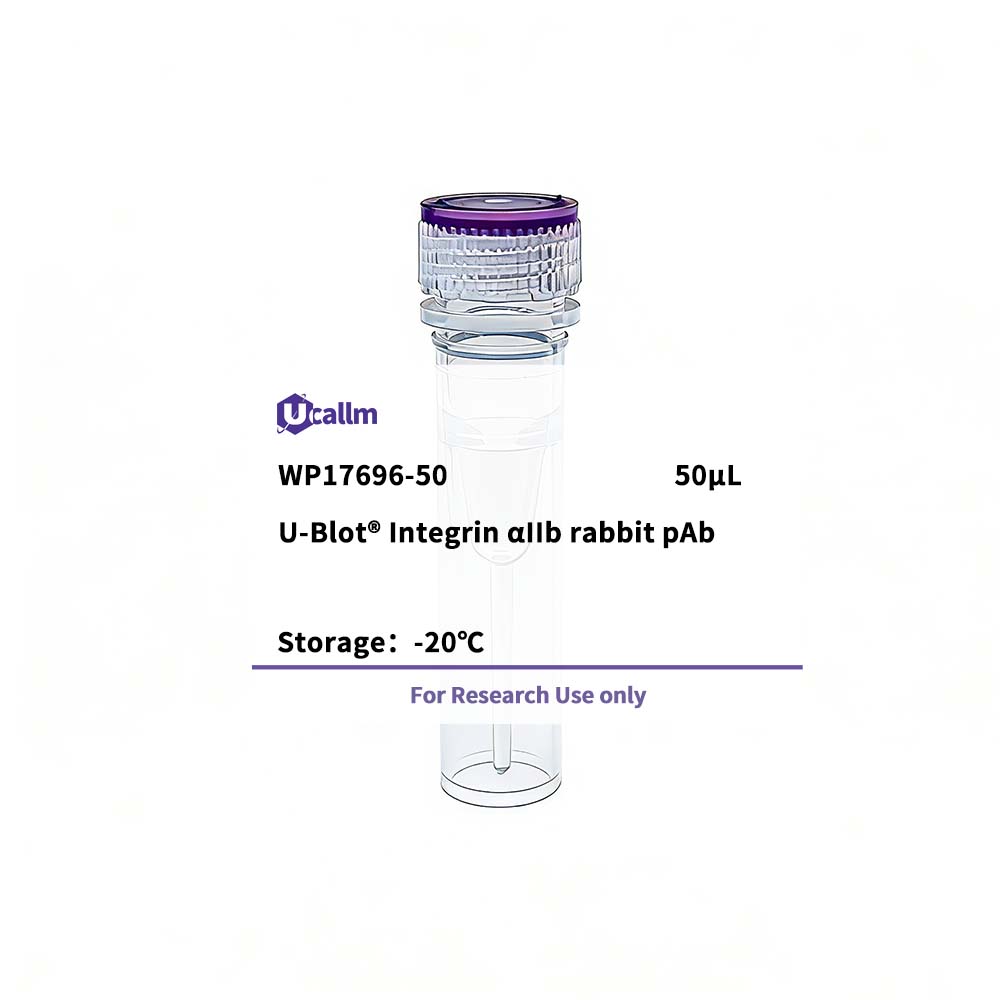
SKU: WP17696 Categories: ,

Integrin αIIb rabbit pAb

Price range: $268.00 through $328.00

SKU: WP17696-100
Enter the quantity you would like, or drag the panel to find the quantity and price that best for you
Bulk QuoteAuthorize OEM & ODM

Product details

Background:

This gene encodes a member of the integrin alpha chain family of proteins. The encoded preproprotein is proteolytically processed to generate light and heavy chains that associate through disulfide linkages to form a subunit of the alpha-IIb/beta-3 integrin cell adhesion receptor. This receptor plays a crucial role in the blood coagulation system, by mediating platelet aggregation. Mutations in this gene are associated with platelet-type bleeding disorders, which are characterized by a failure of platelet aggregation, including Glanzmann thrombasthenia. [provided by RefSeq, Jan 2016],

Specifications

TargetCD41
ReactivityHuman, Mouse
ApplicationsWB, ELISA
MW(Calculated)114kD
MW(Observed)
Host SpeciesRabbit
IsotypeIgG
Conjugate/ModificationUnmodified
Modification
Recommended Dilution RatioWB 1:1000-2000; ELISA 1:5000-20000
FormulationLiquid in PBS containing 50% glycerol, 0.5% BSA and 0.02% sodium azide.
Source
PurificationThe antibody was affinity-purified from rabbit antiserum by affinity-chromatography using epitope-specific immunogen.
Purity
Storage-15°C to -25°C/1 year(Do not lower than -25°C)
Concentration1 mg/ml
ClonalityPolyclonal
Clone Number
ImmunogenSynthesized peptide derived from human Integrin αIIb AA range: 1-80
Sequence
SpecificityThis antibody detects endogenous levels of Human Integrin αIIb
Gene NameITGA2B GP2B ITGAB
Protein NameIntegrin αIIb
Other NameITGA2B; / GP2B; / ITGAB; / Integrin alpha-IIb; / GPalpha IIb; / GPIIb; / Platelet membrane glycoprotein IIb; / CD antigen CD41; / [Cleaved into: Integrin alpha-IIb heavy chain; / Integrin alpha-IIb light chain, form 1; / Integrin alpha-IIb light chain, form 2]
SpeciesHuman
Gene ID-13674
UniprotP08514,
Species.1Mouse
Gene ID-216399
Uniprot.1Q9QUM0
Species.2
Gene ID-3
Uniprot.2
Organism-4
Gene ID-4
SwissProt-4
BackgroundThis gene encodes a member of the integrin alpha chain family of proteins. The encoded preproprotein is proteolytically processed to generate light and heavy chains that associate through disulfide linkages to form a subunit of the alpha-IIb/beta-3 integrin cell adhesion receptor. This receptor plays a crucial role in the blood coagulation system, by mediating platelet aggregation. Mutations in this gene are associated with platelet-type bleeding disorders, which are characterized by a failure of platelet aggregation, including Glanzmann thrombasthenia. [provided by RefSeq, Jan 2016],
Cellular LocalizationMembrane; Single-pass type I membrane protein.
Tissue ExpressionIsoform 1 and isoform 2 are expressed in platelets and megakaryocytes, but not in reticulocytes. Not detected in Jurkat, nor in U937 cell lines (PubMed:2351656). Isoform 3 is expressed in prostate adenocarcinoma, as well as in several erythroleukemia, prostate adenocarcinoma and melanoma cell lines, including PC-3, DU-145, HEL, WM983A, WM983B and WM35. Not detected in platelets, nor in normal prostate (at protein level) (PubMed:9809974).
Signaling_pathwayCellular Processes >> Cellular community - eukaryotes >> Focal adhesion;Cellular Processes >> Cell motility >> Regulation of actin cytoskeleton;Organismal Systems >> Immune system >> Hematopoietic cell lineage;Organismal Systems >> Immune system >> Platelet activation;Organismal Systems >> Immune system >> Neutrophil extracellular trap formation;Human Diseases >> Cancer: overview >> Pathways in cancer;Human Diseases >> Cancer: specific types >> Small cell lung cancer;Environmental Information Processing >> Signal transduction >> Rap1 signaling pathway;Environmental Information Processing >> Signal transduction >> PI3K-Akt signaling pathway;Environmental Information Processing >> Signaling molecules and interaction >> ECM-receptor interaction
Research Areas>>Rap1 signaling pathway; / >>PI3K-Akt signaling pathway; / >>Focal adhesion; / >>ECM-receptor interaction; / >>Platelet activation; / >>Neutrophil extracellular trap formation; / >>Hematopoietic cell lineage; / >>Regulation of actin cytoskeleton; / >>Human papillomavirus infection; / >>Pathways in cancer; / >>Small cell lung cancer; / >>Hypertrophic cardiomyopathy; / >>Arrhythmogenic right ventricular cardiomyopathy; / >>Dilated cardiomyopathy; / >>Fluid shear stress and atherosclerosis
FunctionDisease:Defects in ITGA2B are a cause of Glanzmann thrombasthenia (GT) [MIM:273800]; also known as thrombasthenia of Glanzmann and Naegeli. This autosomal recessive disorder is the most common inherited disease of platelets. GT is characterized by mucocutaneous bleeding of mild-to-moderate severity and the inability of this integrin to recognize macromolecular or synthetic peptide ligands. GT has been classified clinically into types I and II. In type I, platelets show absence of the glycoprotein IIb/beta-3 complexes at their surface and lack fibrinogen and clot retraction capability. In type II, the platelets express the glycoprotein IIb/beta-3 complex at reduced levels (5-20% controls), have detectable amounts of fibrinogen, and have low or moderate clot retraction capability. The platelets of GT 'variants' have normal or near normal (60-100%) expression of dysfunctional receptors.,Function:Integrin alpha-IIb/beta-3 is a receptor for fibronectin, fibrinogen, plasminogen, prothrombin, thrombospondin and vitronectin. It recognizes the sequence R-G-D in a wide array of ligands. It recognizes the sequence H-H-L-G-G-G-A-K-Q-A-G-D-V in fibrinogen gamma chain. Following activation integrin alpha-IIb/beta-3 brings about platelet/platelet interaction through binding of soluble fibrinogen. This step leads to rapid platelet aggregation which physically plugs ruptured endothelial cell surface.,polymorphism:Position 874 is associated with platelet-specific alloantigen HPA-3/BAK/LEK. HPA-3A/BAK(A)/LEK(A) has Ile-874 and HPA-3B/BAK(B)/LEK(B) has Ser-874. HPA-3B is involved in neonatal alloimmune thrombocytopenia (NAIT or NATP).,similarity:Belongs to the integrin alpha chain family.,similarity:Contains 7 FG-GAP repeats.,subunit:Heterodimer of an alpha and a beta subunit. The alpha subunit is composed of an heavy and a light chain linked by a disulfide bond. Alpha-IIb associates with beta-3. Directly interacts with RNF181.,tissue specificity:Isoform 1 and isoform 2 were identified in platelets and megakaryocytes, but not in reticulocytes or in Jurkat and U937 white blood cell line. Isoform 3 is expressed by leukemia, prostate adenocarcinoma and melanoma cells but not by platelets or normal prostate or breast epithelial cells.,
RRID
Please login to post questions
Back to Top
Product has been added to your cart