

β-actin [PTR2364] mouse mAb
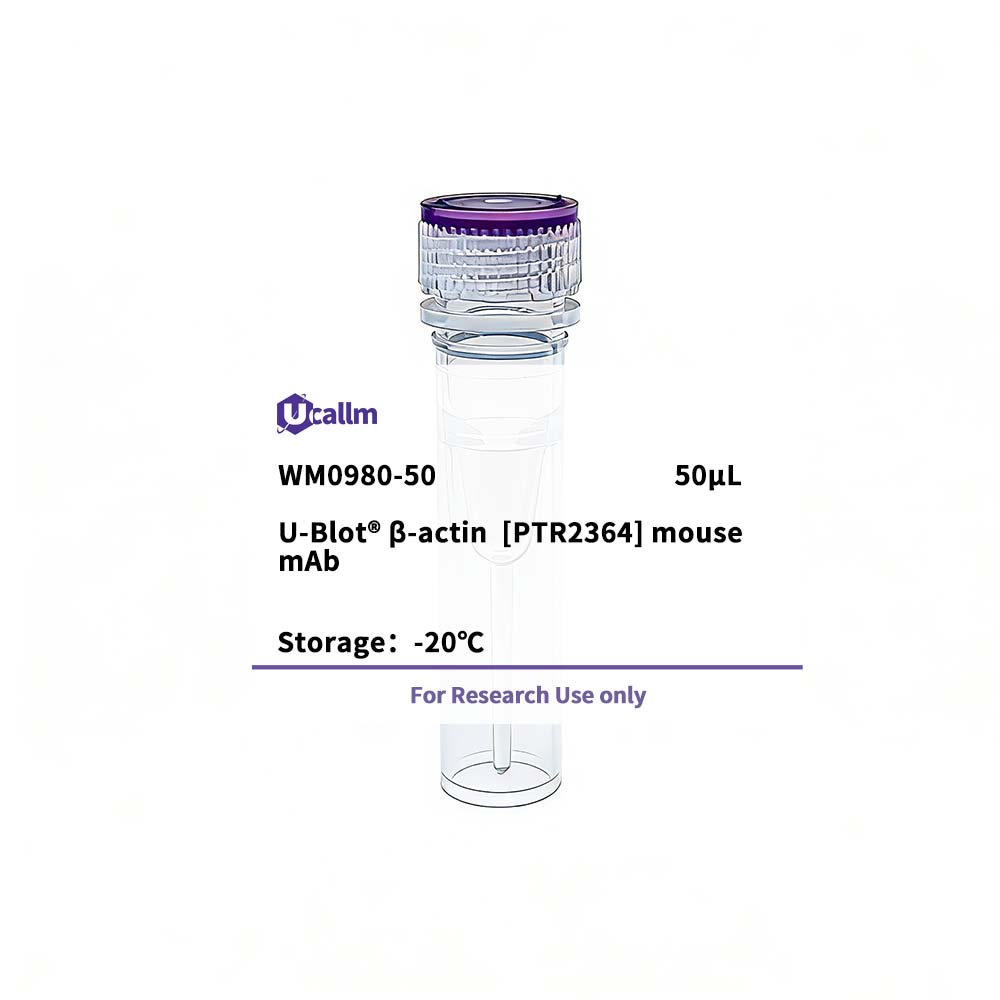
Ucallm_WM0980-50
Price range: $268.00 through $328.00
Product details
Background:
This gene encodes one of six different actin proteins. Actins are highly conserved proteins that are involved in cell motility, structure, and integrity. This actin is a major constituent of the contractile apparatus and one of the two nonmuscle cytoskeletal actins. [provided by RefSeq, Jul 2008],
Specifications
| Size | 50μL/100μL |
| Target | Actin β |
| Reactivity | Human, Mouse, Rat |
| Applications | WB, IF, IP, ELISA |
| MW(Calculated) | 42kD |
| MW(Observed) | 42kD |
| Host Species | Mouse |
| Isotype | IgG1,Kappa |
| Conjugate/Modification | Unmodified |
| Recommended Dilution Ratio | WB 1:1000-5000; IF 1:100-500; ELISA 1:5000-50000; IP 1:50-1:200; |
| Formulation | PBS, 50% glycerol, 0.05% Proclin 300, 0.05%BSA |
| Purification | Recombinant Antibody expressed in animal component-free (ACF) media, purified via Protein G affinity chromatography. |
| Storage | -15°C to -25°C/1 year(Do not lower than -25°C) |
| Concentration | 1 mg/ml |
| Clonality | Monoclonal |
| Clone Number | RMMR2364 |
| Immunogen | Synthesized peptide derived from human protein.AA range: 1-100 |
| Specificity | This antibody detects endogenous levels of β-actin protein. |
| Gene Name | ACTB |
| Protein Name | Actin cytoplasmic 1 |
| Other Name | ACTB; / Actin; / cytoplasmic 1; / Beta-actin; / Actin β; / β-Actin; / Beta actin; / B actin; / actin Beta |
| Species | Human |
| Gene ID | 60 |
| Uniprot | P60709, |
| Species.1 | Mouse |
| Gene ID.1 | 11461 |
| Uniprot.1 | P60710, |
| Species.2 | Rat |
| Gene ID.2 | 81822 |
| Uniprot.2 | P60711 |
| Cellular Localization | Cytoplasmic |
| Tissue Expression | B-cell lymphoma,Brain,Cajal-Retzius cell,Eye,Fetal brain cortex,Foreskin,Hepatocellular car |
| Signaling_pathway | Cellular Processes >> Transport and catabolism >> Phagosome;Cellular Processes >> Cell growth and death >> Apoptosis;Cellular Processes >> Cellular community - eukaryotes >> Focal adhesion;Cellular Processes >> Cellular community - eukaryotes >> Adherens junction;Cellular Processes >> Cellular community - eukaryotes >> Tight junction;Cellular Processes >> Cell motility >> Regulation of actin cytoskeleton;Organismal Systems >> Immune system >> Platelet activation;Organismal Systems >> Immune system >> Neutrophil extracellular trap formation;Organismal Systems >> Immune system >> Leukocyte transendothelial migration;Organismal Systems >> Endocrine system >> Oxytocin signaling pathway;Organismal Systems >> Endocrine system >> Thyroid hormone signaling pathway;Human Diseases >> Cancer: specific types >> Hepatocellular carcinoma;Human Diseases >> Neurodegenerative disease >> Amyotrophic lateral sclerosis;Environmental Information Processing >> Signal transduction >> Rap1 signaling pathway;Environmental Information Processing >> Signal transduction >> Hippo signaling pathway;Genetic Information Processing >> Chromosome >> ATP-dependent chromatin remodeling |
| Research Areas | >>Rap1 signaling pathway; / >>Phagosome; / >>Apoptosis; / >>Hippo signaling pathway; / >>Focal adhesion; / >>Adherens junction; / >>Tight junction; / >>Platelet activation; / >>Neutrophil extracellular trap formation; / >>Leukocyte transendothelial migration; / >>Thermogenesis; / >>Regulation of actin cytoskeleton; / >>Thyroid hormone signaling pathway; / >>Oxytocin signaling pathway; / >>Gastric acid secretion; / >>Amyotrophic lateral sclerosis; / >>Bacterial invasion of epithelial cells; / >>Vibrio cholerae infection; / >>Pathogenic Escherichia coli infection; / >>Shigellosis; / >>Salmonella infection; / >>Yersinia infection; / >>Influenza A; / >>Proteoglycans in cancer; / >>Hepatocellular carcinoma; / >>Hypertrophic cardiomyopathy; / >>Arrhythmogenic right ventricular cardiomyopathy; / >>Dilated cardiomyopathy; / >>Viral myocarditis; / >>Fluid shear stress and atherosclerosis |
| Function | Disease:Defects in ACTB are a cause of dystonia juvenile-onset (DYTJ) [MIM:607371]. DYTJ is a form of dystonia with juvenile onset. Dystonia is defined by the presence of sustained involuntary muscle contraction, often leading to abnormal postures. DYTJ patients manifest progressive, generalized, dopa-unresponsive dystonia, developmental malformations and sensory hearing loss.,Function:Actins are highly conserved proteins that are involved in various types of cell motility and are ubiquitously expressed in all eukaryotic cells.,miscellaneous:In vertebrates 3 main groups of actin isoforms, alpha, beta and gamma have been identified. The alpha actins are found in muscle tissues and are a major constituent of the contractile apparatus. The beta and gamma actins coexist in most cell types as components of the cytoskeleton and as mediators of internal cell motility.,similarity:Belongs to the actin family.,subunit:Polymerization of globular actin (G-actin) leads to a structural filament (F-actin) in the form of a two-stranded helix. Each actin can bind to 4 others. Component of the BAF complex, which includes at least actin (ACTB), ARID1A, ARID1B/BAF250, SMARCA2, SMARCA4/BRG1, ACTL6A/BAF53, ACTL6B/BAF53B, SMARCE1/BAF57 SMARCC1/BAF155, SMARCC2/BAF170, SMARCB1/SNF5/INI1, and one or more of SMARCD1/BAF60A, SMARCD2/BAF60B, or SMARCD3/BAF60C. In muscle cells, the BAF complex also contains DPF3. Found in a complex with XPO6, Ran, ACTB and PFN1. Interacts with XPO6., |
Please login to post questions
Related products




