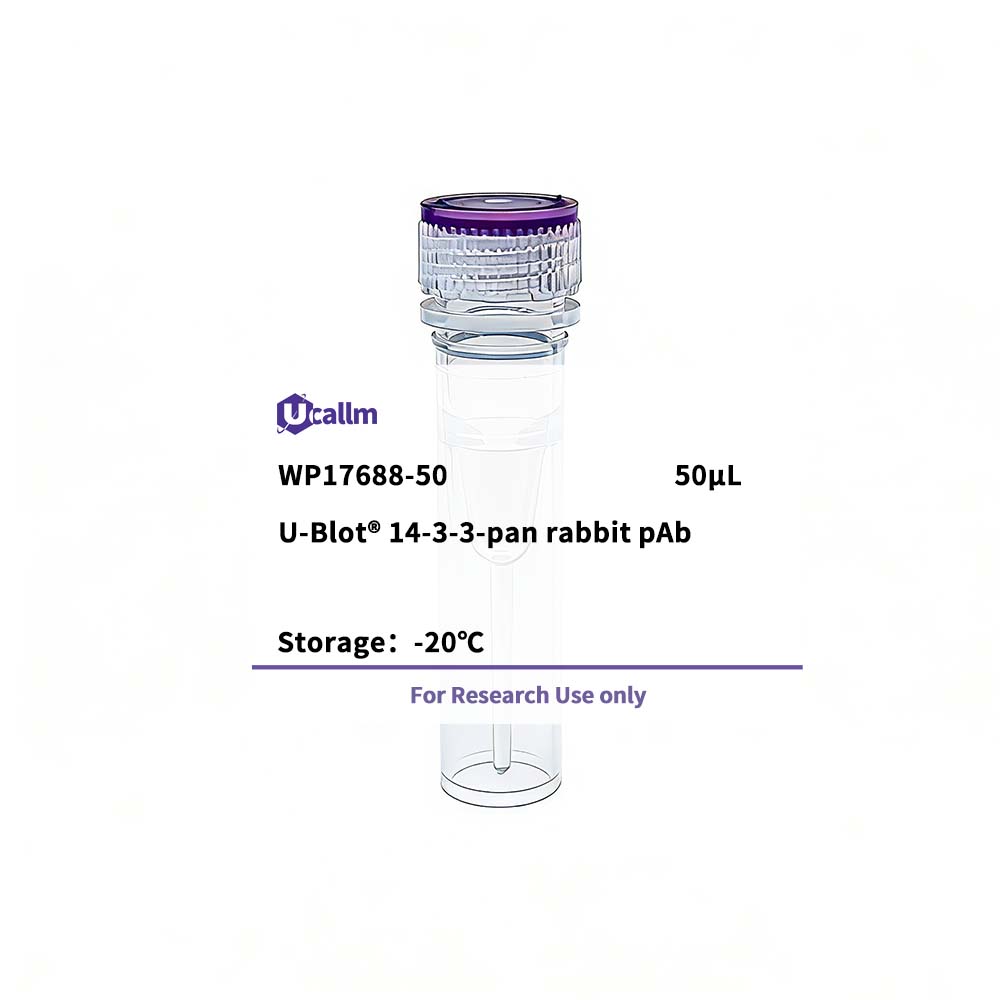
SKU: WP17688 Categories: ,

14-3-3-pan rabbit pAb

Price range: $268.00 through $328.00

SKU: WP17688-100
Enter the quantity you would like, or drag the panel to find the quantity and price that best for you
Bulk QuoteAuthorize OEM & ODM

Product details

Background:

This gene encodes a protein belonging to the 14-3-3 family of proteins, members of which mediate signal transduction by binding to phosphoserine-containing proteins. This highly conserved protein family is found in both plants and mammals. The encoded protein has been shown to interact with RAF1 and CDC25 phosphatases, suggesting that it may play a role in linking mitogenic signaling and the cell cycle machinery. Two transcript variants, which encode the same protein, have been identified for this gene. [provided by RefSeq, Jul 2008],

Specifications

Size50μL/100μL
Target14-3-3-pan
ReactivityHuman, Mouse, Rat
ApplicationsWB, ELISA
MW(Calculated)27kD
MW(Observed)30kD
Host SpeciesRabbit
IsotypeIgG
Conjugate/ModificationUnmodified
Recommended Dilution RatioWB 1:1000-2000; ELISA 1:5000-20000
FormulationLiquid in PBS containing 50% glycerol, 0.5% BSA and 0.02% sodium azide.
PurificationThe antibody was affinity-purified from rabbit antiserum by affinity-chromatography using epitope-specific immunogen.
Storage-15°C to -25°C/1 year(Do not lower than -25°C)
Concentration1 mg/ml
ClonalityPolyclonal
Clone Number
ImmunogenSynthesized peptide derived from human 14-3-3-pan
SpecificityThis antibody detects endogenous levels of Human,Mouse,Rat 14-3-3-pan
Gene NameYWHAB
Protein Name14-3-3-pan
Other Name14-3-3 protein beta/alpha; / Protein 1054; / Protein kinase C inhibitor protein 1; / KCIP-1; / [Cleaved into: 14-3-3 protein beta/alpha, N-terminally processed]
SpeciesHuman
Gene ID7529
UniprotP31946;P61981;P27348;P63104;P31947,
Species.1Mouse
Gene ID.154401
Uniprot.1Q9CQV8,
Species.2Rat
Gene ID.256011
Uniprot.2P35213
Cellular LocalizationCytoplasm . Melanosome . Identified by mass spectrometry in melanosome fractions from stage I to stage IV.; Vacuole membrane . (Microbial infection) Upon infection with Chlamydia trachomatis, this protein is associated with the pathogen-containing vacuole membrane where it colocalizes with IncG. .
Tissue Expression
Signaling_pathwayCellular Processes >> Cell growth and death >> Cell cycle;Environmental Information Processing >> Signal transduction >> Hippo signaling pathway;Environmental Information Processing >> Signal transduction >> PI3K-Akt signaling pathway
Research Areas>>Cell cycle; / >>Oocyte meiosis; / >>PI3K-Akt signaling pathway; / >>Hippo signaling pathway; / >>Hepatitis C; / >>Hepatitis B; / >>Viral carcinogenesis
FunctionFunction:Adapter protein implicated in the regulation of a large spectrum of both general and specialized signaling pathway. Binds to a large number of partners, usually by recognition of a phosphoserine or phosphothreonine motif. Binding generally results in the modulation of the activity of the binding partner. Negative regulator of osteogenesis.,PTM:Isoform Short contains a N-acetylmethionine at position 1.,PTM:The alpha, brain-specific form differs from the beta form in being phosphorylated.,similarity:Belongs to the 14-3-3 family.,subcellular location:Identified by mass spectrometry in melanosome fractions from stage I to stage IV.,subunit:Homodimer. Interacts with SSH1 and TORC2/CRTC2. Interacts with ABL1; the interaction results in cytoplasmic location of ABL1 and inhition of cABL-mediated apoptosis. Interacts with ROR2 (dimer); the interaction results in phosphorylation of YWHAB on tyrosine residues.,
Please login to post questions
Back to Top
Product has been added to your cart

