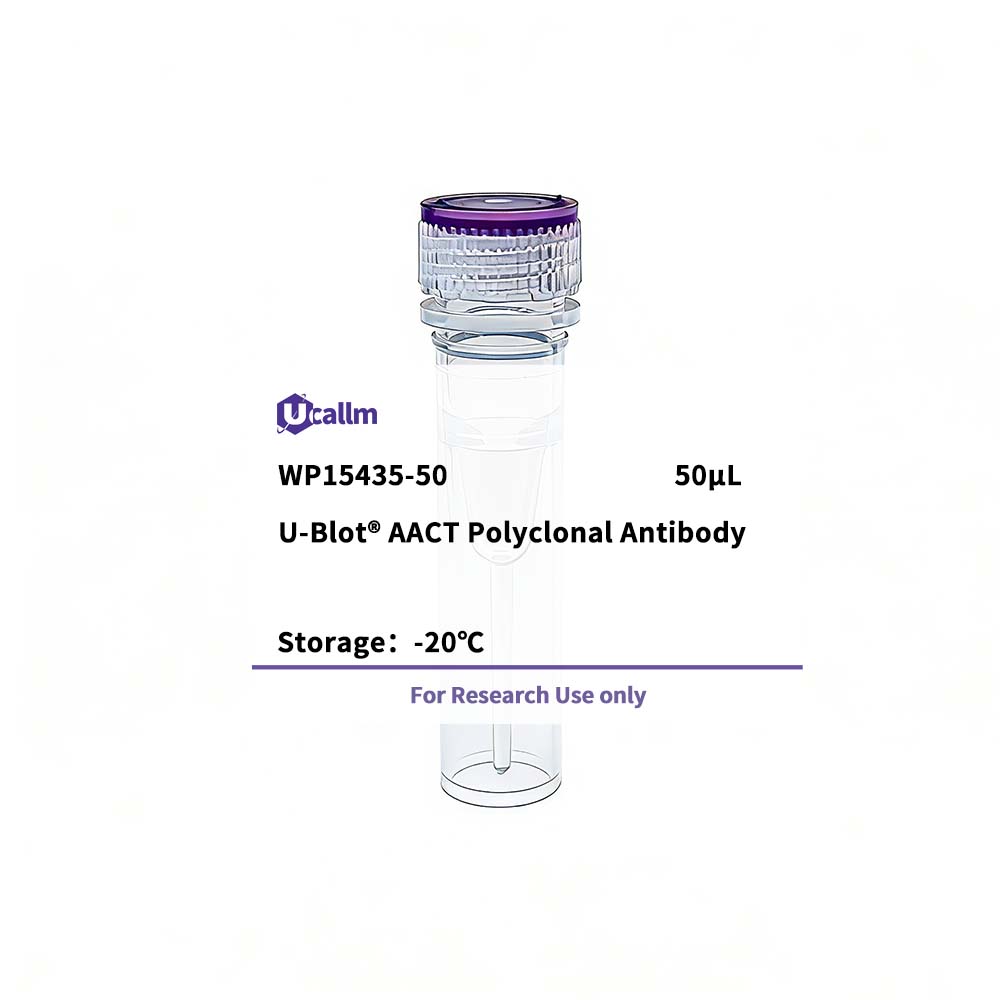
SKU: WP15435 Categories: ,

AACT Polyclonal Antibody

Price range: $268.00 through $328.00

SKU: WP15435-100
Enter the quantity you would like, or drag the panel to find the quantity and price that best for you
Bulk QuoteAuthorize OEM & ODM

Product details

Background:

The protein encoded by this gene is a plasma protease inhibitor and member of the serine protease inhibitor class. Polymorphisms in this protein appear to be tissue specific and influence protease targeting. Variations in this protein's sequence have been implicated in Alzheimer's disease, and deficiency of this protein has been associated with liver disease. Mutations have been identified in patients with Parkinson disease and chronic obstructive pulmonary disease. [provided by RefSeq, Jul 2008],


Specifications

Size50μL/100μL
TargetAACT
ReactivityHuman
ApplicationsWB, IHC, IF, ELISA
MW(Calculated)
MW(Observed)46kD
Host SpeciesRabbit
IsotypeIgG
Conjugate/ModificationUnmodified
Recommended Dilution RatioWB 1:500-1:2000; IHC: 1:100-1:300; ELISA 1:20000; IF 1:50-200 / Note: For IHC, we suggest antigen retrieval with TE buffer pH 9.0 (Cat#WT1004)
FormulationLiquid in PBS containing 50% glycerol, 0.5% BSA and 0.02% sodium azide.
PurificationThe antibody was affinity-purified from rabbit antiserum by affinity-chromatography using epitope-specific immunogen.
Storage-15°C to -25°C/1 year(Do not lower than -25°C)
Concentration1 mg/ml
ClonalityPolyclonal
Clone Number
ImmunogenThe antiserum was produced against synthesized peptide derived from the Internal region of human SERPINA3. AA range:251-300
SpecificityAACT Polyclonal Antibody detects endogenous levels of AACT protein.
Gene NameSERPINA3
Protein NameAlpha-1-antichymotrypsin
Other NameSERPINA3; / AACT; / GIG24; / GIG25; / Alpha-1-antichymotrypsin; / ACT; / Cell growth-inhibiting gene 24/25 protein; / Serpin A3
SpeciesHuman
Gene ID12
UniprotP01011
Species.1
Gene ID.1
Uniprot.1
Species.2
Gene ID.2
Uniprot.2
Cellular LocalizationSecreted.
Tissue ExpressionPlasma. Synthesized in the liver. Like the related alpha-1-antitrypsin, its concentration increases in the acute phase of inflammation or infection. Found in the amyloid plaques from the hippocampus of Alzheimer disease brains.
Signaling_pathway
Research Areas
FunctionCaution:It is uncertain whether Met-1 or Met-4 is the initiator.,Disease:Defects in SERPINA3 may be a cause of chronic obstructive pulmonary disease (COPD) [MIM:107280].,Domain:The reactive center loop (RCL) extends out from the body of the protein and directs binding to the target protease. The protease cleaves the serpin at the reactive site within the RCL, establishing a covalent linkage between the carboxyl group of the serpin reactive site and the serine hydroxyl of the protease. The resulting inactive serpin-protease complex is highly stable.,Function:Although its physiological function is unclear, it can inhibit neutrophil cathepsin G and mast cell chymase, both of which can convert angiotensin-1 to the active angiotensin-2.,miscellaneous:Alpha-1-antichymotrypsin can bind DNA.,online information:Alpha-1 antichymotrypsin entry,sequence Caution:Translation N-terminally shortened.,similarity:Belongs to the serpin family.,subunit:Interacts with DNAJC1.,tissue specificity:Plasma. Synthesized in the liver. Like the related alpha-1-antitrypsin, its concentration increases in the acute phase of inflammation or infection. Found in the myloid plaques from the hippocampus of Alzheimer's disease brains.,
Please login to post questions
Back to Top
Product has been added to your cart
