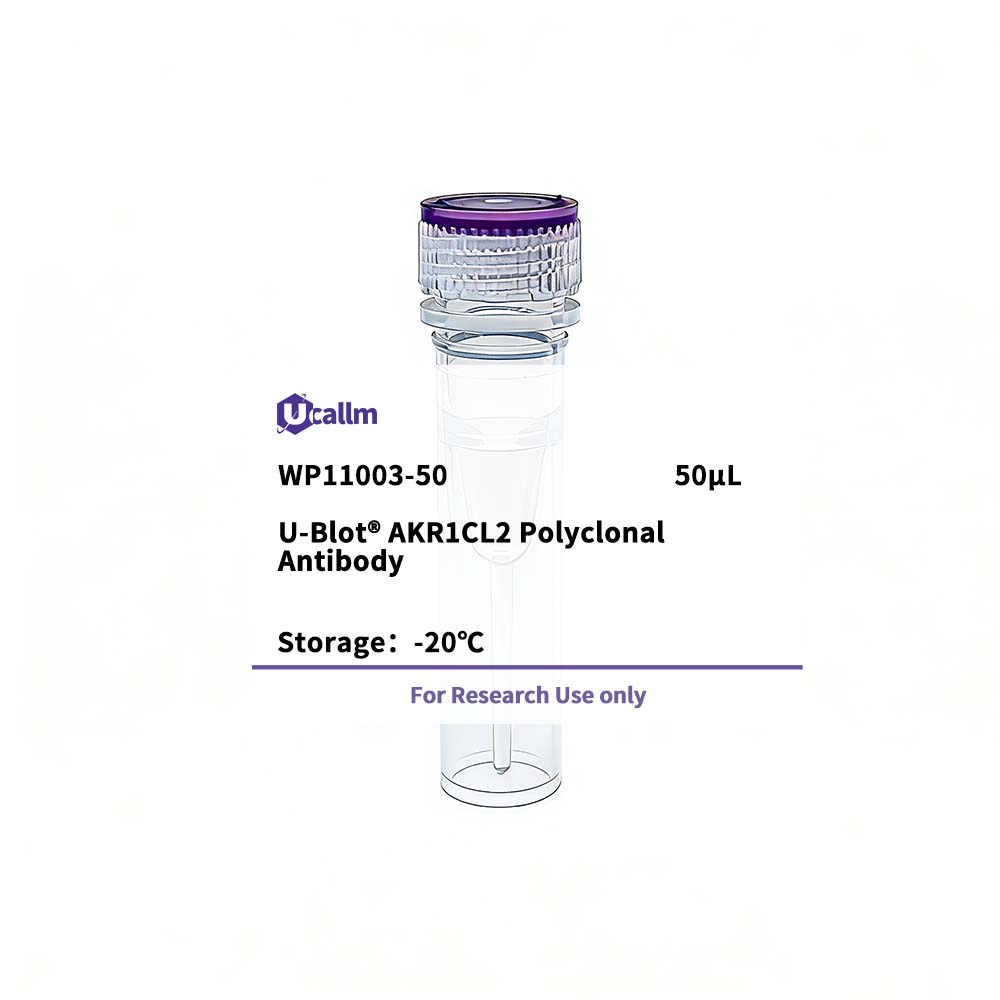
SKU: WP11003 Categories: ,

AKR1CL2 Polyclonal Antibody

Price range: $268.00 through $328.00

SKU: WP11003-100
Enter the quantity you would like, or drag the panel to find the quantity and price that best for you
Bulk QuoteAuthorize OEM & ODM

Product details

Background:

The protein encoded by this gene is a member of the aldo-keto reductase superfamily. Members in this family are characterized by their structure (evolutionarily highly conserved TIM barrel) and function (NAD(P)H-dependent oxido-reduction of carbonyl groups). Transcripts of this gene have been reported in specimens of human testis. Alternative splicing results in multiple transcript variants. [provided by RefSeq, Aug 2012],

Specifications

Size50μL/100μL
TargetAKR1CL2
ReactivityHuman, Mouse, Rat
ApplicationsWB, IHC, IF, ELISA
MW(Calculated)
MW(Observed)37kD
Host SpeciesRabbit
IsotypeIgG
Conjugate/ModificationUnmodified
Recommended Dilution RatioWB 1:500-1:2000; IHC 1:100-1:300; ELISA 1:10000; IF 1:50-200 / Note: For IHC, we suggest antigen retrieval with TE buffer pH 9.0 (Cat#WT1004)
FormulationLiquid in PBS containing 50% glycerol, 0.5% BSA and 0.02% sodium azide.
PurificationThe antibody was affinity-purified from rabbit antiserum by affinity-chromatography using epitope-specific immunogen.
Storage-15°C to -25°C/1 year(Do not lower than -25°C)
Concentration1 mg/ml
ClonalityPolyclonal
Clone Number
ImmunogenThe antiserum was produced against synthesized peptide derived from human AKR1CL2. AA range:141-190
SpecificityAKR1CL2 Polyclonal Antibody detects endogenous levels of AKR1CL2 protein.
Gene NameAKR1E2
Protein Name1,5-anhydro-D-fructose reductase
Other NameAKR1E2; / AKR1CL2; / AKRDC1; / 1; / 5-anhydro-D-fructose reductase; / AF reductase; / Aldo-keto reductase family 1 member C-like protein 2; / Aldo-keto reductase family 1 member E2; / LoopADR; / Testis-specific protein; / hTSP
SpeciesHuman
Gene ID83592
UniprotQ96JD6,
Species.1Mouse
Gene ID.1
Uniprot.1Q9DCT1
Species.2
Gene ID.2
Uniprot.2
Cellular LocalizationCytoplasm .
Tissue ExpressionSpecifically expressed in testis (PubMed:12604216, PubMed:15118078). Expressed in testicular germ cells and testis interstitial cells (PubMed:15118078).
Signaling_pathway
Research Areas
FunctionCatalytic activity:1,5-anhydro-D-glucitol + NADP(+) = 1,5-anhydro-D-fructose + NADPH.,Function:Catalyzes the NADPH-dependent reduction of 1,5-anhydro-D-fructose (AF) to 1,5-anhydro-D-glucitol. Can also catalyze the reduction of various aldehydes and quinones.,similarity:Belongs to the aldo/keto reductase family.,tissue specificity:Testis-specific.,
Please login to post questions
Back to Top
Product has been added to your cart
