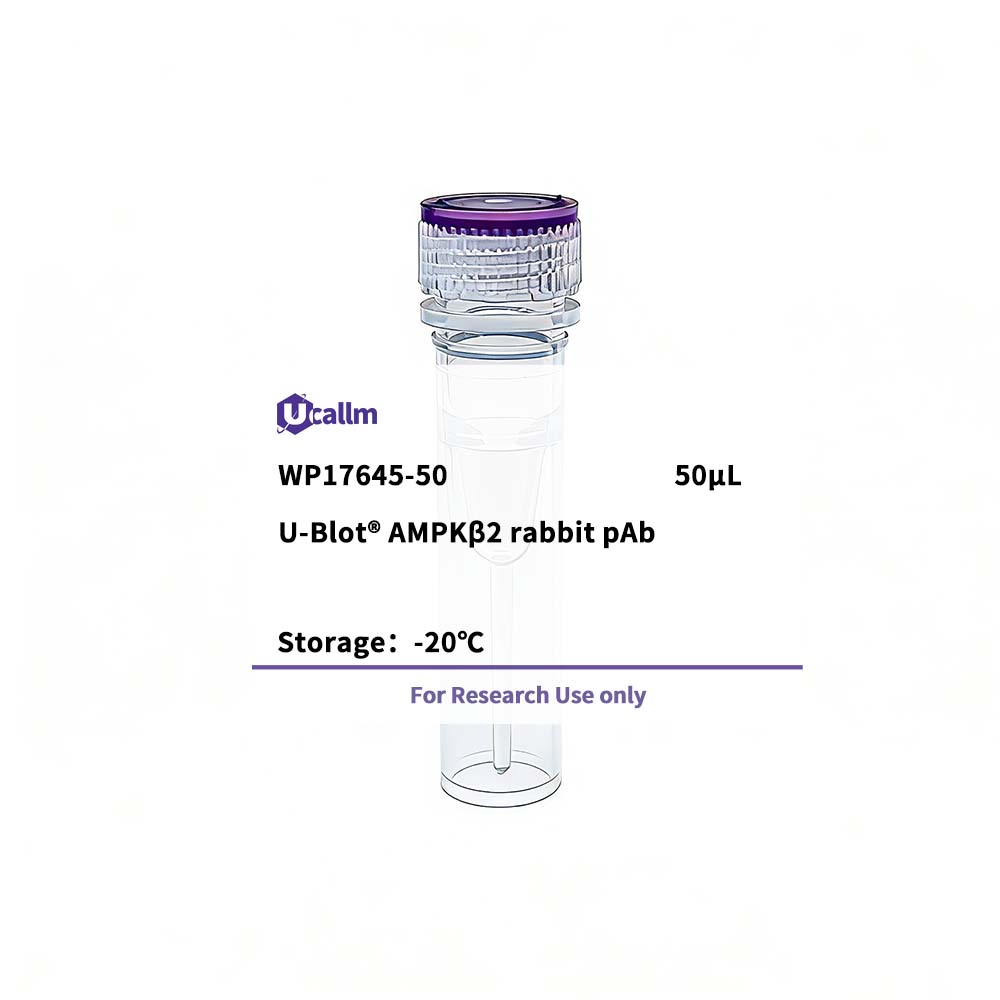
SKU: WP17645 Categories: ,

AMPKβ2 rabbit pAb

Price range: $268.00 through $328.00

SKU: WP17645-100
Enter the quantity you would like, or drag the panel to find the quantity and price that best for you
Bulk QuoteAuthorize OEM & ODM

Product details

Background:

function:AMPK is responsible for the regulation of fatty acid synthesis by phosphorylation of acetyl-CoA carboxylase. Also regulates cholesterol synthesis via phosphorylation and inactivation of hydroxymethylglutaryl-CoA reductase and hormone-sensitive lipase. This is a regulatory subunit, may be a positive regulator of AMPK activity. It may also serve as an adapter molecule for the catalytic alpha-subunit., PTM:Phosphorylated when associated with the catalytic subunit., similarity:Belongs to the 5′-AMP-activated protein kinase beta subunit family., subunit:Heterotrimer of an alpha catalytic subunit, a beta and a gamma non-catalytic regulatory subunits.,

Specifications

Size50μL/100μL
TargetAMPKβ2
ReactivityHuman, Mouse, Rat
ApplicationsWB, ELISA
MW(Calculated)30kD
MW(Observed)
Host SpeciesRabbit
IsotypeIgG
Conjugate/ModificationUnmodified
Recommended Dilution RatioWB 1:1000-2000; ELISA 1:5000-20000
FormulationLiquid in PBS containing 50% glycerol, 0.5% BSA and 0.02% sodium azide.
PurificationThe antibody was affinity-purified from rabbit antiserum by affinity-chromatography using epitope-specific immunogen.
Storage-15°C to -25°C/1 year(Do not lower than -25°C)
Concentration1 mg/ml
ClonalityPolyclonal
Clone Number
ImmunogenSynthesized peptide derived from human AMPKβ2 AA range: 130-210
SpecificityThis antibody detects endogenous levels of Human AMPKβ2
Gene NamePRKAB2
Protein Name5'-AMP-activated protein kinase subunit beta-2
Other NamePRKAB2; / 5'-AMP-activated protein kinase subunit beta-2; / AMPK subunit beta-2
SpeciesHuman
Gene ID5565
UniprotO43741,
Species.1Mouse
Gene ID.1108097
Uniprot.1Q6PAM0,
Species.2Rat
Gene ID.264562
Uniprot.2Q9QZH4
Cellular Localization
Tissue Expression
Signaling_pathwayCellular Processes >> Cellular community - eukaryotes >> Tight junction;Organismal Systems >> Endocrine system >> Insulin signaling pathway;Organismal Systems >> Endocrine system >> Glucagon signaling pathway;Organismal Systems >> Endocrine system >> Adipocytokine signaling pathway;Organismal Systems >> Endocrine system >> Oxytocin signaling pathway;Organismal Systems >> Aging >> Longevity regulating pathway;Organismal Systems >> Aging >> Longevity regulating pathway - multiple species;Organismal Systems >> Environmental adaptation >> Circadian rhythm;Environmental Information Processing >> Signal transduction >> Apelin signaling pathway;Environmental Information Processing >> Signal transduction >> FoxO signaling pathway;Environmental Information Processing >> Signal transduction >> AMPK signaling pathway
Research Areas>>FoxO signaling pathway; / >>AMPK signaling pathway; / >>Longevity regulating pathway; / >>Longevity regulating pathway - multiple species; / >>Apelin signaling pathway; / >>Tight junction; / >>Circadian rhythm; / >>Thermogenesis; / >>Insulin signaling pathway; / >>Adipocytokine signaling pathway; / >>Oxytocin signaling pathway; / >>Glucagon signaling pathway; / >>Insulin resistance; / >>Non-alcoholic fatty liver disease; / >>Alcoholic liver disease; / >>Hypertrophic cardiomyopathy
Functionfatty acid metabolic process, fatty acid biosynthetic process, lipid biosynthetic process, regulation of cellular ketone metabolic process, organic acid biosynthetic process, regulation of lipid metabolic process, regulation of fatty acid metabolic process, regulation of fatty acid oxidation, carboxylic acid biosynthetic process,
Please login to post questions
Back to Top
Product has been added to your cart