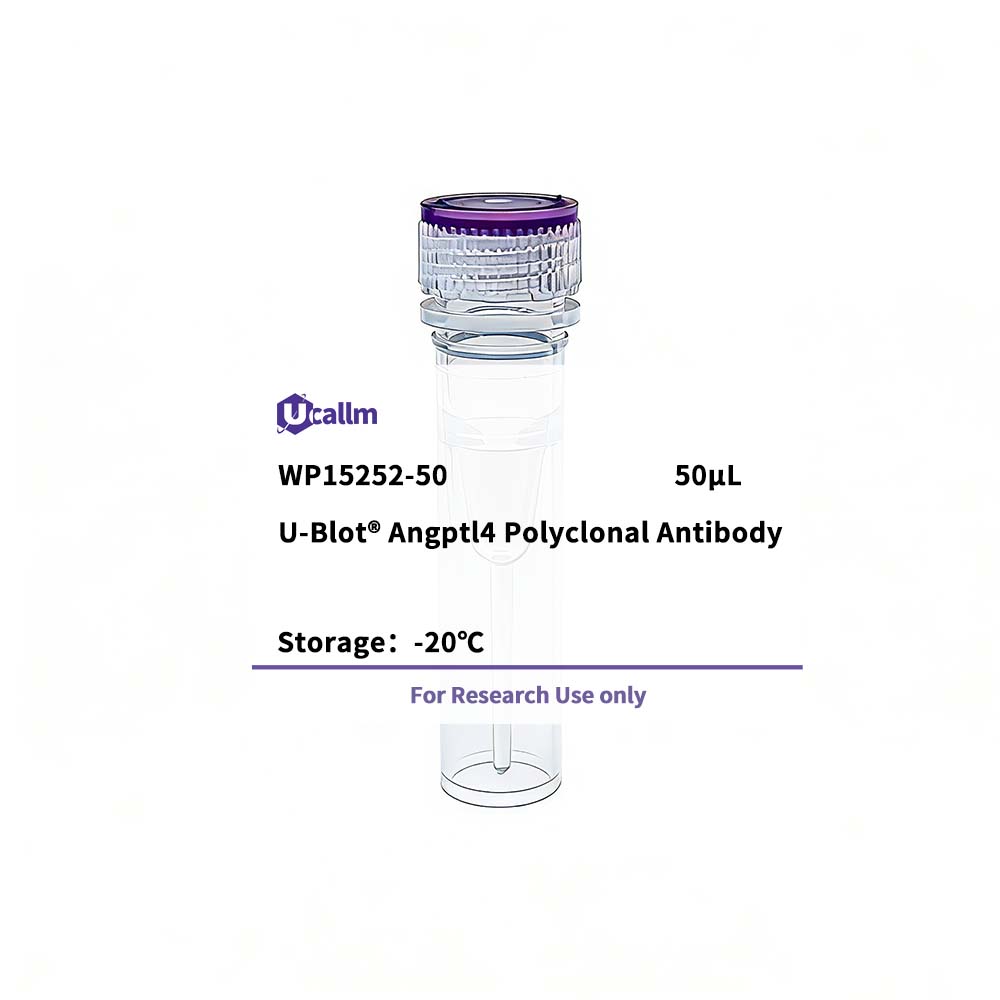
SKU: WP15252 Categories: ,

Angptl4 Polyclonal Antibody

Price range: $268.00 through $328.00

SKU: WP15252-100
Enter the quantity you would like, or drag the panel to find the quantity and price that best for you
Bulk QuoteAuthorize OEM & ODM

Product details

Background:

This gene encodes a glycosylated, secreted protein containing a C-terminal fibrinogen domain. The encoded protein is induced by peroxisome proliferation activators and functions as a serum hormone that regulates glucose homeostasis, lipid metabolism, and insulin sensitivity. This protein can also act as an apoptosis survival factor for vascular endothelial cells and can prevent metastasis by inhibiting vascular growth and tumor cell invasion. The C-terminal domain may be proteolytically-cleaved from the full-length secreted protein. Decreased expression of this gene has been associated with type 2 diabetes. Alternative splicing results in multiple transcript variants. This gene was previously referred to as ANGPTL2 but has been renamed ANGPTL4. [provided by RefSeq, Sep 2013],


Specifications

Size50μL/100μL
TargetANGPTL4
ReactivityHuman, Mouse, Rat
ApplicationsWB, IHC, IF, ELISA
MW(Calculated)
MW(Observed)45kD
Host SpeciesRabbit
IsotypeIgG
Conjugate/ModificationUnmodified
Recommended Dilution RatioIHC: 100-300; WB 1:500-1:2000; ELISA 1:20000; IF 1:50-200 / Note: For IHC, we suggest antigen retrieval with TE buffer pH 9.0 (Cat#WT1004)
FormulationLiquid in PBS containing 50% glycerol, 0.5% BSA and 0.02% sodium azide.
PurificationThe antibody was affinity-purified from rabbit antiserum by affinity-chromatography using epitope-specific immunogen.
Storage-15°C to -25°C/1 year(Do not lower than -25°C)
Concentration1 mg/ml
ClonalityPolyclonal
Clone Number
ImmunogenThe antiserum was produced against synthesized peptide derived from the Internal region of human ANGPTL4. AA range:301-350
SpecificityAngptl4 Polyclonal Antibody detects endogenous levels of Angptl4 protein.
Gene NameANGPTL4
Protein NameAngiopoietin-related protein 4
Other NameANGPTL4; / ARP4; / HFARP; / PGAR; / PP1158; / PSEC0166; / Angiopoietin-related protein 4; / Angiopoietin-like protein 4; / Hepatic fibrinogen/angiopoietin-related protein; / HFARP
SpeciesHuman
Gene ID51129
UniprotQ9BY76,
Species.1Mouse
Gene ID.157875
Uniprot.1Q9Z1P8,
Species.2Rat
Gene ID.2362850
Uniprot.2Q6TMA8
Cellular LocalizationSecreted . Secreted, extracellular space, extracellular matrix . The unprocessed form interacts with the extracellular matrix (PubMed:17068295, PubMed:21398697). This may constitute a dynamic reservoir, a regulatory mechanism of the bioavailability of ANGPTL4 (Probable). .
Tissue ExpressionDetected in blood plasma (at protein level) (PubMed:29899519). Detected in liver (PubMed:10698685). Detected in white fat tissue and placenta (PubMed:10866690). Expressed at high levels in the placenta, heart, liver, muscle, pancreas and lung but expressed poorly in the brain and kidney.
Signaling_pathwayOrganismal Systems >> Endocrine system >> PPAR signaling pathway
Research Areas>>PPAR signaling pathway; / >>Cholesterol metabolism
FunctionCaution:The sequence shown here is derived from an Ensembl automatic analysis pipeline and should be considered as preliminary data.,Disease:Found to be highly expressed in the early stages of collagen-induced arthritis (CIA).,Disease:Produced in ischemic tissues in conditions such as critical leg ischemia. In tumors, ANGPTL4 could be produced in the hypoxic areas surrounding necrotic regions. High levels could be produced in tumor cells of conventional renal cell carcinoma. This molecule therefore seems to be a marker of conventional renal cell carcinoma.,Disease:Serum levels of ANGPTL4 are significantly lower in patients with diabetes type 2 than those in healthy subjects, suggesting that decreased ANGPTL4 could be a causative factor of this disease.,Function:Protein with hypoxia-induced expression in endothelial cells. May act as a regulator of angiogenesis and modulate tumorgenesis. Inhibits proliferation, migration, and tubule formation of endothelial cells and reduces vascular leakage. May exert a protective function on endothelial cells through an endocrine action. It is directly involved in regulating glucose homeostasis, lipid metabolism, and insulin sensitivity. In response to hypoxia, the unprocessed form of the protein accumulates in the subendothelial extracellular matrix (ECM). The matrix-associated and immobilized unprocessed form limits the formation of actin stress fibers and focal contacts in the adhering endothelial cells and inhibits their adhesion. It also decreases motility of endothelial cells and inhibits the sprouting and tube formation.,PTM:N-glycosylated.,similarity:Contains 1 fibrinogen C-terminal domain.,subcellular location:The unprocessed form interacts with the extracellular matrix. This may constitute a dynamic reservoir, a regulatory mechanism of the bioavailability of ANGPTL4.,subunit:Homooligomer. The homooligomer undergoes proteolytic processing to release its carboxyl fibrinogen-like domain, which circulates as a monomer. The homooligomer unprocessed form is able to interact with the extracellular matrix.,tissue specificity:Expressed at high levels in the placenta, heart, liver, muscle, pancreas and lung but expressed poorly in the brain and kidney.,
Please login to post questions
Back to Top
Product has been added to your cart