


BMP-2 Polyclonal Antibody
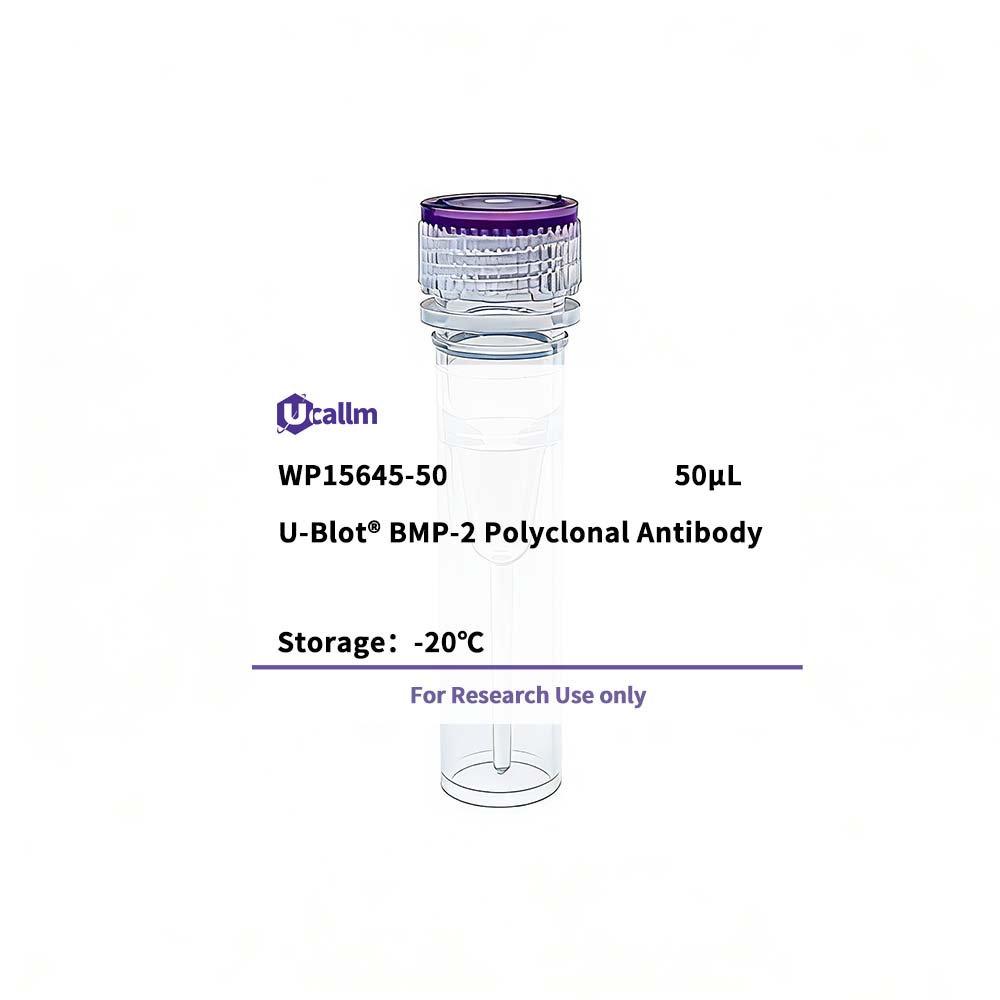
Ucallm_WP15645-50
Price range: $268.00 through $328.00
Product details
Background:
This gene encodes a secreted ligand of the TGF-beta (transforming growth factor-beta) superfamily of proteins. Ligands of this family bind various TGF-beta receptors leading to recruitment and activation of SMAD family transcription factors that regulate gene expression. The encoded preproprotein is proteolytically processed to generate each subunit of the disulfide-linked homodimer, which plays a role in bone and cartilage development. Duplication of a regulatory region downstream of this gene causes a form of brachydactyly characterized by a malformed index finger and second toe in human patients. [provided by RefSeq, Jul 2016],
Specifications
| Size | 50μL/100μL |
| Target | BMP-2 |
| Reactivity | Human, Mouse, Rat |
| Applications | IF, WB, IHC, ELISA |
| MW(Calculated) | |
| MW(Observed) | 44kD |
| Host Species | Rabbit |
| Isotype | IgG |
| Conjugate/Modification | Unmodified |
| Recommended Dilution Ratio | IF 1:50-200; WB 1:500-1:2000; IHC: 1:100-1:300; ELISA 1:10000; Not yet tested in other applications; / Note: For IHC, we suggest antigen retrieval with TE buffer pH 9.0 (Cat#WT1004) |
| Formulation | Liquid in PBS containing 50% glycerol, 0.5% BSA and 0.02% sodium azide. |
| Purification | The antibody was affinity-purified from rabbit antiserum by affinity-chromatography using epitope-specific immunogen. |
| Storage | -15°C to -25°C/1 year(Do not lower than -25°C) |
| Concentration | 1 mg/ml |
| Clonality | Polyclonal |
| Clone Number | |
| Immunogen | Synthesized peptide derived from Bone morphogenetic protein 2 at AA range: 341-390 |
| Specificity | BMP-2 Polyclonal Antibody detects endogenous levels of BMP-2 protein. |
| Gene Name | BMP2 |
| Protein Name | Bone morphogenetic protein 2 |
| Other Name | BMP2; / BMP2A; / Bone morphogenetic protein 2; / BMP-2; / Bone morphogenetic protein 2A; / BMP-2A |
| Species | Human |
| Gene ID | 650 |
| Uniprot | P12643, |
| Species.1 | Mouse |
| Gene ID.1 | 12156 |
| Uniprot.1 | P21274, |
| Species.2 | Rat |
| Gene ID.2 | 29373 |
| Uniprot.2 | P49001 |
| Cellular Localization | Secreted. |
| Tissue Expression | Particularly abundant in lung, spleen and colon and in low but significant levels in heart, brain, placenta, liver, skeletal muscle, kidney, pancreas, prostate, ovary and small intestine. |
| Signaling_pathway | Human Diseases >> Cancer: overview >> Pathways in cancer;Human Diseases >> Cancer: specific types >> Basal cell carcinoma;Environmental Information Processing >> Signal transduction >> TGF-beta signaling pathway;Environmental Information Processing >> Signal transduction >> Hippo signaling pathway;Environmental Information Processing >> Signaling molecules and interaction >> Cytokine-cytokine receptor interaction |
| Research Areas | >>Cytokine-cytokine receptor interaction; / >>TGF-beta signaling pathway; / >>Hippo signaling pathway; / >>Pathways in cancer; / >>Basal cell carcinoma |
| Function | Function:Induces cartilage and bone formation.,online information:Bone morphogenetic protein 2 entry,similarity:Belongs to the TGF-beta family.,subunit:Homodimer; disulfide-linked. Interacts with GREM2 (By similarity) and SOSTDC1.,tissue specificity:Particularly abundant in lung, spleen and colon and in low but significant levels in heart, brain, placenta, liver, skeletal muscle, kidney, pancreas, prostate, ovary and small intestine., |
Please login to post questions
Related products



