SKU: WR4294 Categories: ,

U-Blot® c-Jun Rabbit mAb

Price range: $268.00 through $328.00

SKU: WR4294-50
Enter the quantity you would like, or drag the panel to find the quantity and price that best for you
Bulk QuoteAuthorize OEM & ODM

Product details

Background:function:Transcription factor that recognizes and binds toThe enhancer heptamer motif 5′-TGA[CG]TCA-3′.,PTM:Phosphorylation enhancesThe transcriptional activity. Phosphorylated by PRKDC.,similarity:Belongs toThe bZIP family.,similarity:Belongs toThe bZIP family. Jun subfamily.,similarity:Contains 1 bZIP domain.,subunit:Heterodimer with either FOS or BATF3. Interacts with HIVEP3 (By similarity). Interacts with SMAD3/SMAD4 heterodimers. Interacts with MYBBP1A, SPIB and TCF20. Interacts with COPS5; indirectly leading to its phosphorylation. Interacts with DSIPI; this interaction inhibitsThe binding of active AP1 to its target DNA.,


Specifications

Size50μL/100μL
Targetc-JUN
ReactivityHuman, Mouse, Rat
ApplicationsWB, IHC, IF, IP, ELISA
MW(Calculated)36kD
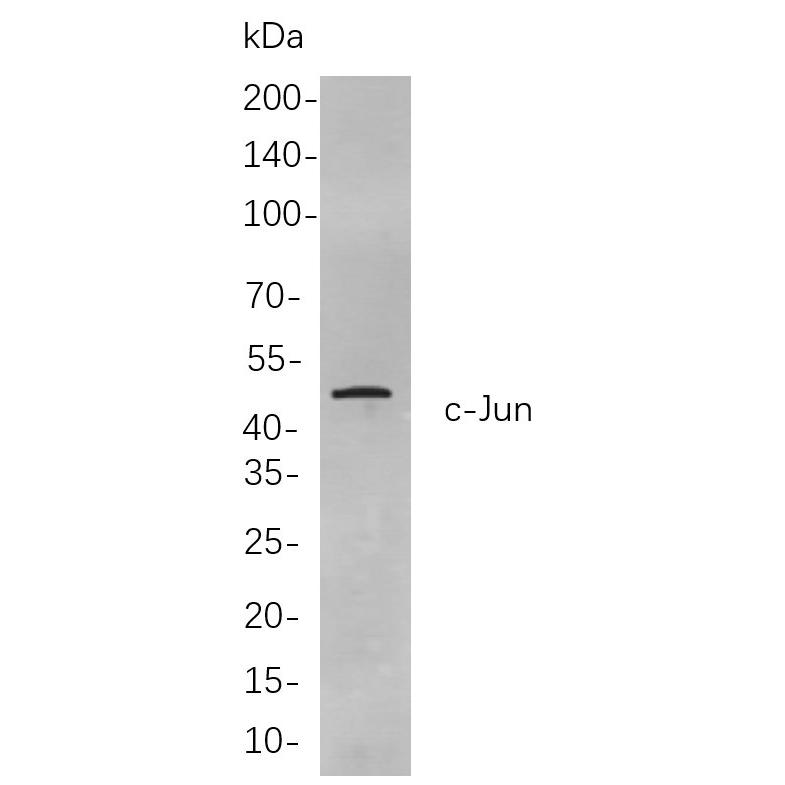
MW(Observed)43kD
Host SpeciesRabbit
IsotypeIgG,Kappa
Conjugate/ModificationUnmodified
Recommended Dilution RatioIHC 1:200-1:1000; WB 1:2000-1:10000; IF 1:200-1:1000; ELISA 1:5000-1:20000; IP 1:50-1:200; / Note: For IHC, we suggest antigen retrieval with TE buffer pH 9.0 (Cat#WT1004)
FormulationPBS, 50% glycerol, 0.05% Proclin 300, 0.05%BSA
PurificationRecombinant Antibody expressed in animal component-free (ACF) media, purified via Protein A affinity chromatography.
Storage-15°C to -25°C/1 year(Do not lower than -25°C)
Concentration
ClonalityMonoclonal
Clone NumberRM0489R
ImmunogenThe specific immunogen used to produce this antibody is proprietary information.
SpecificityEndogenous
Gene NameJUN
Protein NameC-Jun (Hydroxylated-p244); Transcription factor AP-1; jun; c-jun;AP-1
Other NameTranscription factor AP-1 (Activator protein 1; / AP1; / Proto-oncogene c-Jun; / V-jun avian sarcoma virus 17 oncogene homolog; / p39)
SpeciesHuman
Gene ID3725
UniprotP05412,
Species.1Mouse
Gene ID.116476
Uniprot.1P05627,
Species.2Rat
Gene ID.224516
Uniprot.2P17325
Cellular LocalizationNucleus
Tissue ExpressionExpressed in the developing and adult prostate and prostate cancer cells.
Signaling_pathwayCellular Processes >> Transport and catabolism >> Mitophagy - animal;Cellular Processes >> Cell growth and death >> Apoptosis;Cellular Processes >> Cellular community - eukaryotes >> Focal adhesion;Cellular Processes >> Cellular community - eukaryotes >> Tight junction;Organismal Systems >> Immune system >> Toll-like receptor signaling pathway;Organismal Systems >> Immune system >> NOD-like receptor signaling pathway;Organismal Systems >> Immune system >> T cell receptor signaling pathway;Organismal Systems >> Immune system >> Th1 and Th2 cell differentiation;Organismal Systems >> Immune system >> Th17 cell differentiation;Organismal Systems >> Immune system >> IL-17 signaling pathway;Organismal Systems >> Immune system >> B cell receptor signaling pathway;Organismal Systems >> Endocrine system >> GnRH signaling pathway;Organismal Systems >> Endocrine system >> Estrogen signaling pathway;Organismal Systems >> Endocrine system >> Oxytocin signaling pathway;Organismal Systems >> Endocrine system >> Relaxin signaling pathway;Organismal Systems >> Nervous system >> Neurotrophin signaling pathway;Organismal Systems >> Development and regeneration >> Osteoclast differentiation;Human Diseases >> Cancer: overview >> Pathways in cancer;Human Diseases >> Cancer: overview >> PD-L1 expression and PD-1 checkpoint pathway in cancer;Human Diseases >> Cancer: specific types >> Colorectal cancer;Human Diseases >> Cancer: specific types >> Renal cell carcinoma;Human Diseases >> Cancer: specific types >> Breast cancer;Human Diseases >> Immune disease >> Rheumatoid arthritis;Human Diseases >> Immune disease >> Inflammatory bowel disease;Environmental Information Processing >> Signal transduction >> MAPK signaling pathway;Environmental Information Processing >> Signal transduction >> ErbB signaling pathway;Environmental Information Processing >> Signal transduction >> Wnt signaling pathway;Environmental Information Processing >> Signal transduction >> TNF signaling pathway;Environmental Information Processing >> Signal transduction >> cAMP signaling pathway
Research Areas>>Endocrine resistance; / >>MAPK signaling pathway; / >>ErbB signaling pathway; / >>cAMP signaling pathway; / >>Mitophagy - animal; / >>Apoptosis; / >>Wnt signaling pathway; / >>Osteoclast differentiation; / >>Focal adhesion; / >>Tight junction; / >>Toll-like receptor signaling pathway; / >>NOD-like receptor signaling pathway; / >>C-type lectin receptor signaling pathway; / >>IL-17 signaling pathway; / >>Th1 and Th2 cell differentiation; / >>Th17 cell differentiation; / >>T cell receptor signaling pathway; / >>B cell receptor signaling pathway; / >>TNF signaling pathway; / >>Neurotrophin signaling pathway; / >>GnRH signaling pathway; / >>Estrogen signaling pathway; / >>Oxytocin signaling pathway; / >>Relaxin signaling pathway; / >>Non-alcoholic fatty liver disease; / >>AGE-RAGE signaling pathway in diabetic complications; / >>Cocaine addiction; / >>Amphetamine addiction; / >>Epithelial cell signaling in Helicobacter pylori infection; / >>Pathogenic Escherichia coli infection; / >>Shigellosis; / >>Salmonella infection; / >>Pertussis; / >>Yersinia infection; / >>Leishmaniasis; / >>Chagas disease; / >>Hepatitis B; / >>Measles; / >>Human T-cell leukemia virus 1 infection; / >>Kaposi sarcoma-associated herpesvirus infection; / >>Epstein-Barr virus infection; / >>Human immunodeficiency virus 1 infection; / >>Coronavirus disease - COVID-19; / >>Pathways in cancer; / >>Viral carcinogenesis; / >>Chemical carcinogenesis - receptor activation; / >>Chemical carcinogenesis - reactive oxygen species; / >>Colorectal cancer; / >>Renal cell carcinoma; / >>Breast cancer; / >>Choline metabolism in cancer; / >>PD-L1 expression and PD-1 checkpoint pathway in cancer; / >>Inflammatory bowel disease; / >>Rheumatoid arthritis; / >>Lipid and atherosclerosis; / >>Fluid shear stress and atherosclerosis
Functionprotein import into nucleus, translocation, response to reactive oxygen species, angiogenesis, blood vessel development, release of cytochrome c from mitochondria, regulation of protein amino acid phosphorylation, negative regulation of protein amino acid phosphorylation, vasculature development, response to molecule of bacterial origin,regulation of myeloid leukocyte differentiation, positive regulation of myeloid leukocyte differentiation, regulation of DNA replication, transcription, regulation of transcription, DNA-dependent, regulation of transcription from RNA polymerase II promoter, protein targeting, protein import into nucleus, cellular ion homeostasis, intracellular protein transport, nucleocytoplasmic transport, apoptosis, response to oxidative stress, mitochondrion organization, cell surface receptor linked signal transduction, enzyme linked receptor protein signaling pathway, transmembrane receptor protein serine/threonine kinase signaling pathway, transforming growth factor beta receptor signaling pathway, SMAD protein nuclear translocation, aging, behavior, learning or memory, learning, circadian rhythm, protein localization, cell death, positive regulation of cell proliferation, negative regulation of cell proliferation, apoptotic mitochondrial changes, cellular response to starvation, response to mechanical stimulus, response to bacterium,response to abiotic stimulus, positive regulation of biosynthetic process, response to extracellular stimulus, response to organic substance, response to inorganic substance, positive regulation of macromolecule biosynthetic process,negative regulation of phosphorus metabolic process, positive regulation of macromolecule metabolic process,negative regulation of macromolecule metabolic process, positive regulation of gene expression, regulation of cell death, positive regulation of cell death, programmed cell death, response to organic cyclic substance, protein transport, death, protein import, regulation of phosphate metabolic process, cellular homeostasis, epithelial cell differentiation, positive regulation of cellular biosynthetic process, regulation of protein modification process, negative regulation of protein modification process, response to nutrient levels, cellular response to extracellular stimulus,cellular response to nutrient levels, regulation of protein amino acid autophosphorylation, negative regulation of protein amino acid autophosphorylation, regulation of cellular protein metabolic process, negative regulation of cellular protein metabolic process, response to lipopolysaccharide, protein localization in organelle, cellular response to stress, response to cytokine stimulus, protein localization in nucleus, cellular protein localization, leading edge cell differentiation, regulation of cell proliferation, regulation of phosphorylation, negative regulation of phosphorylation,regulation of membrane potential, response to drug, response to hydrogen peroxide, homeostatic process, response to starvation, regulation of apoptosis, positive regulation of apoptosis, regulation of programmed cell death, positive regulation of programmed cell death, regulation of neuron apoptosis, positive regulation of neuron apoptosis,establishment of protein localization, regulation of transcription, positive regulation of cell differentiation, regulation of myeloid cell differentiation, positive regulation of myeloid cell differentiation, regulation of monocyte differentiation,positive regulation of monocyte differentiation, positive regulation of DNA replication, positive regulation of transcription, DNA-dependent, positive regulation of nucleobase, nucleoside, nucleotide and nucleic acid metabolic process, negative regulation of phosphate metabolic process, positive regulation of transcription, positive regulation of transcription from RNA polymerase II promoter, intracellular transport, rhythmic process, blood vessel morphogenesis, regulation of smooth muscle cell proliferation, positive regulation of smooth muscle cell proliferation,chemical homeostasis, ion homeostasis, neurological system process, cognition, regulation of DNA metabolic process,positive regulation of DNA metabolic process, positive regulation of developmental process, nuclear transport, nuclear import, positive regulation of nitrogen compound metabolic process, regulation of phosphorus metabolic process,negative regulation of protein metabolic process, regulation of RNA metabolic process, positive regulation of RNA metabolic process, cellular response to potassium ion starvation, response to cAMP, regulation of cell cycle, membrane depolarization, cellular chemical homeostasis, SMAD protein signal transduction, epithelium development, cellular macromolecule localization,
Please login to post questions

Back to Top
Product has been added to your cart
