


c-MYC [PTR2340] mouse mAb
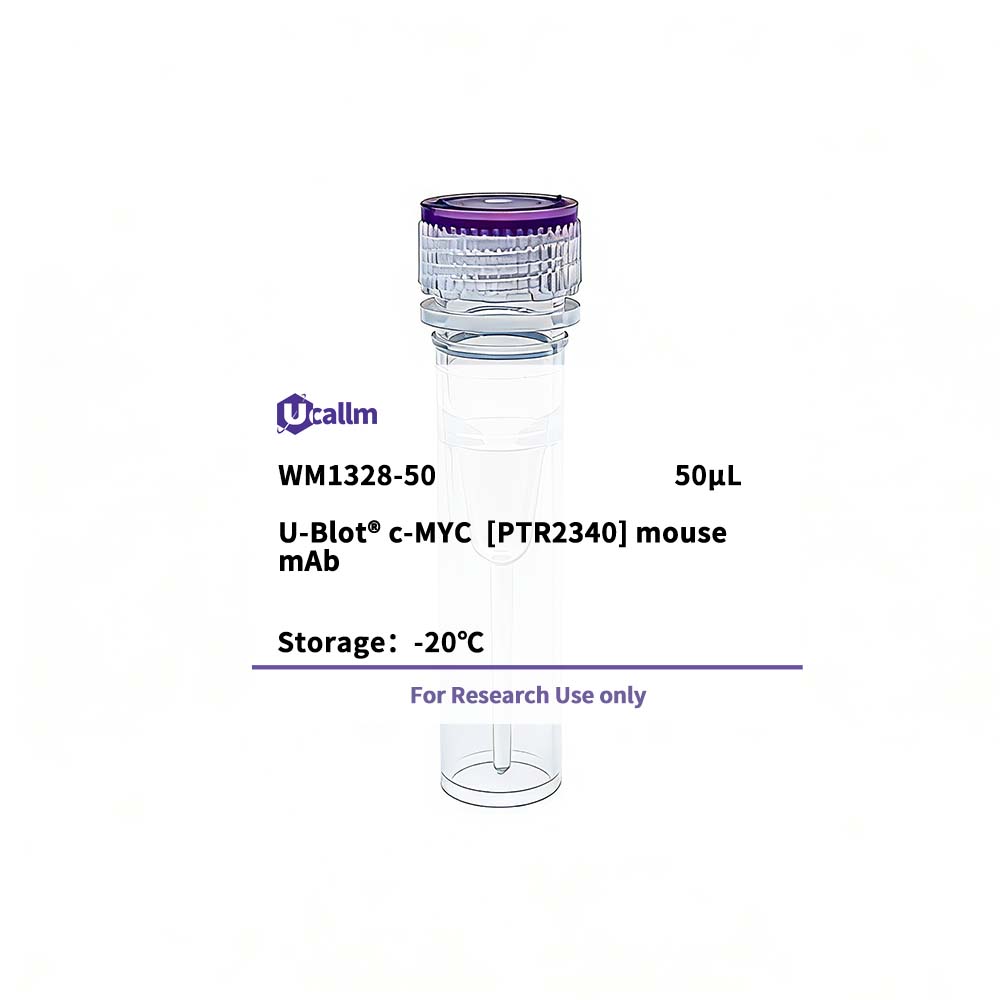
Ucallm_WM1328-50
Price range: $268.00 through $328.00
Product details
Background:
v-myc avian myelocytomatosis viral oncogene homolog(MYC) Homo sapiens The protein encoded by this gene is a multifunctional, nuclear phosphoprotein that plays a role in cell cycle progression, apoptosis and cellular transformation. It functions as a transcription factor that regulates transcription of specific target genes. Mutations, overexpression, rearrangement and translocation of this gene have been associated with a variety of hematopoietic tumors, leukemias and lymphomas, including Burkitt lymphoma. There is evidence to show that alternative translation initiations from an upstream, in-frame non-AUG (CUG) and a downstream AUG start site result in the production of two isoforms with distinct N-termini. The synthesis of non-AUG initiated protein is suppressed in Burkitt's lymphomas, suggesting its importance in the normal function of this gene. [provided by RefSeq, Jul 2008],
Specifications
| Size | 50μL/100μL |
| Target | c-Myc |
| Reactivity | Human, Mouse, Rat |
| Applications | IHC, WB, IF, ELISA |
| MW(Calculated) | 48kD |
| MW(Observed) | 57kD |
| Host Species | Mouse |
| Isotype | IgG2b,Kappa |
| Conjugate/Modification | Unmodified |
| Recommended Dilution Ratio | IHC 1:200-1000; WB 1:500-2000; IF 1:100-500; ELISA 1:1000-5000 / Note: For IHC, we suggest antigen retrieval with TE buffer pH 9.0 (Cat#WT1004) |
| Formulation | PBS, 50% glycerol, 0.05% Proclin 300, 0.05%BSA |
| Purification | Recombinant Antibody expressed in animal component-free (ACF) media, purified via Protein G affinity chromatography. |
| Storage | -15°C to -25°C/1 year(Do not lower than -25°C) |
| Concentration | |
| Clonality | Monoclonal |
| Clone Number | RMMR2340 |
| Immunogen | Synthesized peptide derived from human c-MYC AA range: 350-453 |
| Specificity | This antibody detects endogenous levels of c-MYC protein. |
| Gene Name | MYC BHLHE39 |
| Protein Name | Myc proto-oncogene protein (Class E basic helix-loop-helix protein 39) (bHLHe39) (Proto-oncogene c-Myc) (Transcription factor p64) |
| Other Name | MYC; / BHLHE39; / Myc proto-oncogene protein; / Class E basic helix-loop-helix protein 39; / bHLHe39; / Proto-oncogene c-Myc; / Transcription factor p64 |
| Species | Human |
| Gene ID | 4609 |
| Uniprot | P01106, |
| Species.1 | Mouse |
| Gene ID.1 | 17869 |
| Uniprot.1 | P01108, |
| Species.2 | Rat |
| Gene ID.2 | 24577 |
| Uniprot.2 | P09416 |
| Cellular Localization | Nuclear |
| Tissue Expression | |
| Signaling_pathway | Cellular Processes >> Cell growth and death >> Cell cycle;Cellular Processes >> Cell growth and death >> Cellular senescence;Cellular Processes >> Cellular community - eukaryotes >> Signaling pathways regulating pluripotency of stem cells;Organismal Systems >> Endocrine system >> Thyroid hormone signaling pathway;Human Diseases >> Cancer: overview >> Pathways in cancer;Human Diseases >> Cancer: overview >> Transcriptional misregulation in cancer;Human Diseases >> Cancer: overview >> MicroRNAs in cancer;Human Diseases >> Cancer: overview >> Central carbon metabolism in cancer;Human Diseases >> Cancer: specific types >> Colorectal cancer;Human Diseases >> Cancer: specific types >> Hepatocellular carcinoma;Human Diseases >> Cancer: specific types >> Gastric cancer;Human Diseases >> Cancer: specific types >> Thyroid cancer;Human Diseases >> Cancer: specific types >> Acute myeloid leukemia;Human Diseases >> Cancer: specific types >> Chronic myeloid leukemia;Human Diseases >> Cancer: specific types >> Bladder cancer;Human Diseases >> Cancer: specific types >> Endometrial cancer;Human Diseases >> Cancer: specific types >> Breast cancer;Human Diseases >> Cancer: specific types >> Small cell lung cancer;Environmental Information Processing >> Signal transduction >> MAPK signaling pathway;Environmental Information Processing >> Signal transduction >> ErbB signaling pathway;Environmental Information Processing >> Signal transduction >> Wnt signaling pathway;Environmental Information Processing >> Signal transduction >> TGF-beta signaling pathway;Environmental Information Processing >> Signal transduction >> Hippo signaling pathway;Environmental Information Processing >> Signal transduction >> JAK-STAT signaling pathway;Environmental Information Processing >> Signal transduction >> PI3K-Akt signaling pathway |
| Research Areas | >>MAPK signaling pathway; / >>ErbB signaling pathway; / >>Cell cycle; / >>PI3K-Akt signaling pathway; / >>Cellular senescence; / >>Wnt signaling pathway; / >>TGF-beta signaling pathway; / >>Hippo signaling pathway; / >>Signaling pathways regulating pluripotency of stem cells; / >>JAK-STAT signaling pathway; / >>Thyroid hormone signaling pathway; / >>Salmonella infection; / >>Hepatitis C; / >>Hepatitis B; / >>Human cytomegalovirus infection; / >>Human T-cell leukemia virus 1 infection; / >>Kaposi sarcoma-associated herpesvirus infection; / >>Epstein-Barr virus infection; / >>Pathways in cancer; / >>Transcriptional misregulation in cancer; / >>Proteoglycans in cancer; / >>MicroRNAs in cancer; / >>Chemical carcinogenesis - receptor activation; / >>Colorectal cancer; / >>Endometrial cancer; / >>Thyroid cancer; / >>Bladder cancer; / >>Chronic myeloid leukemia; / >>Acute myeloid leukemia; / >>Small cell lung cancer; / >>Breast cancer; / >>Hepatocellular carcinoma; / >>Gastric cancer; / >>Central carbon metabolism in cancer |
| Function | Disease:A chromosomal aberration involving MYC may be a cause of a form of B-cell chronic lymphocytic leukemia. Translocation t(8; 12)(q24; q22) with BTG1.,Disease:Overexpression of MYC is implicated in the etiology of a variety of hematopoietic tumors.,Function:Participates in the regulation of gene transcription. Binds DNA both in a non-specific manner and also specifically to recognizes the core sequence 5'-CAC[GA]TG-3'. Seems to activate the transcription of growth-related genes.,online information:Myc entry,PTM:Phosphorylated by PRKDC.,similarity:Contains 1 basic helix-loop-helix (bHLH) domain.,subunit:Efficient DNA binding requires dimerization with another bHLH protein. Binds DNA as a heterodimer with MAX. Interacts with TAF1C and SPAG9. Interacts with PARP10. Interacts with KDM5A and KDM5B., |
Please login to post questions
Related products




