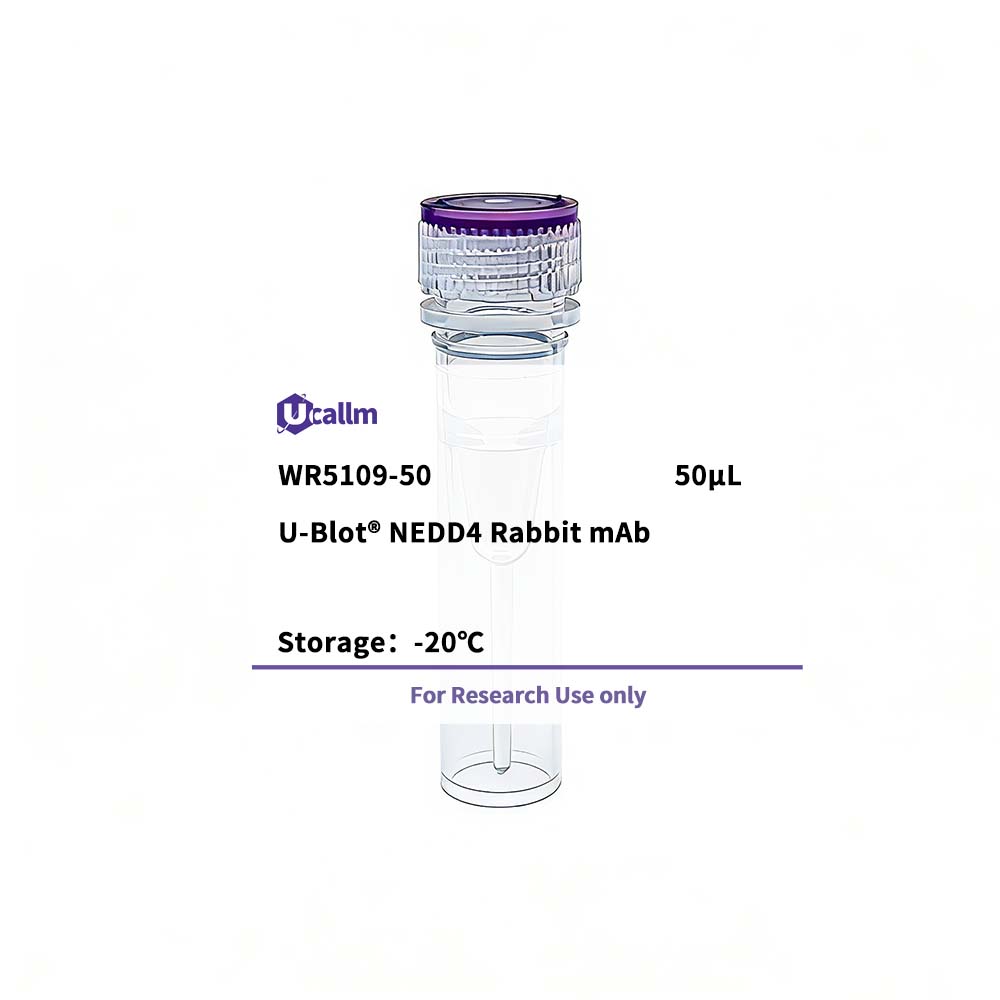
SKU: WR5109 Categories: ,

U-Blot® NEDD4 Rabbit mAb

Price range: $268.00 through $328.00

SKU: WR5109-50
Enter the quantity you would like, or drag the panel to find the quantity and price that best for you
Bulk QuoteAuthorize OEM & ODM

Product details

Background:This gene is the founding member of the NEDD4 family of HECT ubiquitin ligases that function in the ubiquitin proteasome system of protein degradation. The encoded protein contains an N-terminal calcium and phospholipid binding C2 domain followed by multiple tryptophan-rich WW domains and, a C-terminal HECT ubiquitin ligase catalytic domain. It plays critical role in the regulation of a number of membrane receptors, endocytic machinery components and the tumor suppressor PTEN. [provided by RefSeq, Jul 2016],

Specifications

Size50μL/100μL
TargetNEDD4
ReactivityHuman, Mouse, Rat
ApplicationsWB, IF, IP, ELISA
MW(Calculated)149kD
MW(Observed)130kD
Host SpeciesRabbit
IsotypeIgG,Kappa
Conjugate/ModificationUnmodified
Recommended Dilution RatioWB 1:2000-1:10000; IF 1:200-1:1000; ELISA 1:5000-1:20000; IP 1:50-1:200;
FormulationPBS, 50% glycerol, 0.05% Proclin 300, 0.05%BSA
PurificationRecombinant Antibody expressed in animal component-free (ACF) media, purified via Protein A affinity chromatography.
Storage-15°C to -25°C/1 year(Do not lower than -25°C)
Concentration
ClonalityMonoclonal
Clone NumberRM1292R
ImmunogenThe specific immunogen used to produce this antibody is proprietary information.
SpecificityEndogenous
Gene NameNEDD4 KIAA0093 NEDD4-1 PIG53
Protein NameNEDD4
Other Name
SpeciesHuman
Gene ID4734
UniprotP46934,
Species.1Mouse
Gene ID.117999
Uniprot.1P46935,
Species.2Rat
Gene ID.225489
Uniprot.2Q62940
Cellular LocalizationCytoplasm . Cell membrane; Peripheral membrane protein . Recruited to the plasma membrane by GRB10. Once complexed with GRB10 and IGF1R, follows IGF1R internalization, remaining associated with early endosomes. Uncouples from IGF1R-containing endosomes before the sorting of the receptor to the lysosomal compartment (By similarity). May be recruited to exosomes by NDFIP1. .
Tissue Expression
Signaling_pathwayCellular Processes >> Cellular community - eukaryotes >> Tight junction;Genetic Information Processing >> Folding, sorting and degradation >> Ubiquitin mediated proteolysis
Research Areas>>Ubiquitin mediated proteolysis; / >>Endocytosis; / >>Tight junction; / >>Epstein-Barr virus infection
FunctionDomain:The WW domains mediate interaction with LITAF, RNF11, WBP1, WBP2, TMEPAI, NDFIP1 and PRRG2.,Function:E3 ubiquitin-protein ligase which accepts ubiquitin from an E2 ubiquitin-conjugating enzyme in the form of a thioester and then directly transfers the ubiquitin to targeted substrates (By similarity). Involved in the budding of many viruses.,miscellaneous:A cysteine residue is required for ubiquitin-thioester formation.,pathway:Protein modification; protein ubiquitination.,similarity:Contains 1 C2 domain.,similarity:Contains 1 HECT (E6AP-type E3 ubiquitin-protein ligase) domain.,similarity:Contains 4 WW domains.,subunit:Interacts with UBE2D2. Binds SCNN1A, SCNN1B and SCNN1G. Binds, in vitro, through the WW2 and WW3 domains, to neural isoforms of ENAH that contain the PPSY motif. Interacts with LITAF, RNF11, WBP1, WBP2, TMEPAI, NDFIP1 and PRRG2 (By similarity). Interacts with viral proteins that contain a late-budding motif P-P-P-Y. This interaction is essential for viral particle budding of a lot of retroviruses, like HTLV-1 Gag and MLV Gag.,
Please login to post questions
Back to Top
Product has been added to your cart