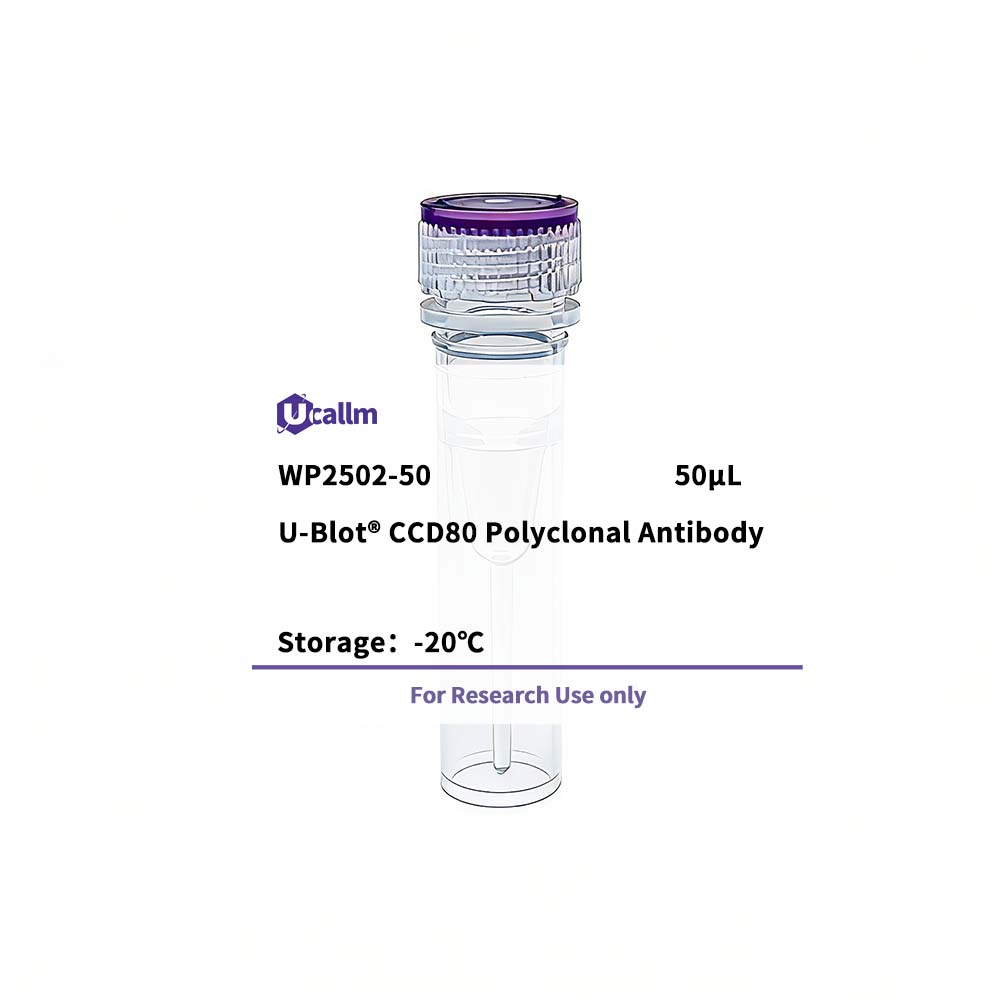
SKU: WP2502 Categories: ,

CCD80 Polyclonal Antibody

Price range: $268.00 through $328.00

SKU: WP2502-100
Enter the quantity you would like, or drag the panel to find the quantity and price that best for you
Bulk QuoteAuthorize OEM & ODM

Product details

Background:

function:Promotes cell adhesion and matrix assembly., induction:Down-regulated in cancer and after osteoblastic differentiation. Up-regulated by dihydrotestosterone (DHT)., PTM:Phosphorylated., similarity:Belongs to the CCDC80 family., subunit:Binds to various extracellular matrix proteins., tissue specificity:Expressed in dermal papilla and dermal fibroblasts (at protein level). Expressed in heart, thymus, placenta, pancreas, colon, epithelium, spleen and osteoblasts.,

Specifications

Size50μL/100μL
TargetCCD80
ReactivityHuman, Mouse, Rat
ApplicationsWB, ELISA
MW(Calculated)
MW(Observed)104kD
Host SpeciesRabbit
IsotypeIgG
Conjugate/ModificationUnmodified
Recommended Dilution RatioWB 1:500-2000; ELISA 1:5000-20000
FormulationLiquid in PBS containing 50% glycerol,0.5% BSA and 0.02% sodium azide.
PurificationThe antibody was affinity-purified from rabbit antiserum by affinity-chromatography using epitope-specific immunogen.
Storage-15°C to -25°C/1 year(Do not lower than -25°C)
Concentration1 mg/ml
ClonalityPolyclonal
Clone Number
ImmunogenSynthesized peptide derived from part region of human protein AA range: 530-580
SpecificityCCD80 Polyclonal Antibody detects endogenous levels of protein.
Gene NameCCDC80 DRO1 URB HBE245
Protein NameCoiled-coil domain-containing protein 80 (Down-regulated by oncogenes protein 1) (Up-regulated in BRS-3 deficient mouse homolog)
Other Name
SpeciesHuman
Gene ID151887
UniprotQ76M96,
Species.1Mouse
Gene ID.1
Uniprot.1Q8R2G6,
Species.2Rat
Gene ID.2
Uniprot.2Q6QD51
Cellular LocalizationSecreted, extracellular space, extracellular matrix .
Tissue ExpressionExpressed in dermal papilla and dermal fibroblasts (at protein level). Expressed in heart, thymus, placenta, pancreas, colon, epithelium, spleen and osteoblasts.
Signaling_pathway
Research Areas
FunctionFunction:Promotes cell adhesion and matrix assembly.,induction:Down-regulated in cancer and after osteoblastic differentiation. Up-regulated by dihydrotestosterone (DHT).,PTM:Phosphorylated.,similarity:Belongs to the CCDC80 family.,subunit:Binds to various extracellular matrix proteins.,tissue specificity:Expressed in dermal papilla and dermal fibroblasts (at protein level). Expressed in heart, thymus, placenta, pancreas, colon, epithelium, spleen and osteoblasts.,
Please login to post questions
Back to Top
Product has been added to your cart