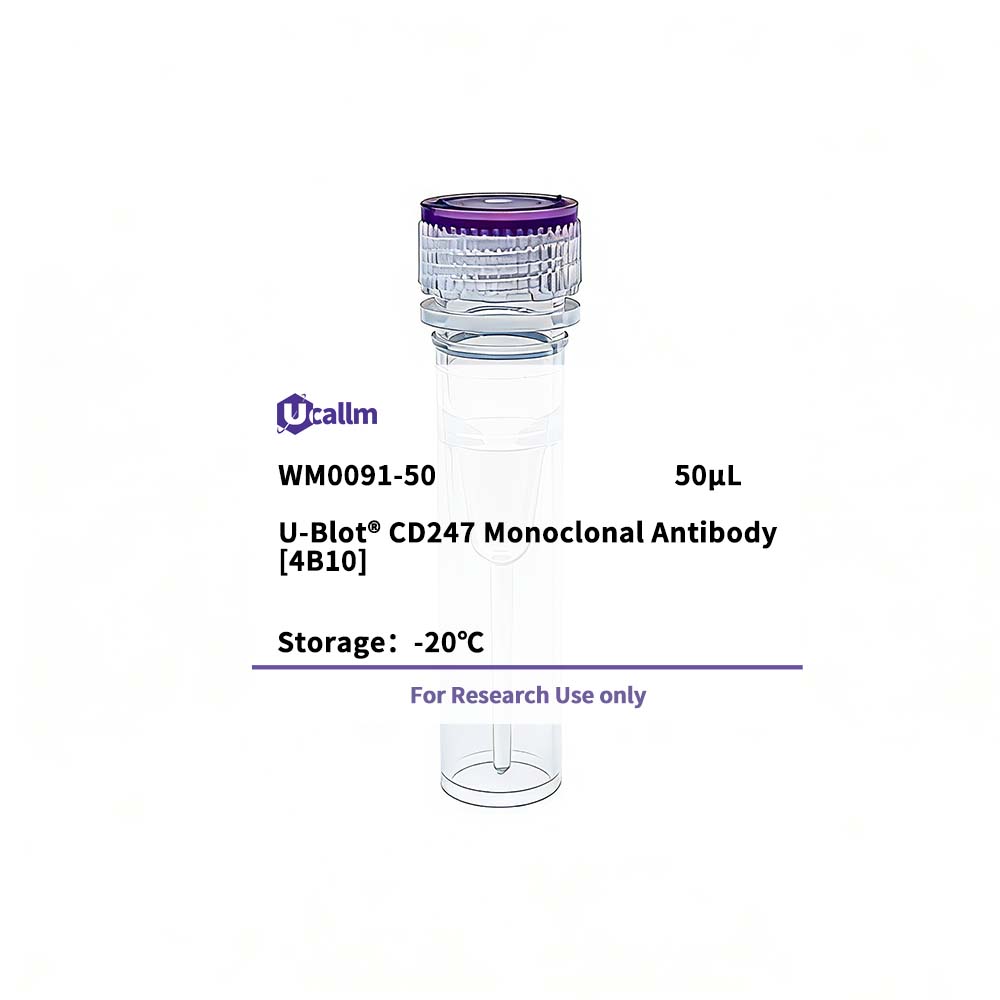
SKU: WM0091 Categories: ,

CD247 Monoclonal Antibody [4B10]

Price range: $268.00 through $328.00

SKU: WM0091-50
Enter the quantity you would like, or drag the panel to find the quantity and price that best for you
Bulk QuoteAuthorize OEM & ODM

Product details

Background:
The protein encoded by this gene is T-cell receptor zeta, which together with T-cell receptor alpha/beta and gamma/delta heterodimers, and with CD3-gamma, -delta and -epsilon, forms the T-cell receptor-CD3 complex. The zeta chain plays an important role in coupling antigen recognition to several intracellular signal-transduction pathways. Low expression of the antigen results in impaired immune response. Two alternatively spliced transcript variants encoding distinct isoforms have been found for this gene. [provided by RefSeq, Jul 2008],


Specifications

Size50μL/100μL
TargetCD3 ζ
ReactivityHuman
ApplicationsWB, IHC, IF, FC, ELISA
MW(Calculated)19kD
MW(Observed)
Host SpeciesMouse
Isotype
Conjugate/ModificationUnmodified
Recommended Dilution RatioWB 1:500-1:2000; IHC 1:200-1:1000; IF 1:200-1:1000; Flow Cyt 1:200-1:400; ELISA 1:10000; Not yet tested in other applications. / Note: For IHC, we suggest antigen retrieval with TE buffer pH 9.0 (Cat#WT1004)
FormulationLiquid in PBS containing 50% glycerol, 0.5% BSA and 0.02% sodium azide.
PurificationAffinity purification
Storage-15°C to -25°C/1 year(Do not lower than -25°C)
Concentration
ClonalityMonoclonal
Clone Number4B10
ImmunogenPurified recombinant fragment of human CD247 expressed in E. Coli.
SpecificityCD247 Monoclonal Antibody detects endogenous levels of CD247 protein.
Gene NameCD247
Protein NameT-cell surface glycoprotein CD3 zeta chain
Other NameCD247; / CD3Z; / T3Z; / TCRZ; / T-cell surface glycoprotein CD3 zeta chain; / T-cell receptor T3 zeta chain; / CD antigen CD247
SpeciesHuman
Gene ID919
UniprotP20963
Species.1
Gene ID.1
Uniprot.1
Species.2
Gene ID.2
Uniprot.2
Cellular LocalizationCell membrane; Single-pass type I membrane protein.
Tissue ExpressionCD3Z is expressed in normal lymphoid tissue and in peripheral blood mononuclear cells (PBMCs) (PubMed:11722641).
Signaling_pathwayOrganismal Systems >> Immune system >> Natural killer cell mediated cytotoxicity;Organismal Systems >> Immune system >> T cell receptor signaling pathway;Organismal Systems >> Immune system >> Th1 and Th2 cell differentiation;Organismal Systems >> Immune system >> Th17 cell differentiation;Human Diseases >> Cancer: overview >> PD-L1 expression and PD-1 checkpoint pathway in cancer
Research Areas>>Natural killer cell mediated cytotoxicity; / >>Th1 and Th2 cell differentiation; / >>Th17 cell differentiation; / >>T cell receptor signaling pathway; / >>Chagas disease; / >>Epstein-Barr virus infection; / >>Human immunodeficiency virus 1 infection; / >>PD-L1 expression and PD-1 checkpoint pathway in cancer
FunctionDisease:Defects in CD247 are a cause of primary T-cell immunodeficiency [MIM:610163]. Affected individuals suffer of recurrent infections. Patients T-cell counts are very low and B-cell counts are normal.,Domain:The ITAM domains mediate interaction with SHB.,Function:Probable role in assembly and expression of the TCR complex as well as signal transduction upon antigen triggering.,online information:CD247 mutation db,PTM:Phosphorylated on Tyr residues after T-cell receptor triggering.,similarity:Belongs to the CD3Z/FCER1G family.,similarity:Contains 3 ITAM domains.,subunit:The TCR/CD3 complex of T-lymphocytes consists of either a TCR alpha/beta or TCR gamma/delta heterodimer coexpressed at the cell surface with the invariant subunits of CD3 labeled gamma, delta, epsilon, zeta, and eta. CD3-zeta forms either homodimers or heterodimers with CD3-eta. Interacts with SLA and SLA2. Interacts with DOCK2 and TRAT1. Interacts with HIV-1 Nef protein. Interacts with SHB.,
Please login to post questions
Back to Top
Product has been added to your cart

