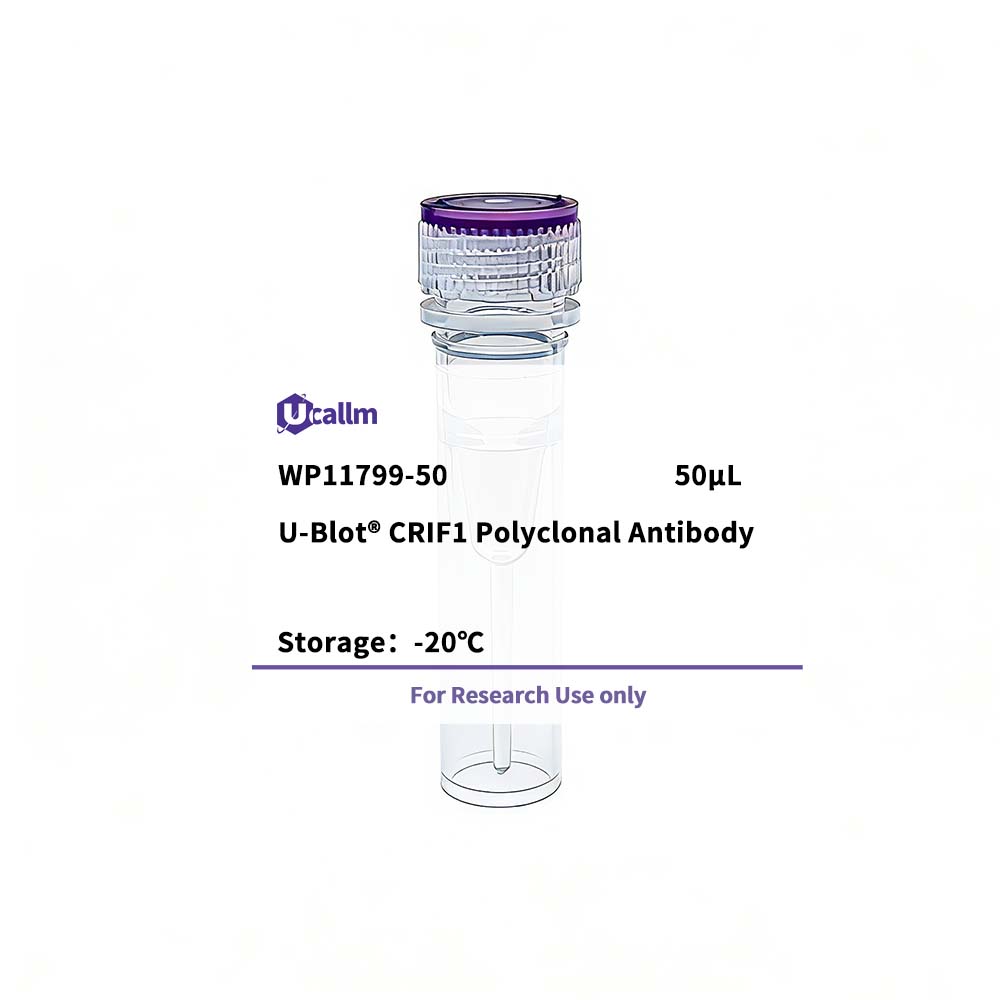
SKU: WP11799 Categories: ,

CRIF1 Polyclonal Antibody

Price range: $268.00 through $328.00

SKU: WP11799-100
Enter the quantity you would like, or drag the panel to find the quantity and price that best for you
Bulk QuoteAuthorize OEM & ODM

Product details

Background:

This gene encodes a nuclear-localized protein that may be induced by p53 and regulates the cell cycle by inhibiting G1 to S phase progression. The encoded protein may interact with other cell cycle regulators. [provided by RefSeq, Aug 2012],

Specifications

Size50μL/100μL
TargetCRIF1
ReactivityHuman, Mouse, Rat
ApplicationsIHC, IF, ELISA
MW(Calculated)25kD
MW(Observed)
Host SpeciesRabbit
IsotypeIgG
Conjugate/ModificationUnmodified
Recommended Dilution RatioIHC 1:100-1:300; ELISA 1:40000; IF 1:50-200 / Note: For IHC, we suggest antigen retrieval with TE buffer pH 9.0 (Cat#WT1004)
FormulationLiquid in PBS containing 50% glycerol, 0.5% BSA and 0.02% sodium azide.
PurificationThe antibody was affinity-purified from rabbit antiserum by affinity-chromatography using epitope-specific immunogen.
Storage-15°C to -25°C/1 year(Do not lower than -25°C)
Concentration1 mg/ml
ClonalityPolyclonal
Clone Number
ImmunogenThe antiserum was produced against synthesized peptide derived from human GADD45GIP1. AA range:91-140
SpecificityCRIF1 Polyclonal Antibody detects endogenous levels of CRIF1 protein.
Gene NameGADD45GIP1
Protein NameGrowth arrest and DNA damage-inducible proteins-interacting protein 1
Other NameGADD45GIP1; / PLINP1; / PRG6; / Growth arrest and DNA damage-inducible proteins-interacting protein 1; / CKII beta-associating protein; / CR6-interacting factor 1; / CRIF1; / Papillomavirus L2-interacting nuclear protein 1; / PLINP; / PLINP-1; / p53-responsive
SpeciesHuman
Gene ID90480
UniprotQ8TAE8,
Species.1Mouse
Gene ID.1
Uniprot.1Q9CR59
Species.2
Gene ID.2
Uniprot.2
Cellular LocalizationMitochondrion . Nucleus . Using N-terminally tagged constructs, has been found in the nucleus (PubMed:12482659). C-terminally tagged constructs are targeted exclusively to mitochondria (PubMed:22453275). This discrepancy may be explained by masking of a potential N-terminal mitochondrial targeting signal by the tag (PubMed:22453275). .
Tissue ExpressionWidely expressed. Highly expressed in the thyroid gland, heart, lymph nodes, trachea and adrenal tissues. Expressed at lower level in liver skeletal muscle, kidney, pancreas, testis, ovary and stomach. Barely detectable in adrenal adenoma and papillary thyroid cancer.
Signaling_pathway
Research Areas
FunctionFunction:Acts as a negative regulator of G1 to S cell cycle phase progression by inhibiting cyclin-dependent kinases. Inhibitory effects are additive with GADD45 proteins but occurs also in the absence of GADD45 proteins. Acts as a repressor of the orphan nuclear receptor NR4A1 by inhibiting AB domain-mediated transcriptional activity. May be involved in the hormone-mediated regulation of NR4A1 transcriptional activity.,induction:Down-regulated by p53/TP53 in apopoptic cells.,miscellaneous:Cells overexpressing GADD45GIP1 were more likely to be in G1 and less likely to be in S phase and grow more slowly than control cells. Inhibiting the expression of GADD45GIP1 promotes cell cycle progression.,subunit:Interacts with GADD45A, GADD45B and GADD45G. Interacts with NR4A1 via the NR4A1 AB domain. Interacts with the human papilloma virus type 16 (HPV 16) minor capsid protein L2.,tissue specificity:Widely expressed. Highly expressed in the thyroid gland, heart, lymph nodes, trachea and adrenal tissues. Expressed at lower level in liver skeletal muscle, kidney, pancreas, testis, ovary and stomach. Barely detectable in adrenal adenoma and papillary thyroid cancer.,
Please login to post questions
Back to Top
Product has been added to your cart