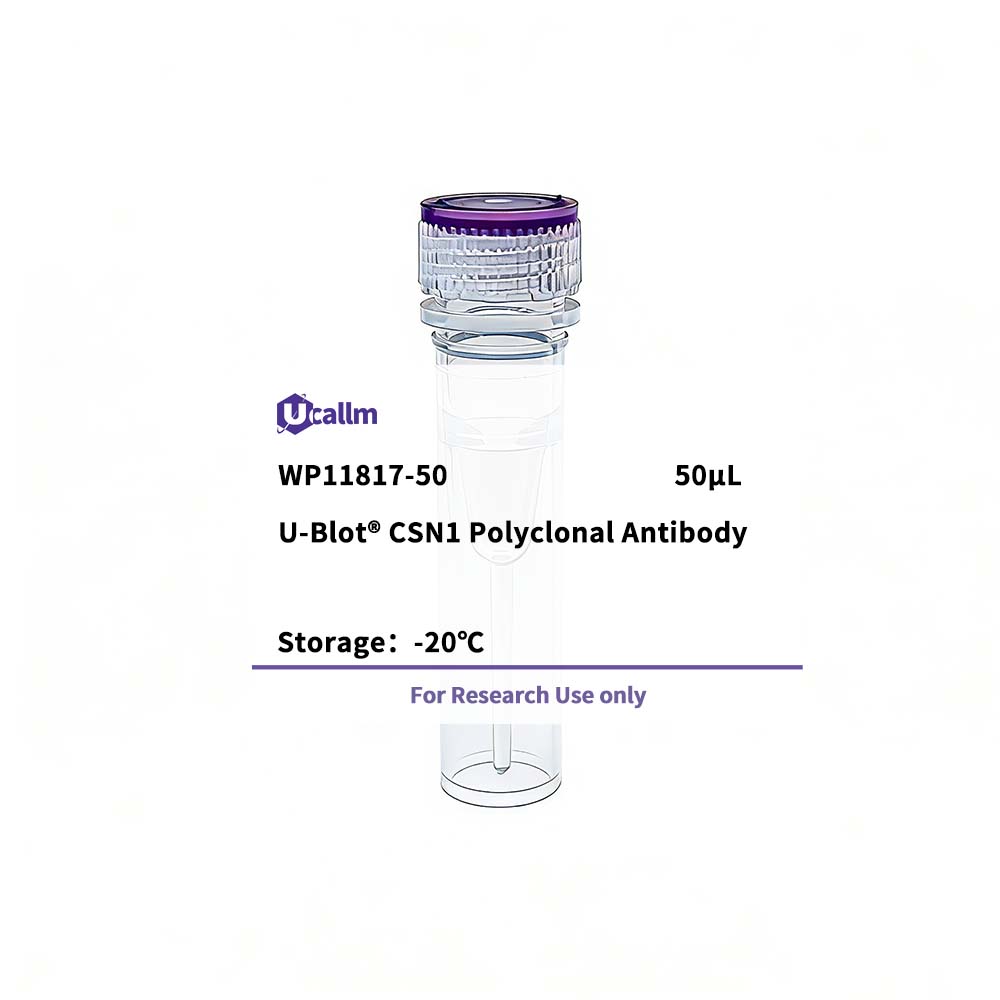
SKU: WP11817 Categories: ,

CSN1 Polyclonal Antibody

Price range: $268.00 through $328.00

SKU: WP11817-100
Enter the quantity you would like, or drag the panel to find the quantity and price that best for you
Bulk QuoteAuthorize OEM & ODM

Product details

Background:

This gene is known to suppress G-protein and mitogen-activated signal transduction in mammalian cells. The encoded protein shares significant similarity with Arabidopsis FUS6, which is a regulator of light-mediated signal transduction in plant cells. [provided by RefSeq, Mar 2016],

Specifications

Size50μL/100μL
TargetCSN1
ReactivityHuman, Mouse, Rat
ApplicationsIHC, IF, ELISA
MW(Calculated)53kD
MW(Observed)
Host SpeciesRabbit
IsotypeIgG
Conjugate/ModificationUnmodified
Recommended Dilution RatioIHC 1:100-1:300; ELISA 1:20000; IF 1:50-200 / Note: For IHC, we suggest antigen retrieval with TE buffer pH 9.0 (Cat#WT1004)
FormulationLiquid in PBS containing 50% glycerol, 0.5% BSA and 0.02% sodium azide.
PurificationThe antibody was affinity-purified from rabbit antiserum by affinity-chromatography using epitope-specific immunogen.
Storage-15°C to -25°C/1 year(Do not lower than -25°C)
Concentration1 mg/ml
ClonalityPolyclonal
Clone Number
ImmunogenThe antiserum was produced against synthesized peptide derived from human COPS1. AA range:420-469
SpecificityCSN1 Polyclonal Antibody detects endogenous levels of CSN1 protein.
Gene NameGPS1
Protein NameCOP9 signalosome complex subunit 1
Other NameGPS1; / COPS1; / CSN1; / COP9 signalosome complex subunit 1; / SGN1; / Signalosome subunit 1; / G protein pathway suppressor 1; / GPS-1; / JAB1-containing signalosome subunit 1; / Protein MFH
SpeciesHuman
Gene ID2873
UniprotQ13098,
Species.1Mouse
Gene ID.1
Uniprot.1Q99LD4,
Species.2Rat
Gene ID.2117039
Uniprot.2P97834
Cellular LocalizationCytoplasm . Nucleus .
Tissue ExpressionWidely expressed.
Signaling_pathway
Research Areas
FunctionDomain:The N-terminal part (1-216), which is not required for deneddylating activity and CSN complex formation, is nevertheless essential for other aspects of CSN complex function, such as repression of c-fos/FOS expression.,Domain:The PCI domain is necessary and sufficient for the interactions with other CSN subunits of the complex. Mediates the interaction with CAPN8.,Function:Essential component of the COP9 signalosome complex (CSN), a complex involved in various cellular and developmental processes. The CSN complex is an essential regulator of the ubiquitin (Ubl) conjugation pathway by mediating the deneddylation of the cullin subunits of SCF-type E3 ligase complexes, leading to decrease the Ubl ligase activity of SCF-type complexes such as SCF, CSA or DDB2. The complex is also involved in phosphorylation of p53/TP53, c-jun/JUN, IkappaBalpha/NFKBIA, ITPK1 and IRF8/ICSBP, possibly via its association with CK2 and PKD kinases. CSN-dependent phosphorylation of TP53 and JUN promotes and protects degradation by the Ubl system, respectively. Suppresses G-protein-and mitogen-activated protein kinase-mediated signal transduction.,PTM:Phosphorylated upon DNA damage, probably by ATM or ATR.,similarity:Belongs to the CSN1 family.,similarity:Contains 1 PCI domain.,subunit:Component of the CSN complex, composed of COPS1/GPS1, COPS2, COPS3, COPS4, COPS5, COP6, COPS7 (COPS7A or COPS7B) and COPS8. In the complex, it probably interacts directly with COPS2, COPS3, COPS4 and CSN5. Interacts directly with inositol kinase ITPK1. Interacts with CAPN8.,tissue specificity:Widely expressed.,
Please login to post questions
Back to Top
Product has been added to your cart

