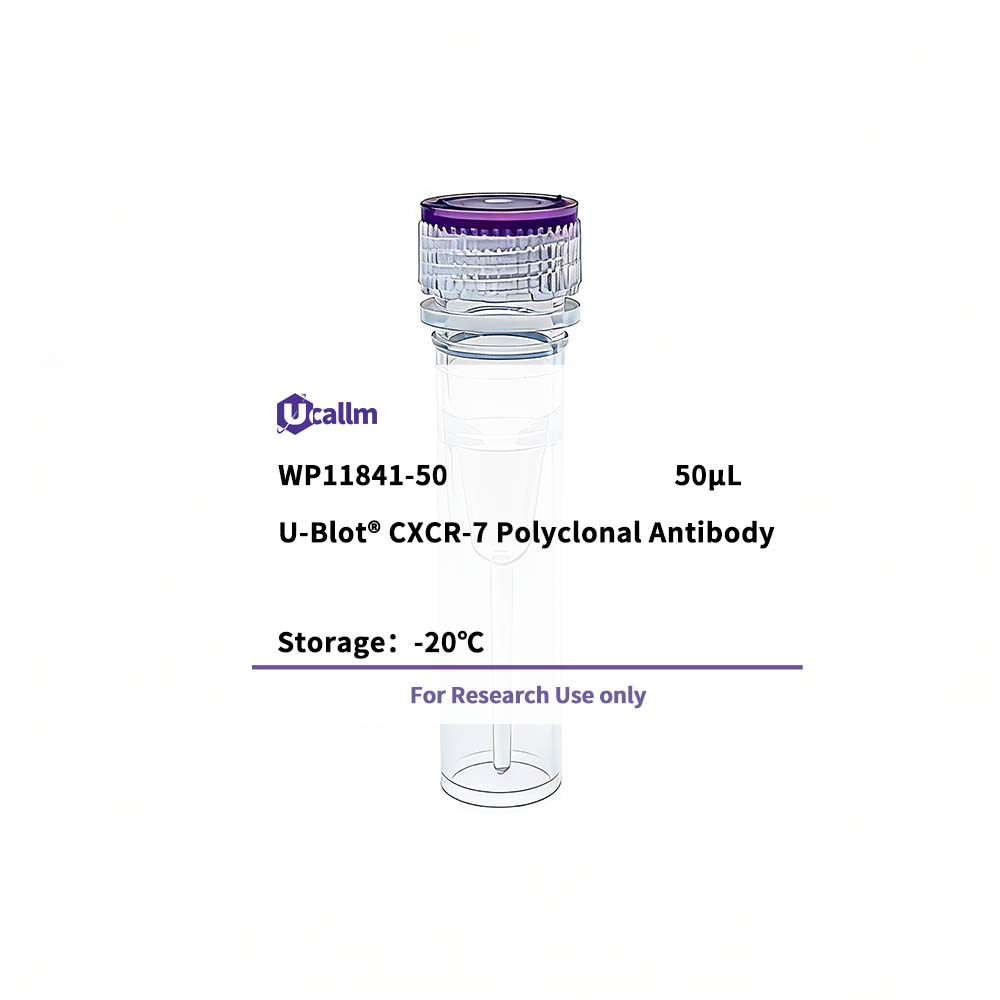
SKU: WP11841 Categories: ,

CXCR-7 Polyclonal Antibody

Price range: $268.00 through $328.00

SKU: WP11841-100
Enter the quantity you would like, or drag the panel to find the quantity and price that best for you
Bulk QuoteAuthorize OEM & ODM

Product details

Background:

This gene encodes a member of the G-protein coupled receptor family. Although this protein was earlier thought to be a receptor for vasoactive intestinal peptide (VIP), it is now considered to be an orphan receptor, in that its endogenous ligand has not been identified. The protein is also a coreceptor for human immunodeficiency viruses (HIV). Translocations involving this gene and HMGA2 on chromosome 12 have been observed in lipomas. [provided by RefSeq, Jul 2008],


Specifications

Size50μL/100μL
TargetCXCR-7
ReactivityHuman, Mouse, Rat, Monkey
ApplicationsWB, IF, ELISA
MW(Calculated)
MW(Observed)41kD
Host SpeciesRabbit
IsotypeIgG
Conjugate/ModificationUnmodified
Recommended Dilution RatioWB 1:500-1:2000; IF 1:200-1:1000; ELISA 1:20000; Not yet tested in other applications.
FormulationLiquid in PBS containing 50% glycerol, 0.5% BSA and 0.02% sodium azide.
PurificationThe antibody was affinity-purified from rabbit antiserum by affinity-chromatography using epitope-specific immunogen.
Storage-15°C to -25°C/1 year(Do not lower than -25°C)
Concentration1 mg/ml
ClonalityPolyclonal
Clone Number
ImmunogenThe antiserum was produced against synthesized peptide derived from human CXCR7. AA range:311-360
SpecificityCXCR-7 Polyclonal Antibody detects endogenous levels of CXCR-7 protein.
Gene NameCXCR7
Protein NameC-X-C chemokine receptor type 7
Other NameCXCR7; / CMKOR1; / GPR159; / RDC1; / C-X-C chemokine receptor type 7; / CXC-R7; / CXCR-7; / Chemokine orphan receptor 1; / G-protein coupled receptor 159; / G-protein coupled receptor RDC1 homolog; / RDC-1
SpeciesHuman
Gene ID57007
UniprotP25106,
Species.1Mouse
Gene ID.112778
Uniprot.1P56485,
Species.2Rat
Gene ID.284348
Uniprot.2O89039
Cellular LocalizationCell membrane; Multi-pass membrane protein . Early endosome . Recycling endosome . Predominantly localizes to endocytic vesicles, and upon stimulation by the ligand is internalized via clathrin-coated pits in a beta-arrestin-dependent manner. Once internalized, the ligand dissociates from the receptor, and is targeted to degradation while the receptor is recycled back to the cell membrane. .
Tissue ExpressionExpressed in monocytes, basophils, B-cells, umbilical vein endothelial cells (HUVEC) and B-lymphoblastoid cells. Lower expression detected in CD4+ T-lymphocytes and natural killer cells. In the brain, detected in endothelial cells and capillaries, and in mature neurons of the frontal cortex and hippocampus. Expressed in tubular formation in the kidney. Highly expressed in astroglial tumor endothelial, microglial and glioma cells. Expressed at low levels in normal CD34+ progenitor cells, but at very high levels in several myeloid malignant cell lines. Expressed in breast carcinomas but not in normal breast tissue (at protein level).
Signaling_pathwayEnvironmental Information Processing >> Signaling molecules and interaction >> Cytokine-cytokine receptor interaction;Environmental Information Processing >> Signaling molecules and interaction >> Viral protein interaction with cytokine and cytokine receptor
Research Areas>>Cytokine-cytokine receptor interaction; / >>Viral protein interaction with cytokine and cytokine receptor
FunctionCaution:Was originally (PubMed:1675791) thought to be the receptor for VIP.,Function:Receptor for CXCL12/SDF1. Acts as coreceptor with CXCR4 for a restricted number of HIV isolates.,online information:CXC chemokine receptors entry,similarity:Belongs to the G-protein coupled receptor 1 family.,tissue specificity:Expressed in monocytes, basophils, and B-cells. Lower expression in CD4+ T-lymphocytes and natural killer cells.,
Please login to post questions
Back to Top
Product has been added to your cart
