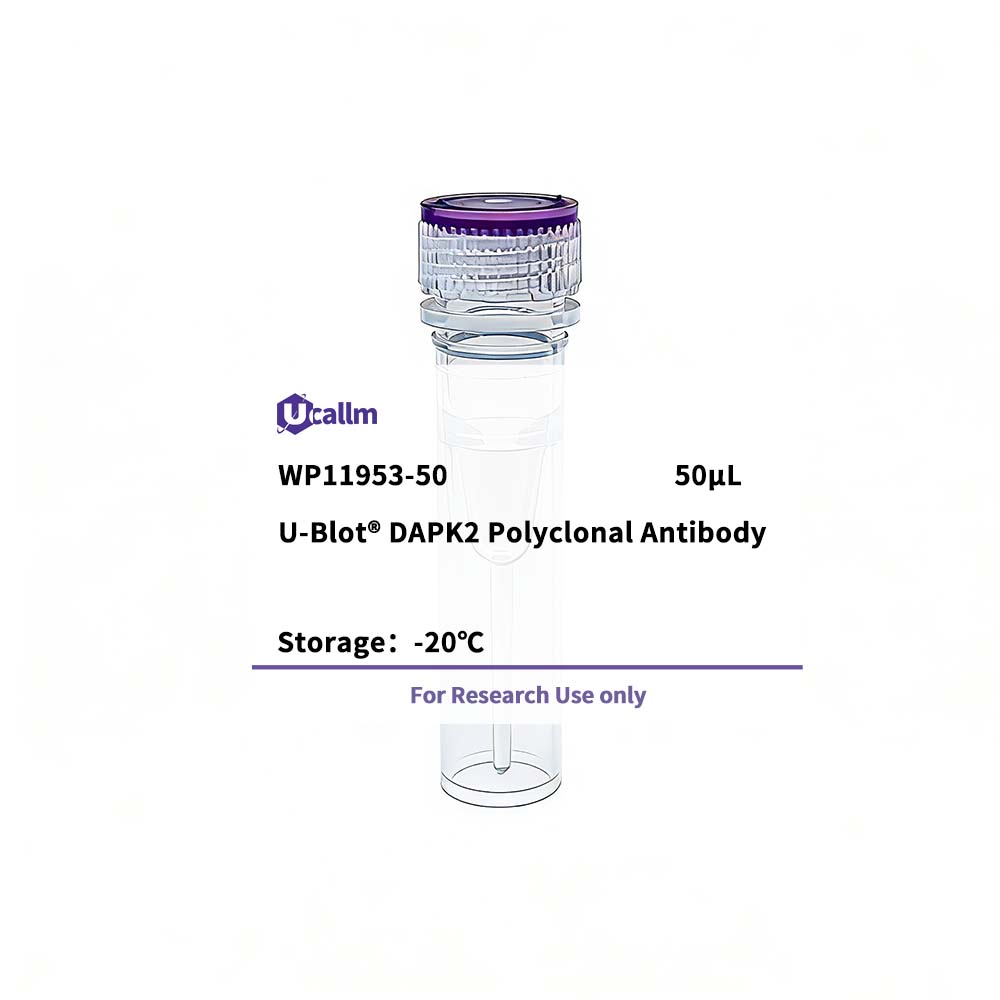
SKU: WP11953 Categories: ,

DAPK2 Polyclonal Antibody

Price range: $268.00 through $328.00

SKU: WP11953-100
Enter the quantity you would like, or drag the panel to find the quantity and price that best for you
Bulk QuoteAuthorize OEM & ODM

Product details

Background:

This gene encodes a protein that belongs to the serine/threonine protein kinase family. This protein contains a N-terminal protein kinase domain followed by a conserved calmodulin-binding domain with significant similarity to that of death-associated protein kinase 1 (DAPK1), a positive regulator of programmed cell death. Overexpression of this gene was shown to induce cell apoptosis. It uses multiple polyadenylation sites. [provided by RefSeq, Jul 2008],


Specifications

Size50μL/100μL
TargetDAPK2
ReactivityHuman, Mouse, Rat
ApplicationsIHC, IF, ELISA
MW(Calculated)43kD
MW(Observed)
Host SpeciesRabbit
IsotypeIgG
Conjugate/ModificationUnmodified
Recommended Dilution RatioIHC 1:100-1:300; ELISA 1:5000; IF 1:50-200 / Note: For IHC, we suggest antigen retrieval with TE buffer pH 9.0 (Cat#WT1004)
FormulationLiquid in PBS containing 50% glycerol, 0.5% BSA and 0.02% sodium azide.
PurificationThe antibody was affinity-purified from rabbit antiserum by affinity-chromatography using epitope-specific immunogen.
Storage-15°C to -25°C/1 year(Do not lower than -25°C)
Concentration1 mg/ml
ClonalityPolyclonal
Clone Number
ImmunogenThe antiserum was produced against synthesized peptide derived from human DAPK2. AA range:284-333
SpecificityDAPK2 Polyclonal Antibody detects endogenous levels of DAPK2 protein.
Gene NameDAPK2
Protein NameDeath-associated protein kinase 2
Other NameDAPK2; / Death-associated protein kinase 2; / DAP kinase 2; / DAP-kinase-related protein 1; / DRP-1
SpeciesHuman
Gene ID23604
UniprotQ9UIK4,
Species.1Mouse
Gene ID.113143
Uniprot.1Q8VDF3
Species.2
Gene ID.2
Uniprot.2
Cellular LocalizationCytoplasm. Cytoplasmic vesicle, autophagosome lumen.
Tissue ExpressionExpressed in neutrophils and eosinophils (PubMed:24163421). Isoform 2 is expressed in embryonic stem cells (at protein level). Isoform 1 is ubiquitously expressed in all tissue types examined with high levels in heart, lung and skeletal muscle.
Signaling_pathwayCellular Processes >> Transport and catabolism >> Autophagy - animal;Human Diseases >> Cancer: overview >> Pathways in cancer;Human Diseases >> Cancer: specific types >> Bladder cancer
Research Areas>>Autophagy - animal; / >>Pathways in cancer; / >>Bladder cancer
FunctionCatalytic activity:ATP + a protein = ADP + a phosphoprotein.,cofactor:Magnesium.,enzyme regulation:Negatively regulated by autophosphorylation on Ser-318.,Function:Calcium/calmodulin-dependent serine/threonine kinase which acts as a positive regulator of apoptosis.,similarity:Belongs to the protein kinase superfamily. CAMK Ser/Thr protein kinase family. DAP kinase subfamily.,similarity:Contains 1 protein kinase domain.,subunit:Homodimer. Homodimerization is required for apoptotic function and is inhibited by autophosphorylation at Ser-318.,tissue specificity:Ubiquitously expressed in all tissue types examined. High levels in heart, lung and skeletal muscle.,
Please login to post questions
Back to Top
Product has been added to your cart