

DDR2 Monoclonal Antibody
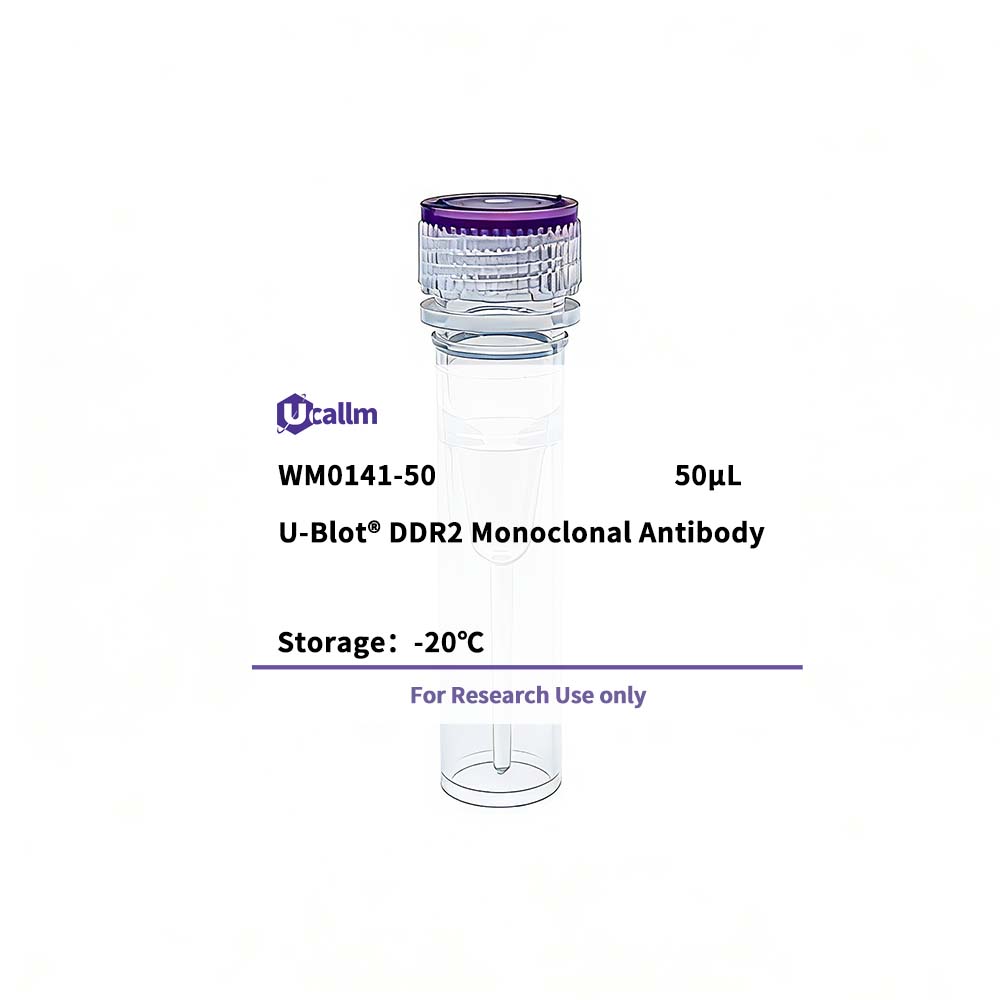
Ucallm_WM0141-50
Price range: $268.00 through $328.00
Product details
Background:
Receptor tyrosine kinases (RTKs) play a key role in the communication of cells with their microenvironment. These molecules are involved in the regulation of cell growth, differentiation, and metabolism. In several cases the biochemical mechanism by which RTKs transduce signals across the membrane has been shown to be ligand induced receptor oligomerization and subsequent intracellular phosphorylation. This autophosphorylation leads to phosphorylation of cytosolic targets as well as association with other molecules, which are involved in pleiotropic effects of signal transduction. RTKs have a tripartite structure with extracellular, transmembrane, and cytoplasmic regions. This gene encodes a member of a novel subclass of RTKs and contains a distinct extracellular region encompassing a factor VIII-like domain. Alternative splicing in the 5' UTR results in multiple transcr
Specifications
| Size | 50μL/100μL |
| Target | DDR2 |
| Reactivity | Human |
| Applications | WB, IHC, IF, ELISA |
| MW(Calculated) | 97kD |
| MW(Observed) | |
| Host Species | Mouse |
| Isotype | |
| Conjugate/Modification | Unmodified |
| Recommended Dilution Ratio | WB 1:500-1:2000; IHC 1:200-1:1000; IF 1:200-1:1000; ELISA 1:10000; Not yet tested in other applications. / Note: For IHC, we suggest antigen retrieval with TE buffer pH 9.0 (Cat#WT1004) |
| Formulation | Liquid in PBS containing 50% glycerol, 0.5% BSA and 0.02% sodium azide. |
| Purification | Affinity purification |
| Storage | -15°C to -25°C/1 year(Do not lower than -25°C) |
| Concentration | |
| Clonality | Monoclonal |
| Clone Number | 18E5 |
| Immunogen | Purified recombinant fragment of human DDR2 expressed in E. Coli. |
| Specificity | DDR2 Monoclonal Antibody detects endogenous levels of DDR2 protein. |
| Gene Name | DDR2 NTRKR3 TKT TYRO10 |
| Protein Name | Discoidin domain-containing receptor 2 |
| Other Name | DDR2; / NTRKR3; / TKT; / TYRO10; / Discoidin domain-containing receptor 2; / Discoidin domain receptor 2; / CD167 antigen-like family member B; / Discoidin domain-containing receptor tyrosine kinase 2; / Neurotrophic tyrosine kinase; / receptor-related 3; / Re |
| Species | Human |
| Gene ID | 4921 |
| Uniprot | Q16832 |
| Species.1 | |
| Gene ID.1 | |
| Uniprot.1 | |
| Species.2 | |
| Gene ID.2 | |
| Uniprot.2 | |
| Cellular Localization | Cell membrane; Single-pass type I membrane protein . |
| Tissue Expression | Detected in osteocytes, osteoblastic cells in subchondral bone, bone lining cells, tibia and cartilage (at protein level). Detected at high levels in heart and lung, and at low levels in brain, placenta, liver, skeletal muscle, pancreas, and kidney. |
| Signaling_pathway | |
| Research Areas | |
| Function | Catalytic activity:ATP + a [protein]-L-tyrosine = ADP + a [protein]-L-tyrosine phosphate.,Function:This tyrosine kinase receptor for fibrillar collagen mediates fibroblast migration and proliferation. Contributes to cutaneous wound healing.,similarity:Belongs to the protein kinase superfamily. Tyr protein kinase family. Insulin receptor subfamily.,similarity:Contains 1 F5/8 type C domain.,similarity:Contains 1 protein kinase domain.,tissue specificity:The major 10 kDa transcript is expressed in high levels in heart and lung, less in brain, placenta, liver, skeletal muscle, pancreas, and kidney., |
Please login to post questions
Related products





