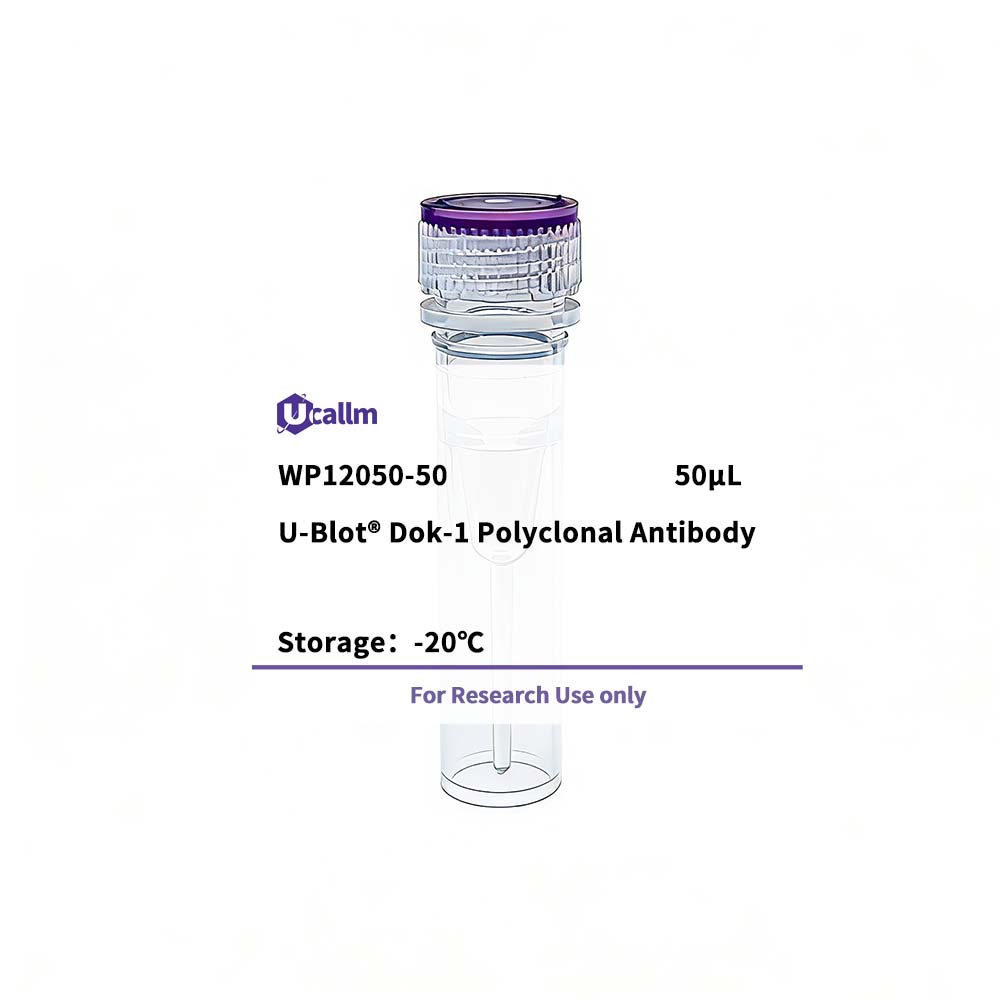
SKU: WP12050 Categories: ,

Dok-1 Polyclonal Antibody

Price range: $268.00 through $328.00

SKU: WP12050-100
Enter the quantity you would like, or drag the panel to find the quantity and price that best for you
Bulk QuoteAuthorize OEM & ODM

Product details

Background:

docking protein 1(DOK1) Homo sapiens The protein encoded by this gene is part of a signal transduction pathway downstream of receptor tyrosine kinases. The encoded protein is a scaffold protein that helps form a platform for the assembly of multiprotein signaling complexes. Several transcript variants encoding different isoforms have been found for this gene. [provided by RefSeq, Jan 2016],

Specifications

Size50μL/100μL
Targetp62 Dok
ReactivityHuman, Mouse, Rat
ApplicationsWB, IHC, IF, ELISA
MW(Calculated)
MW(Observed)52kD
Host SpeciesRabbit
IsotypeIgG
Conjugate/ModificationUnmodified
Recommended Dilution RatioWB 1:500-1:2000; IHC 1:100-1:300; IF 1:200-1:1000; ELISA 1:5000; Not yet tested in other applications. / Note: For IHC, we suggest antigen retrieval with TE buffer pH 9.0 (Cat#WT1004)
FormulationLiquid in PBS containing 50% glycerol, 0.5% BSA and 0.02% sodium azide.
PurificationThe antibody was affinity-purified from rabbit antiserum by affinity-chromatography using epitope-specific immunogen.
Storage-15°C to -25°C/1 year(Do not lower than -25°C)
Concentration1 mg/ml
ClonalityPolyclonal
Clone Number
ImmunogenThe antiserum was produced against synthesized peptide derived from human p62 Dok. AA range:329-378
SpecificityDok-1 Polyclonal Antibody detects endogenous levels of Dok-1 protein.
Gene NameDOK1
Protein NameDocking protein 1
Other NameDOK1; / Docking protein 1; / Downstream of tyrosine kinase 1; / p62; / dok; / pp62
SpeciesHuman
Gene ID1796
UniprotQ99704,
Species.1Mouse
Gene ID.113448
Uniprot.1P97465,
Species.2Rat
Gene ID.2312477
Uniprot.2Q4QQV2
Cellular Localization[Isoform 1]: Cytoplasm. Nucleus.; [Isoform 3]: Cytoplasm, perinuclear region.
Tissue ExpressionExpressed in pancreas, heart, leukocyte and spleen. Expressed in both resting and activated peripheral blood T-cells. Expressed in breast cancer.
Signaling_pathway
Research Areas
FunctionDomain:The PTB domain mediates receptor interaction.,Function:DOK proteins are enzymatically inert adaptor or scaffolding proteins. They provide a docking platform for the assembly of multimolecular signaling complexes. DOK1 appears to be a negative regulator of the insulin signaling pathway. Modulates integrin activation by competing with talin for the same binding site on ITGB3.,PTM:Constitutively tyrosine-phosphorylated.,PTM:Phosphorylated on tyrosine residues by the insulin receptor kinase. Results in the negative regulation of the insulin signaling pathway.,similarity:Belongs to the DOK family. Type A subfamily.,similarity:Contains 1 IRS-type PTB domain.,similarity:Contains 1 PH domain.,subunit:Interacts with ABL (By similarity). Interacts with RasGAP and INPP5D/SHIP1. Interacts directly with phosphorylated ITGB3.,tissue specificity:Expressed in pancreas, heart, leukocyte and spleen. Expressed in both resting and activated peripheral blood T-cells.,
Please login to post questions
Back to Top
Product has been added to your cart