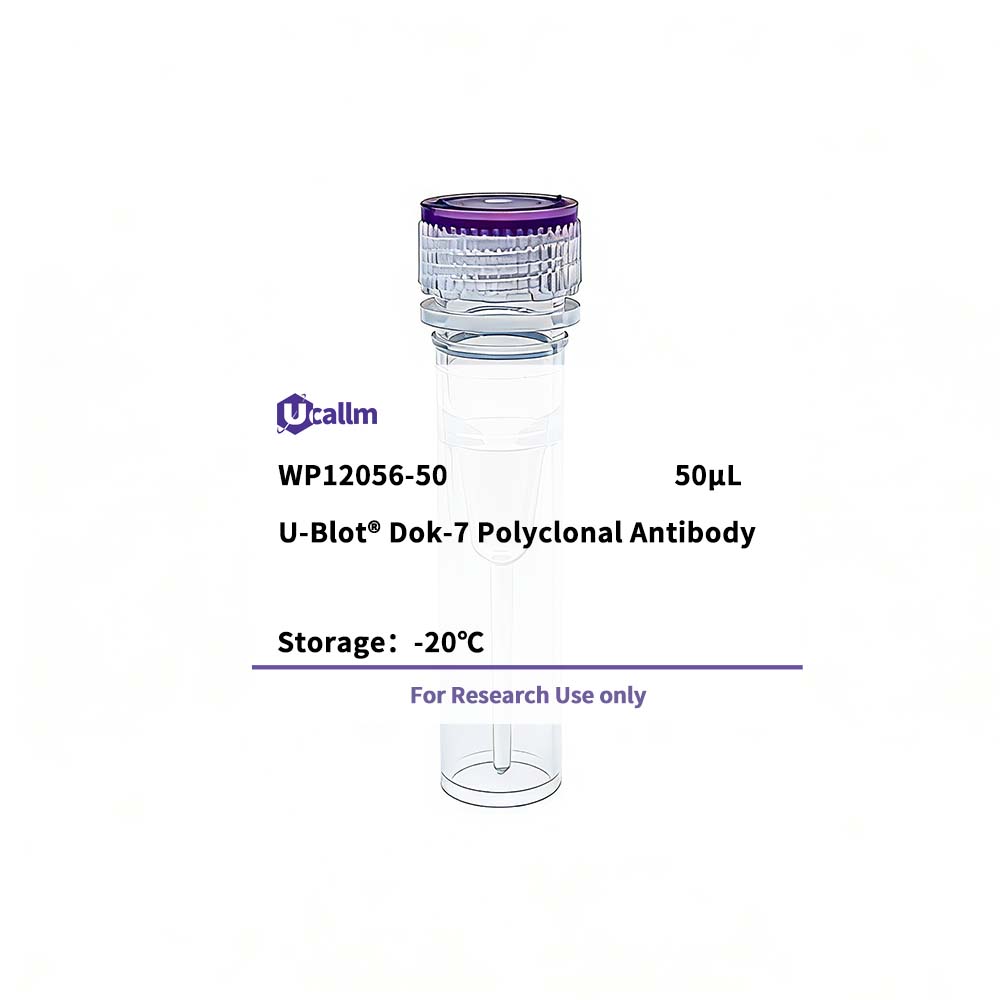
SKU: WP12056 Categories: ,

Dok-7 Polyclonal Antibody

Price range: $268.00 through $328.00

SKU: WP12056-100
Enter the quantity you would like, or drag the panel to find the quantity and price that best for you
Bulk QuoteAuthorize OEM & ODM

Product details

Background:

docking protein 7(DOK7) Homo sapiens The protein encoded by this gene is essential for neuromuscular synaptogenesis. The protein functions in aneural activation of muscle-specific receptor kinase, which is required for postsynaptic differentiation, and in the subsequent clustering of the acetylcholine receptor in myotubes. This protein can also induce autophosphorylation of muscle-specific receptor kinase. Mutations in this gene are a cause of familial limb-girdle myasthenia autosomal recessive, which is also known as congenital myasthenic syndrome type 1B. Alternative splicing results in multiple transcript variants. [provided by RefSeq, Sep 2009],

Specifications

Size50μL/100μL
TargetDok-7
ReactivityHuman, Mouse
ApplicationsWB, IHC, IF, ELISA
MW(Calculated)
MW(Observed)60kD
Host SpeciesRabbit
IsotypeIgG
Conjugate/ModificationUnmodified
Recommended Dilution RatioWB 1:500-1:2000; IHC 1:100-1:300; IF 1:200-1:1000; ELISA 1:20000; Not yet tested in other applications. / Note: For IHC, we suggest antigen retrieval with TE buffer pH 9.0 (Cat#WT1004)
FormulationLiquid in PBS containing 50% glycerol, 0.5% BSA and 0.02% sodium azide.
PurificationThe antibody was affinity-purified from rabbit antiserum by affinity-chromatography using epitope-specific immunogen.
Storage-15°C to -25°C/1 year(Do not lower than -25°C)
Concentration1 mg/ml
ClonalityPolyclonal
Clone Number
ImmunogenThe antiserum was produced against synthesized peptide derived from human DOK7. AA range:10-59
SpecificityDok-7 Polyclonal Antibody detects endogenous levels of Dok-7 protein.
Gene NameDOK7
Protein NameProtein Dok-7
Other NameDOK7; / C4orf25; / Protein Dok-7; / Downstream of tyrosine kinase 7
SpeciesHuman
Gene ID285489
UniprotQ18PE1,
Species.1Mouse
Gene ID.1231134
Uniprot.1Q18PE0
Species.2
Gene ID.2
Uniprot.2
Cellular LocalizationCell membrane; Peripheral membrane protein . Cell junction, synapse . Accumulates at neuromuscular junctions. .
Tissue ExpressionPreferentially expressed in skeletal muscle and heart. Present in thigh muscle, diaphragm and heart but not in the liver or spleen (at protein level).
Signaling_pathway
Research Areas
FunctionDisease:Defects in DOK7 are the cause of familial limb-girdle myasthenia autosomal recessive (LGM) [MIM:254300]; also called congenital myasthenic syndrome type 1B or CMS1B. LGM is a congenital myasthenic syndrome characterized by a typical 'limb girdle' pattern of muscle weakness with small, simplified neuromuscular junctions but normal acetylcholine receptor and acetylcholinesterase function.,Function:Probable muscle-intrinsic activator of MUSK that plays an essential role in neuromuscular synaptogenesis. Acts in aneural activation of MUSK and subsequent acetylcholine receptor (AchR) clustering in myotubes. Induces autophosphorylation of MUSK.,similarity:Contains 1 IRS-type PTB domain.,similarity:Contains 1 PH domain.,subcellular location:Accumulates at neuromuscular junctions.,subunit:Interacts with the cytoplasmic part of MUSK.,tissue specificity:Preferentiall eypressed in skeletal muscle and heart Present in thigh muscle, diaphragm and heart but not in the liver or spleen (at protein level).,
Please login to post questions
Back to Top
Product has been added to your cart



