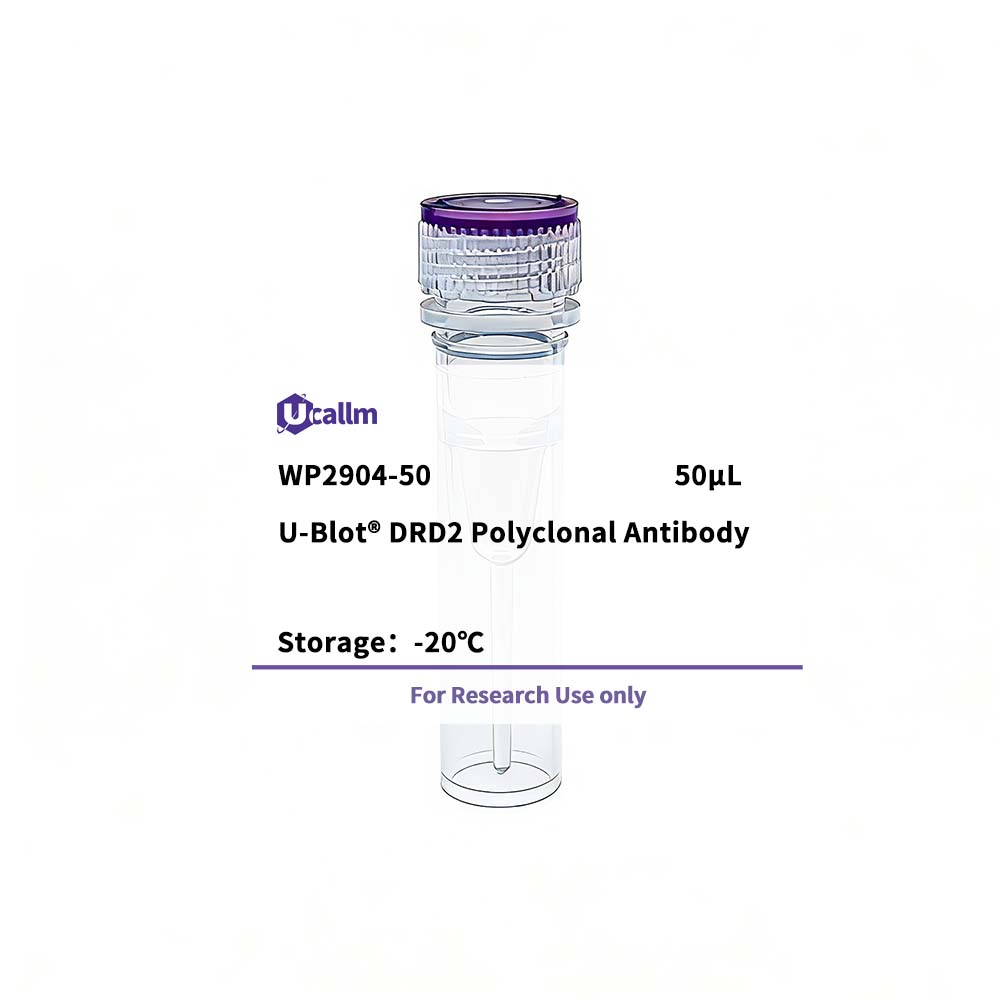
SKU: WP2904 Categories: ,

DRD2 Polyclonal Antibody

Price range: $268.00 through $328.00

SKU: WP2904-100
Enter the quantity you would like, or drag the panel to find the quantity and price that best for you
Bulk QuoteAuthorize OEM & ODM

Product details

Background:

This gene encodes the D2 subtype of the dopamine receptor. This G-protein coupled receptor inhibits adenylyl cyclase activity. A missense mutation in this gene causes myoclonus dystonia; other mutations have been associated with schizophrenia. Alternative splicing of this gene results in two transcript variants encoding different isoforms. A third variant has been described, but it has not been determined whether this form is normal or due to aberrant splicing. [provided by RefSeq, Jul 2008],

Specifications

Size50μL/100μL
TargetDRD2
ReactivityHuman, Rat
ApplicationsWB, ELISA
MW(Calculated)
MW(Observed)48kD
Host SpeciesRabbit
IsotypeIgG
Conjugate/ModificationUnmodified
Recommended Dilution RatioWB 1:500-2000; ELISA 1:5000-20000
FormulationLiquid in PBS containing 50% glycerol,0.5% BSA and 0.02% sodium azide.
PurificationThe antibody was affinity-purified from rabbit antiserum by affinity-chromatography using epitope-specific immunogen.
Storage-15°C to -25°C/1 year(Do not lower than -25°C)
Concentration1 mg/ml
ClonalityPolyclonal
Clone Number
ImmunogenSynthesized peptide derived from human protein . at AA range: 170-250
SpecificityDRD2 Polyclonal Antibody detects endogenous levels of protein.
Gene NameDRD2
Protein NameD(2) dopamine receptor (Dopamine D2 receptor)
Other Name
SpeciesHuman
Gene ID1813
UniprotP14416,
Species.1Mouse
Gene ID.1
Uniprot.1P61168,
Species.2Rat
Gene ID.2
Uniprot.2P61169
Cellular LocalizationCell membrane; Multi-pass membrane protein . Golgi apparatus membrane; Multi-pass membrane protein .
Tissue Expression[Isoform 1]: Expressed in the anterior pituitary gland.; [Isoform 2]: Expressed in the anterior pituitary gland.
Signaling_pathwayCellular Processes >> Cellular community - eukaryotes >> Gap junction;Organismal Systems >> Nervous system >> Dopaminergic synapse;Human Diseases >> Neurodegenerative disease >> Parkinson disease;Environmental Information Processing >> Signal transduction >> Rap1 signaling pathway;Environmental Information Processing >> Signal transduction >> cAMP signaling pathway
Research Areas>>Rap1 signaling pathway; / >>cAMP signaling pathway; / >>Neuroactive ligand-receptor interaction; / >>Gap junction; / >>Dopaminergic synapse; / >>Parkinson disease; / >>Cocaine addiction; / >>Alcoholism
FunctionDisease:Defects in DRD2 are associated with dystonia type 11 (DYT11) [MIM:159900]; also known as alcohol-responsive dystonia. DYT11 is a myoclonic dystonia. Dystonia is defined by the presence of sustained involuntary muscle contractions, often leading to abnormal postures. DYT11 is characterized by involuntary lightning jerks and dystonic movements and postures alleviated by alcohol. Inheritance is autosomal dominant. The age of onset, pattern of body involvement, presence of myoclonus and response to alcohol are all variable.,Disease:It has been suggested that DRD2 is involved in psychiatric disorders; especially in schizophrenia.,Function:This is one of the five types (D1 to D5) of receptors for dopamine. The activity of this receptor is mediated by G proteins which inhibit adenylyl cyclase.,polymorphism:Genetic variations in DRD2 may determine the genetic susceptibility to alcoholism [MIM:103780]. Genetic variations in DRD2 might be a protective factor against the development of withdrawal symptoms but might also be a risk factor in a highly burdened subgroup of alcoholics with a paternal and grandpaternal history of alcoholism and might contribute to suicide risk in alcoholics.,similarity:Belongs to the G-protein coupled receptor 1 family.,subunit:Interacts with GPRASP1, PPP1R9B and CLIC6 (By similarity). Interacts with CADPS and CADPS2.,
Please login to post questions
Back to Top
Product has been added to your cart


