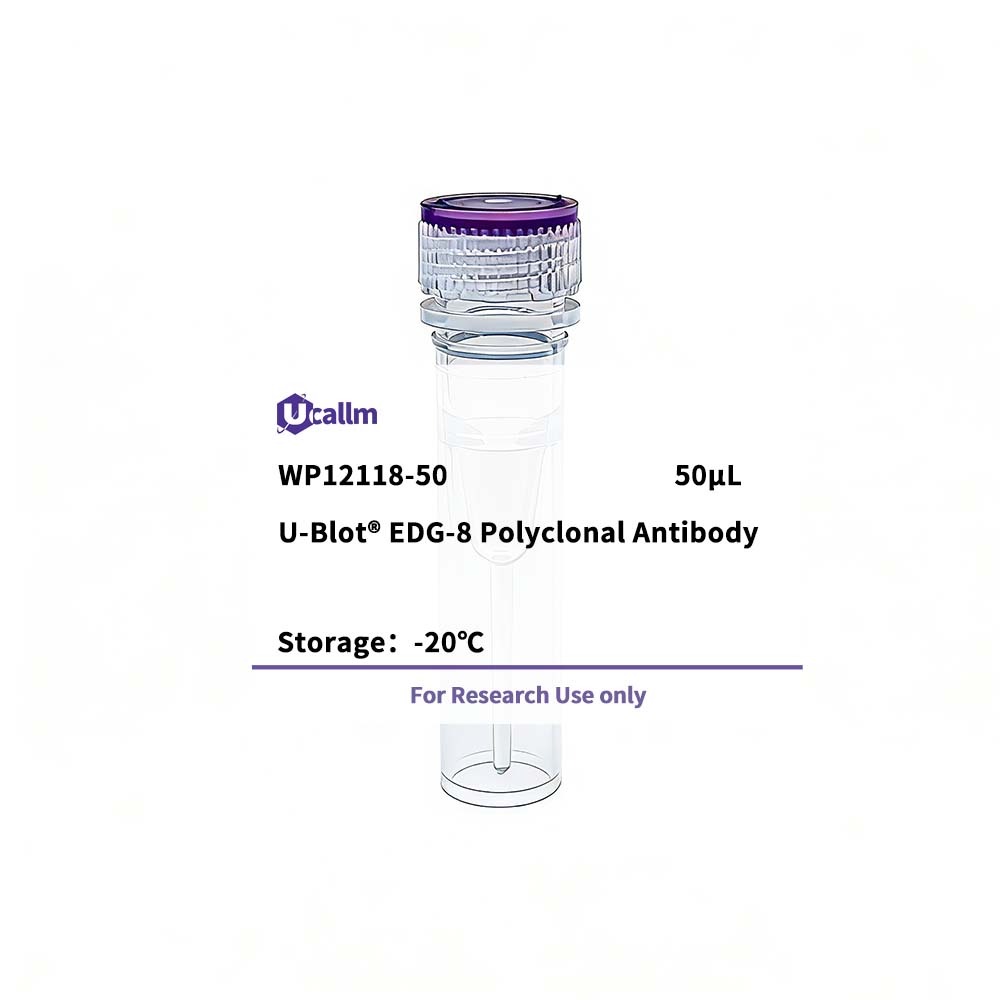
SKU: WP12118 Categories: ,

EDG-8 Polyclonal Antibody

Price range: $268.00 through $328.00

SKU: WP12118-100
Enter the quantity you would like, or drag the panel to find the quantity and price that best for you
Bulk QuoteAuthorize OEM & ODM

Product details

Background:

The lysosphingolipid sphingosine 1-phosphate (S1P) regulates cell proliferation, apoptosis, motility, and neurite retraction. Its actions may be both intracellular as a second messenger and extracellular as a receptor ligand. S1P and the structurally related lysolipid mediator lysophosphatidic acid (LPA) signal cells through a set of G protein-coupled receptors known as EDG receptors. Some EDG receptors (e.g., EDG1; MIM 601974) are S1P receptors; others (e.g., EDG2; MIM 602282) are LPA receptors.[supplied by OMIM, Mar 2008],


Specifications

Size50μL/100μL
TargetEDG-8
ReactivityHuman, Mouse, Rat
ApplicationsIHC, IF, ELISA
MW(Calculated)42kD
MW(Observed)
Host SpeciesRabbit
IsotypeIgG
Conjugate/ModificationUnmodified
Recommended Dilution RatioIHC 1:100-1:300; IF 1:200-1:1000; ELISA 1:5000; Not yet tested in other applications. / Note: For IHC, we suggest antigen retrieval with TE buffer pH 9.0 (Cat#WT1004)
FormulationLiquid in PBS containing 50% glycerol, 0.5% BSA and 0.02% sodium azide.
PurificationThe antibody was affinity-purified from rabbit antiserum by affinity-chromatography using epitope-specific immunogen.
Storage-15°C to -25°C/1 year(Do not lower than -25°C)
Concentration1 mg/ml
ClonalityPolyclonal
Clone Number
ImmunogenThe antiserum was produced against synthesized peptide derived from human EDG8. AA range:335-384
SpecificityEDG-8 Polyclonal Antibody detects endogenous levels of EDG-8 protein.
Gene NameS1PR5
Protein NameSphingosine 1-phosphate receptor 5
Other NameS1PR5; / EDG8; / Sphingosine 1-phosphate receptor 5; / S1P receptor 5; / S1P5; / Endothelial differentiation G-protein-coupled receptor 8; / Sphingosine 1-phosphate receptor Edg-8; / S1P receptor Edg-8
SpeciesHuman
Gene ID53637
UniprotQ9H228,
Species.1Mouse
Gene ID.1
Uniprot.1Q91X56
Species.2
Gene ID.2
Uniprot.2
Cellular LocalizationCell membrane; Multi-pass membrane protein.
Tissue ExpressionWidely expressed in the brain, most prominently in the corpus callosum, which is predominantly white matter. Detected in spleen, peripheral blood leukocytes, placenta, lung, aorta and fetal spleen. Low-level signal detected in many tissue extracts. Overexpressed in leukemic large granular lymphocytes. Isoform 1 is predominantly expressed in peripheral tissues. Isoform 2 is expressed in brain, spleen and peripheral blood leukocytes.
Signaling_pathwayEnvironmental Information Processing >> Signal transduction >> Sphingolipid signaling pathway
Research Areas>>Sphingolipid signaling pathway; / >>Neuroactive ligand-receptor interaction
Functiondevelopmental stage:At 24 weeks of gestation, fragments of radial glial fibers are positive within the cortical plate and subplate of allocortical areas. These positive fragments often appear enlarged as varicosities and some of them terminate at blood vessels. Between 28 and 30 weeks of gestation, all iso- and allocortical areas contain immunolabelled radial glial fibers revealing curvature next to sulci. After 32 weeks of gestation, radial glial fibers gradually disappear; instead positive transitional stages between radial glia and astrocytes were found.,Disease:Overexpressed in leukemic large granular lymphocyte (LGL). LGL is a lymphopropliferative disorder often associated with autoimmune disease.,Function:Receptor for the lysosphingolipid sphingosine 1-phosphate (S1P). S1P is a bioactive lysophospholipid that elicits diverse physiological effect on most types of cells and tissues. Is coupled to both the G(i/0)alpha and G(12) subclass of heteromeric G-proteins (By similarity). May play a regulatory role in the transformation of radial glial cells into astrocytes and may affect proliferative activity of these cells.,similarity:Belongs to the G-protein coupled receptor 1 family.,tissue specificity:Widely expressed in the brain, most prominently in the corpus callosum, which is predominantly white matter. Detected in spleen, peripheral blood leukocytes, placenta, lung, aorta, and fetal spleen. Low-level signal detected in many tissue extracts. Isoform 1 is predominently expressed in peripheral tissues, whereas isoform 2 is expressed in brain, spleen and peripheral blood leukocytes.,
Please login to post questions
Back to Top
Product has been added to your cart