SKU: WR4357 Categories: ,

U-Blot® eIF4E Rabbit mAb

Price range: $268.00 through $328.00

SKU: WR4357-50
Enter the quantity you would like, or drag the panel to find the quantity and price that best for you
Bulk QuoteAuthorize OEM & ODM

Product details

Background:The protein encoded by this gene is a component of the eukaryotic translation initiation factor 4F complex, which recognizes the 7-methylguanosine cap structure at the 5' end of messenger RNAs. The encoded protein aids in translation initiation by recruiting ribosomes to the 5'-cap structure. Association of this protein with the 4F complex is the rate-limiting step in translation initiation. This gene acts as a proto-oncogene, and its expression and activation is associated with transformation and tumorigenesis. Several pseudogenes of this gene are found on other chromosomes. Alternative splicing results in multiple transcript variants. [provided by RefSeq, Sep 2015],

Specifications

Size50μL/100μL
TargeteIF4E
ReactivityHuman, Mouse, Rat
ApplicationsWB, IHC, IF, IP, ELISA
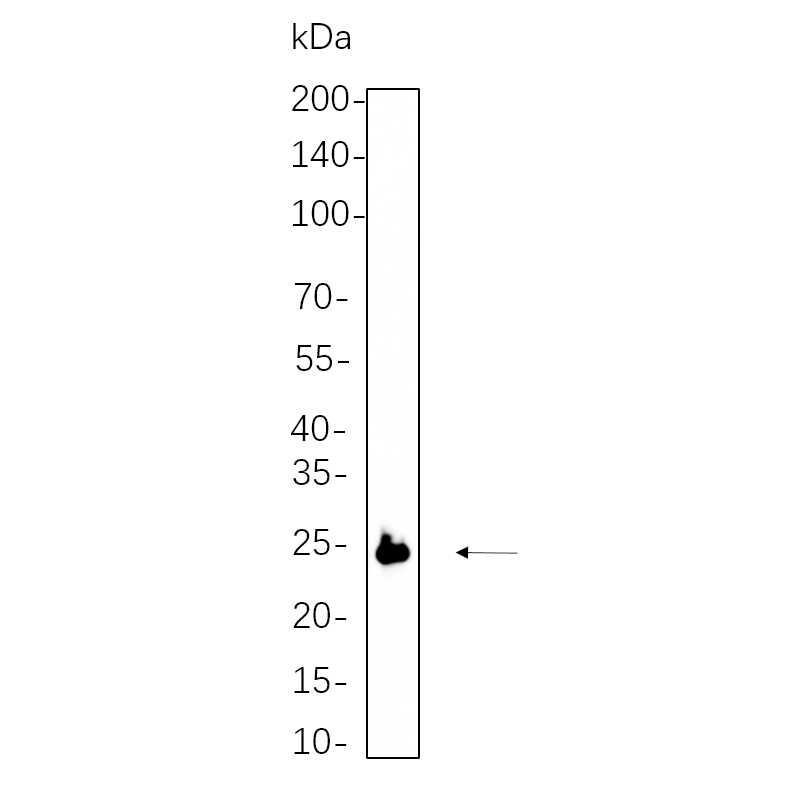
MW(Calculated)25kD
MW(Observed)25kD
Host SpeciesRabbit
IsotypeIgG,Kappa
Conjugate/ModificationUnmodified
Recommended Dilution RatioIHC 1:200-1:1000; WB 1:2000-1:10000; IF 1:200-1:1000; ELISA 1:5000-1:20000; IP 1:50-1:200; / Note: For IHC, we suggest antigen retrieval with TE buffer pH 9.0 (Cat#WT1004)
FormulationPBS, 50% glycerol, 0.05% Proclin 300, 0.05%BSA
PurificationRecombinant Antibody expressed in animal component-free (ACF) media, purified via Protein A affinity chromatography.
Storage-15°C to -25°C/1 year(Do not lower than -25°C)
Concentration
ClonalityMonoclonal
Clone NumberRM0569R
ImmunogenThe specific immunogen used to produce this antibody is proprietary information.
SpecificityEndogenous
Gene NameEIF4E
Protein NameEukaryotic translation initiation factor 4E
Other NameEIF4E; / EIF4EL1; / EIF4F; / Eukaryotic translation initiation factor 4E; / eIF-4E; / eIF4E; / eIF-4F 25 kDa subunit; / mRNA cap-binding protein
SpeciesHuman
Gene ID1977
UniprotP06730,
Species.1Mouse
Gene ID.113684
Uniprot.1P63073,
Species.2Rat
Gene ID.2117045
Uniprot.2P63074
Cellular LocalizationCytoplasm, Nucleus
Tissue ExpressionBrain,Fetal brain,Placenta,Pooled,Small intestine,Testis,
Signaling_pathwayOrganismal Systems >> Endocrine system >> Insulin signaling pathway;Organismal Systems >> Aging >> Longevity regulating pathway;Environmental Information Processing >> Signal transduction >> HIF-1 signaling pathway;Environmental Information Processing >> Signal transduction >> PI3K-Akt signaling pathway;Environmental Information Processing >> Signal transduction >> mTOR signaling pathway
Research Areas>>EGFR tyrosine kinase inhibitor resistance; / >>HIF-1 signaling pathway; / >>mTOR signaling pathway; / >>PI3K-Akt signaling pathway; / >>Longevity regulating pathway; / >>Insulin signaling pathway
FunctionCaution:Was originally thought to be phosphorylated on Ser-53 (PubMed:3112145); this was later shown to be wrong (PubMed:7665584).,Function:Recognizes and binds the 7-methylguanosine-containing mRNA cap during an early step in the initiation of protein synthesis and facilitates ribosome binding by inducing the unwinding of the mRNAs secondary structures.,PTM:Phosphorylation increases the ability of the protein to bind to mRNA caps and to form the eIF4F complex.,similarity:Belongs to the eukaryotic initiation factor 4E family.,subunit:eIF4F is a multi-subunit complex, the composition of which varies with external and internal environmental conditions. It is composed of at least EIF4A, EIF4E and EIF4G1/EIF4G3. EIF4E is also known to interact with other partners. The interaction with EIF4ENIF1 mediates the import into the nucleus. Nonphosphorylated EIF4EBP1, EIF4EBP2 and EIF4EBP3 compete with EIF4G1/EIF4G3 to interact with EIF4E; insulin stimulated MAP-kinase (MAPK1 and MAPK3) phosphorylation of EIF4EBP1 causes dissociation of the complex allowing EIF4G1/EIF4G3 to bind and consequent initiation of translation. Rapamycin can attenuate insulin stimulation, mediated by FKBPs. Interacts mutually exclusive with EIF4A1 and EIF4A2. Interacts with NGDN and PIWIL2 (By similarity). Interacts with Lassa virus Z protein.,
Please login to post questions

Back to Top
Product has been added to your cart
