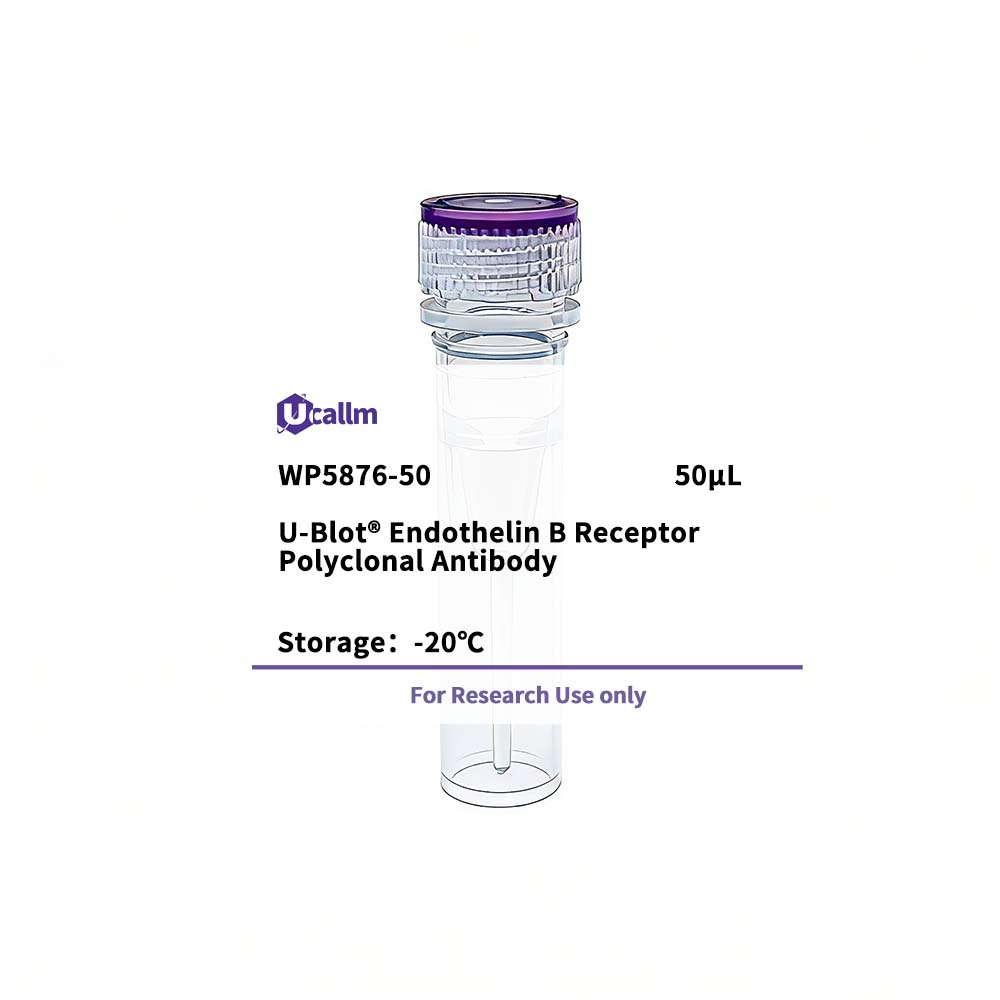
SKU: WP5876 Categories: ,

Endothelin B Receptor Polyclonal Antibody

Price range: $268.00 through $328.00

SKU: WP5876-100
Enter the quantity you would like, or drag the panel to find the quantity and price that best for you
Bulk QuoteAuthorize OEM & ODM

Product details

Background:

The protein encoded by this gene is a G protein-coupled receptor which activates a phosphatidylinositol-calcium second messenger system. Its ligand, endothelin, consists of a family of three potent vasoactive peptides: ET1, ET2, and ET3. Studies suggest that the multigenic disorder, Hirschsprung disease type 2, is due to mutations in the endothelin receptor type B gene. Alternative splicing and the use of alternative promoters results in multiple transcript variants. [provided by RefSeq, Oct 2016],

Specifications

Size50μL/100μL
TargetEndothelin B Receptor
ReactivityHuman, Mouse, Rat
ApplicationsIHC, IF
MW(Calculated)
MW(Observed)50kD
Host SpeciesRabbit
IsotypeIgG
Conjugate/ModificationUnmodified
Recommended Dilution RatioIHC 1:100-200; IF 1:50-200 / Note: For IHC, we suggest antigen retrieval with TE buffer pH 9.0 (Cat#WT1004)
FormulationLiquid in PBS containing 50% glycerol, 0.5% BSA and 0.02% sodium azide.
PurificationThe antibody was affinity-purified from rabbit antiserum by affinity-chromatography using epitope-specific immunogen.
Storage-15°C to -25°C/1 year(Do not lower than -25°C)
Concentration1 mg/ml
ClonalityPolyclonal
Clone Number
ImmunogenSynthetic Peptide of Endothelin B Receptor AA range: 270-350
SpecificityEndothelin B Receptor protein(A221) detects endogenous levels of Endothelin B Receptor
Gene NameEDNRB
Protein NameEndothelin B receptor (ET-B) (ET-BR) (Endothelin receptor non-selective type)
Other NameEndothelin B receptor; / ET-B; / ET-BR; / Endothelin receptor non-selective type
SpeciesHuman
Gene ID1910
UniprotP24530,
Species.1Mouse
Gene ID.113618
Uniprot.1P48302,
Species.2Rat
Gene ID.2
Uniprot.2P21451
Cellular LocalizationCell membrane; Multi-pass membrane protein. internalized after activation by endothelins. .
Tissue ExpressionExpressed in placental stem villi vessels, but not in cultured placental villi smooth muscle cells.
Signaling_pathwayOrganismal Systems >> Endocrine system >> Relaxin signaling pathway;Human Diseases >> Cancer: overview >> Pathways in cancer;Environmental Information Processing >> Signal transduction >> Calcium signaling pathway;Environmental Information Processing >> Signal transduction >> cGMP-PKG signaling pathway
Research Areas>>Calcium signaling pathway; / >>cGMP-PKG signaling pathway; / >>Neuroactive ligand-receptor interaction; / >>Melanogenesis; / >>Relaxin signaling pathway; / >>Pathways in cancer
FunctionDisease:Defects in EDNRB are a cause of Waardenburg syndrome type IV (WS4) [MIM:277580]; also known as Waardenburg-Shah syndrome. WS4 is characterized by the association of Waardenburg features (depigmentation and deafness) and the absence of enteric ganglia in the distal part of the intestine (Hirschsprung disease).,Disease:Defects in EDNRB are the cause of ABCD syndrome (ABCDS) [MIM:600501]. ABCD syndrome is an autosomal recessive syndrome characterized by albinism, black lock at temporal occipital region, bilateral deafness, aganglionosis of the large intestine and total absence of neurocytes and nerve fibers in the small intestine.,Disease:Defects in EDNRB are the cause of Hirschsprung disease type 2 (HSCR2) [MIM:600155]; also known as aganglionic megacolon (MGC). It is a congenital disorder characterized by absence of enteric ganglia along a variable length of the intestine. It is the most common cause of congenital intestinal obstruction. Early symptoms range from complete acute neonatal obstruction, characterized by vomiting, abdominal distention and failure to pass stool, to chronic constipation in the older child.,Function:Non-specific receptor for endothelin 1, 2, and 3. Mediates its action by association with G proteins that activate a phosphatidylinositol-calcium second messenger system.,PTM:Palmitoylation of Cys-402 was confirmed by the palmitoylation of Cys-402 in a deletion mutant lacking both Cys-403 and Cys-405.,similarity:Belongs to the G-protein coupled receptor 1 family.,tissue specificity:Expressed in placental stem villi vessels, but not in cultured placental villi smooth muscle cells.,
Please login to post questions
Back to Top
Product has been added to your cart

