

EphB1 Polyclonal Antibody
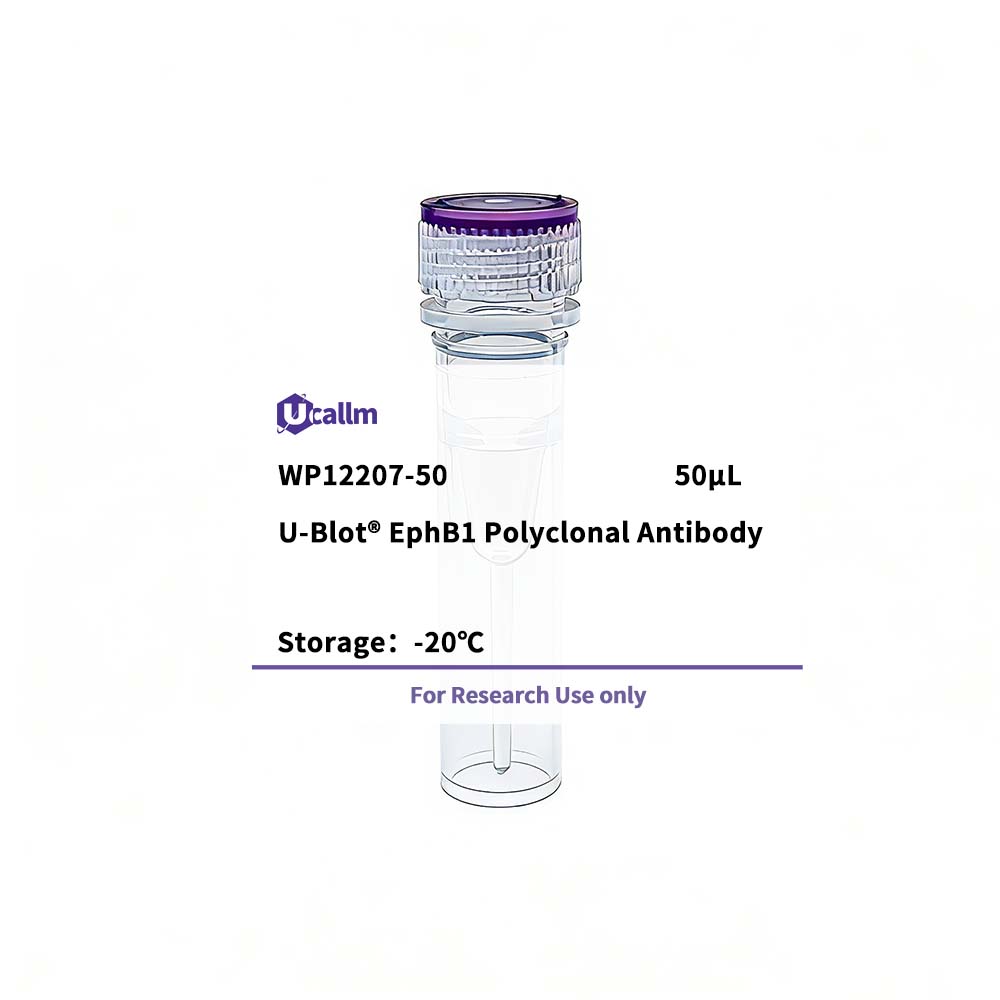
Ucallm_WP12207-50
Price range: $268.00 through $328.00
Product details
Background:
Ephrin receptors and their ligands, the ephrins, mediate numerous developmental processes, particularly in the nervous system. Based on their structures and sequence relationships, ephrins are divided into the ephrin-A (EFNA) class, which are anchored to the membrane by a glycosylphosphatidylinositol linkage, and the ephrin-B (EFNB) class, which are transmembrane proteins. The Eph family of receptors are divided into 2 groups based on the similarity of their extracellular domain sequences and their affinities for binding ephrin-A and ephrin-B ligands. Ephrin receptors make up the largest subgroup of the receptor tyrosine kinase (RTK) family. The protein encoded by this gene is a receptor for ephrin-B family members. [provided by RefSeq, Jul 2008],
Specifications
| Size | 50μL/100μL |
| Target | EphB1 |
| Reactivity | Human, Mouse, Rat, Monkey |
| Applications | WB, ELISA |
| MW(Calculated) | |
| MW(Observed) | 120kD |
| Host Species | Rabbit |
| Isotype | IgG |
| Conjugate/Modification | Unmodified |
| Recommended Dilution Ratio | WB 1:500-1:2000; ELISA 1:20000; Not yet tested in other applications. |
| Formulation | Liquid in PBS containing 50% glycerol, 0.5% BSA and 0.02% sodium azide. |
| Purification | The antibody was affinity-purified from rabbit antiserum by affinity-chromatography using epitope-specific immunogen. |
| Storage | -15°C to -25°C/1 year(Do not lower than -25°C) |
| Concentration | 1 mg/ml |
| Clonality | Polyclonal |
| Clone Number | |
| Immunogen | The antiserum was produced against synthesized peptide derived from human EPHB1. AA range:841-890 |
| Specificity | EphB1 Polyclonal Antibody detects endogenous levels of EphB1 protein. |
| Gene Name | EPHB1 |
| Protein Name | Ephrin type-B receptor 1 |
| Other Name | EPHB1; / ELK; / EPHT2; / HEK6; / NET; / Ephrin type-B receptor 1; / ELK; / EPH tyrosine kinase 2; / EPH-like kinase 6; / EK6; / hEK6; / Neuronally-expressed EPH-related tyrosine kinase; / NET; / Tyrosine-protein kinase receptor EPH-2 |
| Species | Human |
| Gene ID | 2047 |
| Uniprot | P54762, |
| Species.1 | Mouse |
| Gene ID.1 | 270190 |
| Uniprot.1 | Q8CBF3, |
| Species.2 | Rat |
| Gene ID.2 | 24338 |
| Uniprot.2 | P09759 |
| Cellular Localization | Cell membrane; Single-pass type I membrane protein . Early endosome membrane . Cell projection, dendrite . |
| Tissue Expression | Preferentially expressed in brain. |
| Signaling_pathway | |
| Research Areas | >>Axon guidance |
| Function | Catalytic activity:ATP + a [protein]-L-tyrosine = ADP + a [protein]-L-tyrosine phosphate.,Function:Receptor for members of the ephrin-B family. Binds to ephrin-B1, -B2 and -B3. May be involved in cell-cell interactions in the nervous system.,similarity:Belongs to the protein kinase superfamily. Tyr protein kinase family. Ephrin receptor subfamily.,similarity:Contains 1 protein kinase domain.,similarity:Contains 1 SAM (sterile alpha motif) domain.,similarity:Contains 2 fibronectin type-III domains.,subunit:The ligand-activated form interacts with GRB2, GRB10 and NCK through their respective SH2 domains. The GRB10 SH2 domain binds EPHB1 through Tyr-928, while GRB2 binds residues within the catalytic domain. Interacts with EPHB6. The NCK SH2 domain binds EPHB1 through Tyr-594. Interacts with PRKCABP.,tissue specificity:Preferentially expressed in brain., |
Please login to post questions
Related products





