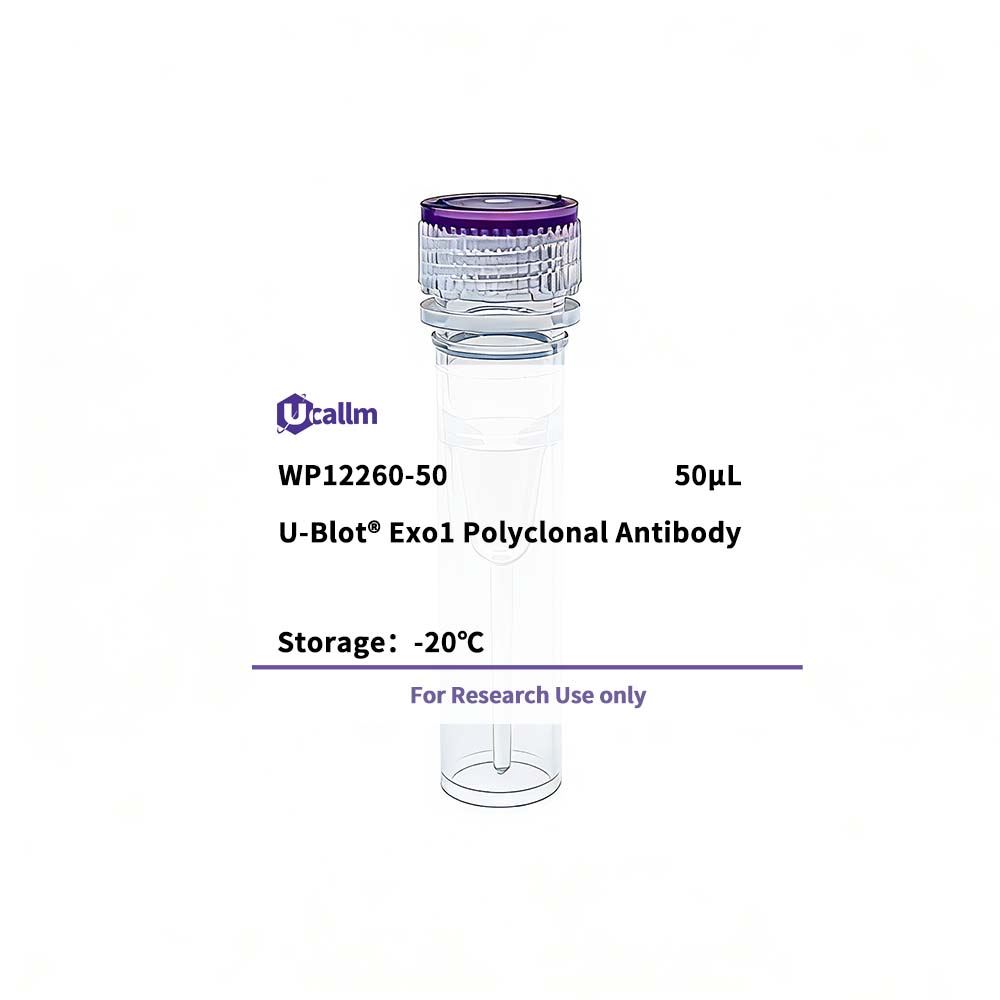
SKU: WP12260 Categories: ,

Exo1 Polyclonal Antibody

Price range: $268.00 through $328.00

SKU: WP12260-100
Enter the quantity you would like, or drag the panel to find the quantity and price that best for you
Bulk QuoteAuthorize OEM & ODM

Product details

Background:

This gene encodes a protein with 5' to 3' exonuclease activity as well as an RNase H activity. It is similar to the Saccharomyces cerevisiae protein Exo1 which interacts with Msh2 and which is involved in mismatch repair and recombination. Alternative splicing of this gene results in three transcript variants encoding two different isoforms. [provided by RefSeq, Jul 2008],

Specifications

Size50μL/100μL
TargetExo1
ReactivityHuman, Mouse
ApplicationsWB, IF, ELISA
MW(Calculated)
MW(Observed)94kD
Host SpeciesRabbit
IsotypeIgG
Conjugate/ModificationUnmodified
Recommended Dilution RatioWB 1:500-1:2000; IF 1:200-1:1000; ELISA 1:10000; Not yet tested in other applications.
FormulationLiquid in PBS containing 50% glycerol, 0.5% BSA and 0.02% sodium azide.
PurificationThe antibody was affinity-purified from rabbit antiserum by affinity-chromatography using epitope-specific immunogen.
Storage-15°C to -25°C/1 year(Do not lower than -25°C)
Concentration1 mg/ml
ClonalityPolyclonal
Clone Number
ImmunogenThe antiserum was produced against synthesized peptide derived from human EXO1. AA range:61-110
SpecificityExo1 Polyclonal Antibody detects endogenous levels of Exo1 protein.
Gene NameEXO1
Protein NameExonuclease 1
Other NameEXO1; / EXOI; / HEX1; / Exonuclease 1; / hExo1; / Exonuclease I; / hExoI
SpeciesHuman
Gene ID9156
UniprotQ9UQ84,
Species.1Mouse
Gene ID.126909
Uniprot.1Q9QZ11
Species.2
Gene ID.2
Uniprot.2
Cellular LocalizationNucleus . Colocalizes with PCNA to discrete nuclear foci in S-phase.
Tissue ExpressionHighly expressed in bone marrow, testis and thymus. Expressed at lower levels in colon, lymph nodes, ovary, placenta, prostate, small intestine, spleen and stomach.
Signaling_pathway
Research Areas>>Mismatch repair
Functioncofactor:Binds 2 magnesium ions per subunit. They probably participate in the reaction catalyzed by the enzyme. May bind an additional third magnesium ion after substrate binding.,developmental stage:Highly expressed in fetal liver and at lower levels in fetal brain, heart, kidney, spleen and thymus.,Function:5'->3' double-stranded DNA exonuclease which may also possess a cryptic 3'->5' double-stranded DNA exonuclease activity. Functions in DNA mismatch repair (MMR) to excise mismatch-containing DNA tracts directed by strand breaks located either 5' or 3' to the mismatch. Also exhibits endonuclease activity against 5'-overhanging flap structures similar to those generated by displacement synthesis when DNA polymerase encounters the 5'-end of a downstream Okazaki fragment. Required for somatic hypermutation (SHM) and class switch recombination (CSR) of immunoglobulin genes. Essential for male and female meiosis.,polymorphism:Most naturally occurring variants in this protein are not associated with familial disposition to hereditary non-polyposis colorectal cancer (HNPCC). Furthermore, germline deletions involving this locus are not associated with clinically manifested colorectal tumors.,PTM:Phosphorylated upon DNA damage, probably by ATM or ATR.,similarity:Belongs to the XPG/RAD2 endonuclease family. EXO1 subfamily.,subcellular location:Colocalizes with PCNA to discrete nuclear foci in S-phase.,subunit:Interacts with the MLH1-PMS2 heterodimer via MLH1. Interacts with MSH3. Interacts with the MSH2-MSH6 heterodimer via MSH2, and this interaction may increase the processivity of the 5'->3' exonuclease activity. Interacts with PCNA, and this interaction may both stimulate the cryptic 3'->5' exonuclease activity and suppress the 5'->3' exonuclease activity. Interacts with WRN, and this interaction stimulates both the 5'->3' exonuclease activity and cleavage of 5'-overhanging flap structures. Interacts with RECQL/RECQ1, and this interaction stimulates cleavage of 5'-overhanging flap structures.,tissue specificity:Highly expressed in bone marrow, testis and thymus. Expressed at lower levels in colon, lymph nodes, ovary, placenta, prostate, small intestine, spleen and stomach.,
Please login to post questions
Back to Top
Product has been added to your cart
