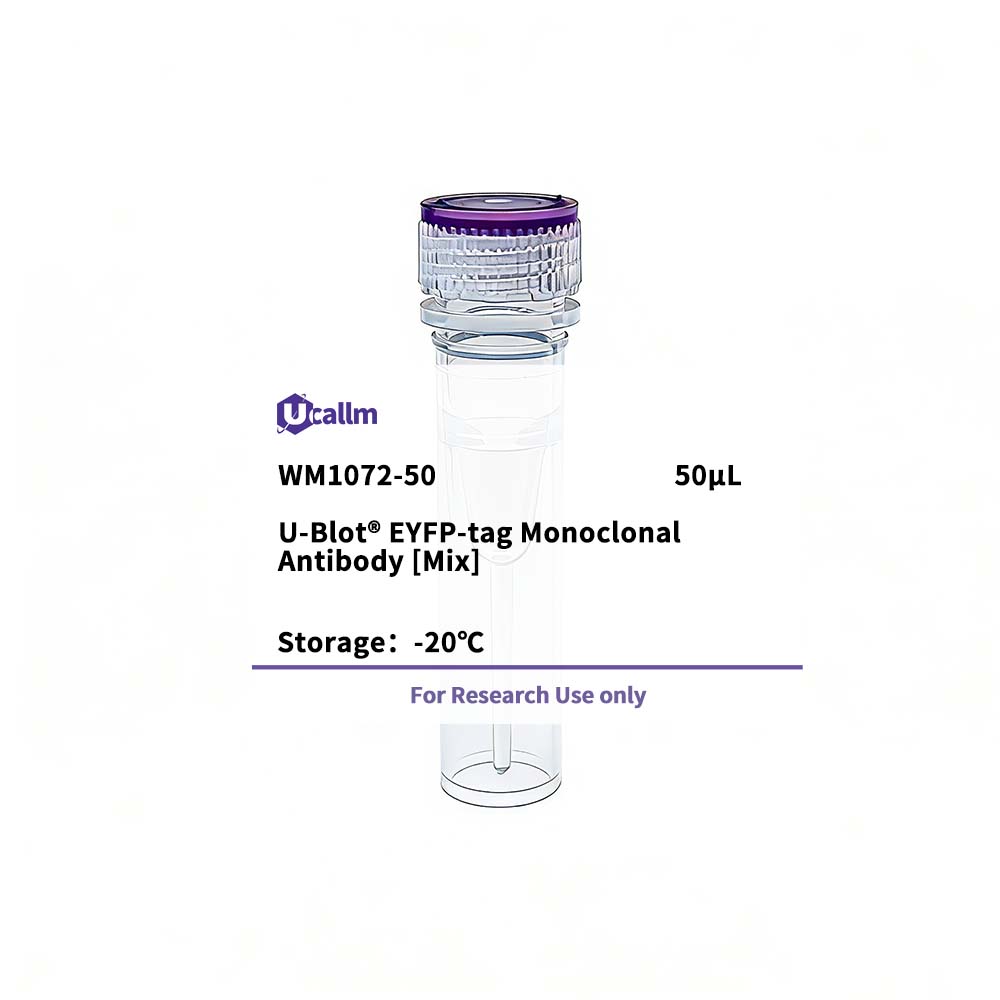
SKU: WM1072 Categories: ,

EYFP-tag Monoclonal Antibody [Mix]

Price range: $268.00 through $328.00

SKU: WM1072-50
Enter the quantity you would like, or drag the panel to find the quantity and price that best for you
Bulk QuoteAuthorize OEM & ODM

Product details

Background:
Enhanced Yellow florescent protein.Yellow Fluorescent Protein (YFP) is a genetic mutant of green fluorescent protein, derived from Aequorea victoria. Its excitation peak is 514nm and its emission peak is 527nm. Like green fluorescent protein (GFP), it is a useful tool in cell and molecular biology, usually explored using fluorescence microscopy. Three improved versions of YFP are Citrine, Venus, and Ypet. They have reduced chloride sensitivity, faster maturation, and increased brightness (product of the extinction coefficient and quantum yield). Typically, yellow FPs serve as the acceptor for genetically-encoded FRET sensors of which the most likely donor FP is mCFP (monomeric cyan FP). The red-shift relative to GFP is caused by a Pi-Pi stacking interaction as a result of the T203Y mutation, which essentially increases the polarizability of the local chromophore environment as well as providing additional electron density into the chromophore.

Specifications

Size50μL/100μL
TargetEYFP
ReactivitySpecies independent
ApplicationsWB, IF
MW(Calculated)
MW(Observed)
Host SpeciesMouse
Isotype
Conjugate/ModificationUnmodified
Recommended Dilution RatioWB 1:5000; IF 1:300-500
FormulationPBS, pH 7.4, containing 0.5%BSA, 0.02% sodium azide as Preservative and 50% Glycerol.
PurificationThe antibody was affinity-purified from mouse ascites by affinity-chromatography using specific immunogen.
Storage-15°C to -25°C/1 year(Do not lower than -25°C)
Concentration
ClonalityMonoclonal
Clone Number7C4
ImmunogenRecombinant Protein of EYFP
SpecificityThe antibody detects EYFP YFP CFP morange tag fusion proteins. It is also reactive against GFP tag weakly
Gene Name
Protein Name
Other Name
Species
Gene ID
Uniprot
Species.1
Gene ID.1
Uniprot.1
Species.2
Gene ID.2
Uniprot.2
Cellular Localization
Tissue Expression
Signaling_pathway
Research Areas
Function
Please login to post questions
Back to Top
Product has been added to your cart
