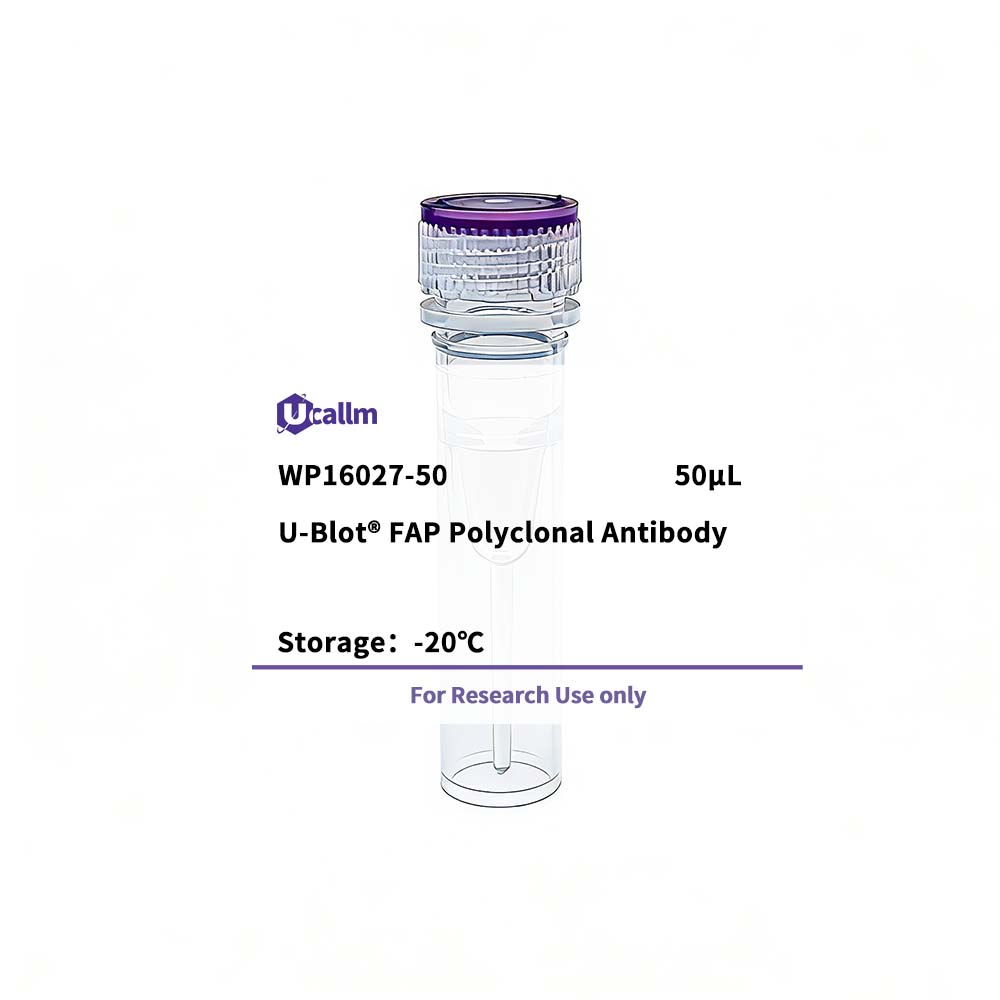
SKU: WP16027 Categories: ,

FAP Polyclonal Antibody

Price range: $268.00 through $328.00

SKU: WP16027-100
Enter the quantity you would like, or drag the panel to find the quantity and price that best for you
Bulk QuoteAuthorize OEM & ODM

Product details

Background:

The protein encoded by this gene is a homodimeric integral membrane gelatinase belonging to the serine protease family. It is selectively expressed in reactive stromal fibroblasts of epithelial cancers, granulation tissue of healing wounds, and malignant cells of bone and soft tissue sarcomas. This protein is thought to be involved in the control of fibroblast growth or epithelial-mesenchymal interactions during development, tissue repair, and epithelial carcinogenesis. Alternatively spliced transcript variants encoding different isoforms have been found for this gene. [provided by RefSeq, Apr 2014],

Specifications

Size50μL/100μL
TargetFAP
ReactivityHuman, Mouse, Rat
ApplicationsWB, ELISA
MW(Calculated)
MW(Observed)90kD
Host SpeciesRabbit
IsotypeIgG
Conjugate/ModificationUnmodified
Recommended Dilution RatioWB 1:500-2000; ELISA 1:10000-20000
FormulationLiquid in PBS containing 50% glycerol, 0.5% BSA and 0.02% sodium azide.
PurificationThe antibody was affinity-purified from rabbit antiserum by affinity-chromatography using epitope-specific immunogen.
Storage-15°C to -25°C/1 year(Do not lower than -25°C)
Concentration1 mg/ml
ClonalityPolyclonal
Clone Number
ImmunogenSynthesized peptide derived from human FAP-1 Polyclonal
SpecificityThis antibody detects endogenous levels of FAP-1.
Gene NameFAP
Protein NameSeprase (170 kDa melanoma membrane-bound gelatinase) (Fibroblast activation protein alpha) (Integral membrane serine protease)
Other NameSeprase; / 170 kDa melanoma membrane-bound gelatinase; / Fibroblast activation protein alpha; / Integral membrane serine protease
SpeciesHuman
Gene ID2191
UniprotQ12884,
Species.1Mouse
Gene ID.114089
Uniprot.1P97321
Species.2
Gene ID.2
Uniprot.2
Cellular Localization[Prolyl endopeptidase FAP]: Cell surface . Cell membrane; Single-pass type II membrane protein . Cell projection, lamellipodium membrane; Single-pass type II membrane protein . Cell projection, invadopodium membrane; Single-pass type II membrane protein . Cell projection, ruffle membrane; Single-pass type II membrane protein . Membrane; Single-pass type II membrane protein . Localized on cell surface with lamellipodia and invadopodia membranes and on shed vesicles. Colocalized with DPP4 at invadopodia and lamellipodia membranes of migratory activated endothelial cells in collagenous matrix. Colocalized with DPP4 on endothelial cells of capillary-like microvessels but not large vessels within invasive breast ductal carcinoma. Anchored and enriched preferentially by integrin alpha-3/beta-1 at invadopodia, plasma membrane protrusions that correspond to sites of cell invasion, in a collagen-dependent manner. Localized at plasma and ruffle membranes in a collagen-independent manner. Colocalized with PLAUR preferentially at the cell surface of invadopodia membranes in a cytoskeleton-, integrin- and vitronectin-dependent manner. Concentrated at invadopodia membranes, specialized protrusions of the ventral plasma membrane in a fibrobectin-dependent manner. Colocalizes with extracellular components (ECM), such as collagen fibers and fibronectin. .; [Antiplasmin-cleaving enzyme FAP, soluble form]: Secreted . Found in blood plasma and serum. .; [Isoform 2]: Cytoplasm .
Tissue ExpressionExpressed in adipose tissue. Expressed in the dermal fibroblasts in the fetal skin. Expressed in the granulation tissue of healing wounds and on reactive stromal fibroblast in epithelial cancers. Expressed in activated fibroblast-like synoviocytes from inflamed synovial tissues. Expressed in activated hepatic stellate cells (HSC) and myofibroblasts from cirrhotic liver, but not detected in normal liver. Expressed in glioma cells (at protein level). Expressed in glioblastomas and glioma cells. Isoform 1 and isoform 2 are expressed in melanoma, carcinoma and fibroblast cell lines.
Signaling_pathway
Research Areas
FunctionCatalytic activity:Degrades gelatin and heat-denatured type I and type IV collagen, but not native type I or type IV collagen. Does not cleave laminin, fibronectin, fibrin or casein.,Function:May have a role in tissue remodeling during development and wound healing, and may contribute to invasiveness in malignant cancers.,induction:In fibroblasts at times and sites of tissue remodeling during development, tissue repair, and carcinogenesis.,PTM:N-glycosylated.,PTM:The N-terminus may be blocked.,similarity:Belongs to the peptidase S9B family.,subcellular location:Found in cell surface lamellipodia, invadopodia and on shed vesicles.,subunit:Homodimer, or heterodimer with DPP4. The monomer is inactive.,tissue specificity:Fibroblast specific.,
Please login to post questions
Back to Top
Product has been added to your cart


