

Product details
Background:
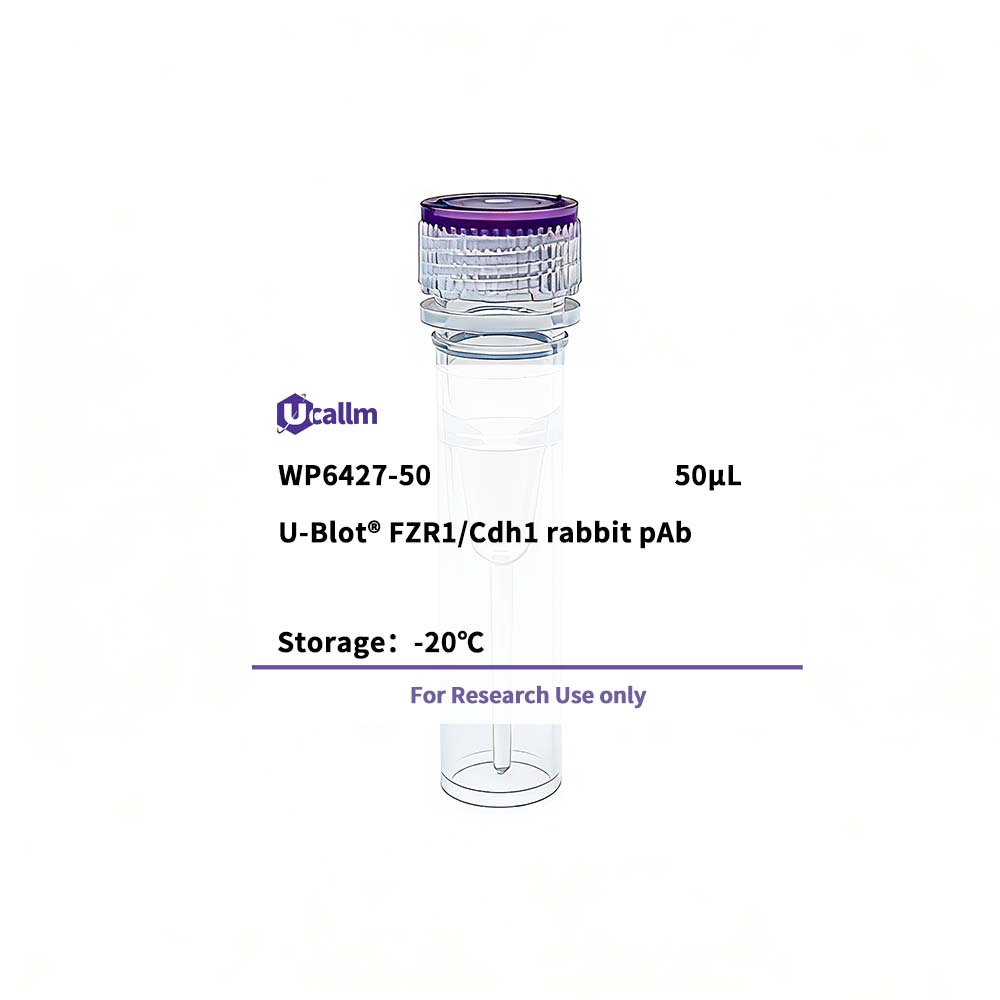
Price range: $268.00 through $328.00
Background:
| Size | 50μL/100μL |
| Target | FZR1 |
| Reactivity | Human, Mouse |
| Applications | WB |
| MW(Calculated) | 55kD |
| MW(Observed) | |
| Host Species | Rabbit |
| Isotype | IgG |
| Conjugate/Modification | Unmodified |
| Recommended Dilution Ratio | WB 1:500-2000 |
| Formulation | Liquid in PBS containing 50% glycerol, 0.5% BSA and 0.02% sodium azide. |
| Purification | The antibody was affinity-purified from rabbit antiserum by affinity-chromatography using epitope-specific immunogen. |
| Storage | -15°C to -25°C/1 year(Do not lower than -25°C) |
| Concentration | 1 mg/ml |
| Clonality | Polyclonal |
| Clone Number | |
| Immunogen | Synthesized peptide derived from human FZR1/Cdh1 |
| Specificity | This antibody detects endogenous levels of FZR1/Cdh1 at Human, Mouse |
| Gene Name | FZR1 CDH1 FYR FZR KIAA1242 |
| Protein Name | Fizzy-related protein homolog (Fzr) (CDC20-like protein 1) (Cdh1/Hct1 homolog) (hCDH1) |
| Other Name | |
| Species | Human |
| Gene ID | 51343 |
| Uniprot | Q9UM11, |
| Species.1 | Mouse |
| Gene ID.1 | 56371 |
| Uniprot.1 | Q9R1K5 |
| Species.2 | |
| Gene ID.2 | |
| Uniprot.2 | |
| Cellular Localization | [Isoform 2]: Nucleus.; [Isoform 3]: Cytoplasm. |
| Tissue Expression | Isoform 2 is expressed at high levels in heart, liver, spleen and some cancer cell lines whereas isoform 3 is expressed only at low levels in these tissues. |
| Signaling_pathway | Cellular Processes >> Cell growth and death >> Cell cycle |
| Research Areas | |
| Function | Substrate-specific adapter for the anaphase promoting complex/cyclosome (APC/C) E3 ubiquitin-protein ligase complex. Associates with the APC/C in late mitosis, in replacement of CDC20, and activates the APC/C during anaphase and telophase. The APC/C remains active in degrading substrates to ensure that positive regulators of the cell cycle do not accumulate prematurely. At the G1/S transition FZR1 is phosphorylated, leading to its dissociation from the APC/C. Following DNA damage, it is required for the G2 DNA damage checkpoint: its dephosphorylation and reassociation with the APC/C leads to the ubiquitination of PLK1, preventing entry into mitosis. Acts as an adapter for APC/C to target the DNA-end resection factor RBBP8/CtIP for ubiquitination and subsequent proteasomal degradation. Through the regulation of RBBP8/CtIP protein turnover, may play a role in DNA damage response, favoring DNA double-strand repair through error-prone non-homologous end joining (NHEJ) over error-free, RBBP8-mediated homologous recombination (HR) . |



