SKU: WP4675 Categories: ,

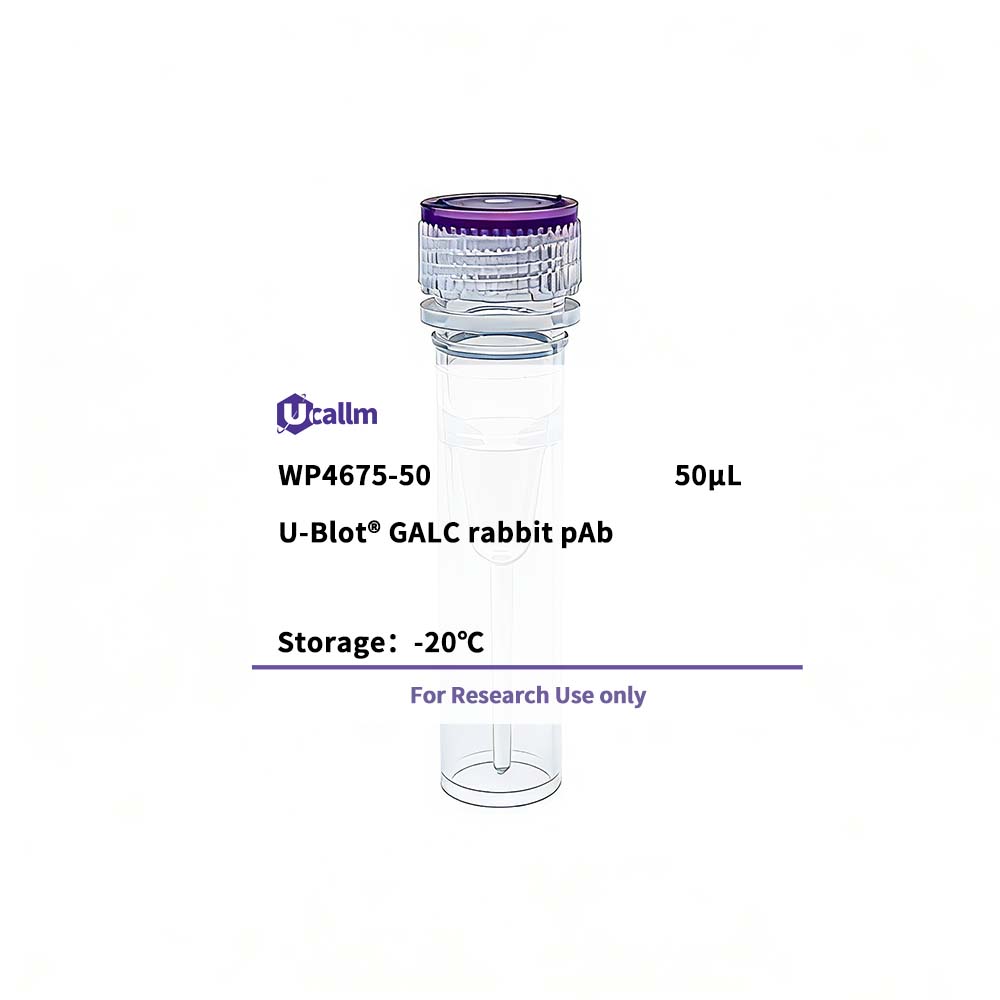
GALC rabbit pAb

Price range: $268.00 through $328.00

SKU: WP4675-100
Enter the quantity you would like, or drag the panel to find the quantity and price that best for you
Bulk QuoteAuthorize OEM & ODM

Product details

Background:

This gene encodes a lysosomal protein which hydrolyzes the galactose ester bonds of galactosylceramide, galactosylsphingosine, lactosylceramide, and monogalactosyldiglyceride. Mutations in this gene have been associated with Krabbe disease, also known as globoid cell leukodystrophy. Alternate transcriptional splice variants, encoding different isoforms, have been characterized. [provided by RefSeq, Jul 2008],

Specifications

TargetGALC
ReactivityHuman, Mouse
ApplicationsWB
MW(Calculated)75kD
MW(Observed)
Host SpeciesRabbit
IsotypeIgG
Conjugate/ModificationUnmodified
Modification
Recommended Dilution RatioWB 1:500-2000
FormulationLiquid in PBS containing 50% glycerol, 0.5% BSA and 0.02% sodium azide.
Source
PurificationThe antibody was affinity-purified from rabbit antiserum by affinity-chromatography using epitope-specific immunogen.
Purity
Storage-15°C to -25°C/1 year(Do not lower than -25°C)
Concentration1 mg/ml
ClonalityPolyclonal
Clone Number
ImmunogenSynthesized peptide derived from human GALC AA range: 481-531
Sequence
SpecificityThis antibody detects endogenous levels of GALC at Human/Mouse
Gene NameGALC
Protein NameGALC
Other Name
SpeciesHuman
Gene ID-12581
UniprotP54803,
Species.1Mouse
Gene ID-214420
Uniprot.1P54818
Species.2
Gene ID-3
Uniprot.2
Organism-4
Gene ID-4
SwissProt-4
BackgroundThis gene encodes a lysosomal protein which hydrolyzes the galactose ester bonds of galactosylceramide, galactosylsphingosine, lactosylceramide, and monogalactosyldiglyceride. Mutations in this gene have been associated with Krabbe disease, also known as globoid cell leukodystrophy. Alternate transcriptional splice variants, encoding different isoforms, have been characterized. [provided by RefSeq, Jul 2008],
Cellular LocalizationLysosome.
Tissue ExpressionDetected in urine. Detected in testis, brain and placenta (at protein level). Detected in kidney and liver.
Signaling_pathwayCellular Processes >> Transport and catabolism >> Lysosome
Research Areas>>Sphingolipid metabolism; / >>Metabolic pathways; / >>Lysosome
FunctionCatalytic activity:D-galactosyl-N-acylsphingosine + H(2)O = D-galactose + N-acylsphingosine.,Caution:It is uncertain whether Met-1 or Met-17 is the initiator.,Disease:Defects in GALC are the cause of leukodystrophy globoid cell (GLD) [MIM:245200]; also known as Krabbe disease. This autosomal recessive disorder results in the insufficient catabolism of several galactolipids that are important in the production of normal myelin. Clinically, the most frequent form is the infantile form. Most patients (90%) present before six months of age with irritability, spasticity, arrest of motor and mental development, and bouts of temperature elevation without infection. This is followed by myoclonic jerks of arms and legs, oposthotonus, hypertonic fits, and mental regression, which progresses to a severe decerebrate condition with no voluntary movements and death from respiratory infections or cerebral hyperpyrexia before 2 years of age. However, a significant number of cases with later onset, presenting with unexplained blindness, weakness and/or progressive motor, and sensory neuropathy that can progress to severe mental incapacity and death, have been identified.,Function:Hydrolyzes the galactose ester bonds of galactosylceramide, galactosylsphingosine, lactosylceramide, and monogalactosyldiglyceride. Enzyme with very low activity responsible for the lysosomal catabolism of galactosylceramide, a major lipid in myelin, kidney and epithelial cells of small intestine and colon.,online information:Krabbe disease website,polymorphism:Polymorphic amino-acid changes are responsible for the wide range of catalytic activities found in the general population.,similarity:Belongs to the glycosyl hydrolase 59 family.,tissue specificity:Highest level of activity in testes compared to brain, kidney, placenta and liver. Can also be found in urine.,
RRID
Please login to post questions
Back to Top
Product has been added to your cart