SKU: WR4947 Categories: ,

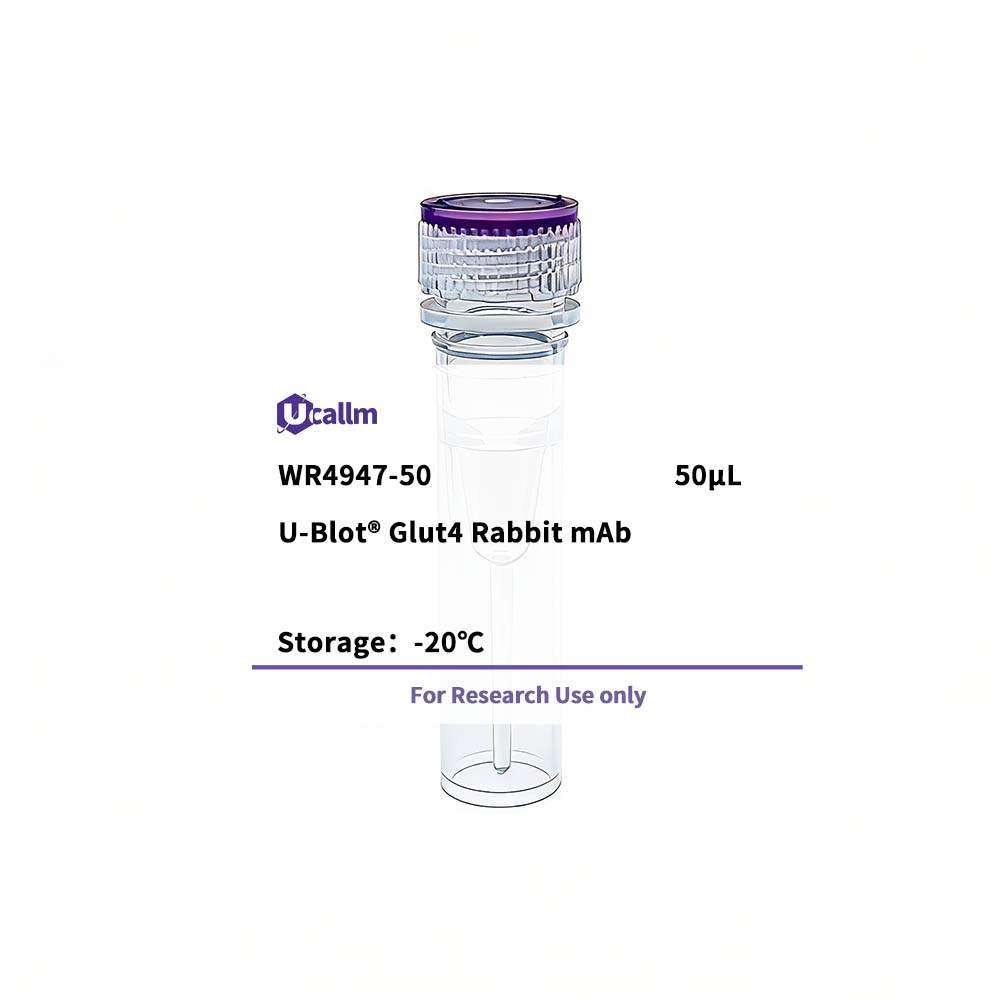
U-Blot® Glut4 Rabbit mAb

Price range: $268.00 through $328.00

SKU: WR4947-50
Enter the quantity you would like, or drag the panel to find the quantity and price that best for you
Bulk QuoteAuthorize OEM & ODM

Product details

Background:This gene is a member of the solute carrier family 2 (facilitated glucose transporter) family and encodes a protein that functions as an insulin-regulated facilitative glucose transporter. In the absence of insulin, this integral membrane protein is sequestered within the cells of muscle and adipose tissue. Within minutes of insulin stimulation, the protein moves to the cell surface and begins to transport glucose across the cell membrane. Mutations in this gene have been associated with noninsulin-dependent diabetes mellitus (NIDDM). [provided by RefSeq, Jul 2008],

Specifications

Size50μL/100μL
TargetGlut4
ReactivityHuman, Mouse, Rat
ApplicationsWB, IHC, IF, IP, ELISA
MW(Calculated)55kD
MW(Observed)55kD
Host SpeciesRabbit
IsotypeIgG,Kappa
Conjugate/ModificationUnmodified
Recommended Dilution RatioIHC 1:200-1:1000; WB 1:2000-1:10000; IF 1:200-1:1000; ELISA 1:5000-1:20000; IP 1:50-1:200; / Note: For IHC, we suggest antigen retrieval with TE buffer pH 9.0 (Cat#WT1004)
FormulationPBS, 50% glycerol, 0.05% Proclin 300, 0.05%BSA
PurificationRecombinant Antibody expressed in animal component-free (ACF) media, purified via Protein A affinity chromatography.
Storage-15°C to -25°C/1 year(Do not lower than -25°C)
Concentration
ClonalityMonoclonal
Clone NumberRM1170R
ImmunogenThe specific immunogen used to produce this antibody is proprietary information.
SpecificityEndogenous
Gene NameSLC2A4
Protein NameSolute carrier family 2 facilitated glucose transporter member 4
Other NameSLC2A4; / GLUT4; / Solute carrier family 2, facilitated glucose transporter member 4; / Glucose transporter type 4, insulin-responsive; / GLUT-4
SpeciesHuman
Gene ID6517
UniprotP14672,
Species.1Mouse
Gene ID.120528
Uniprot.1P14142,
Species.2Rat
Gene ID.225139
Uniprot.2P19357
Cellular LocalizationCell membrane; Multi-pass membrane protein . Endomembrane system; Multi-pass membrane protein . Cytoplasm, perinuclear region . Localizes primarily to the perinuclear region, undergoing continued recycling to the plasma membrane where it is rapidly reinternalized (PubMed:8300557). The dileucine internalization motif is critical for intracellular sequestration (PubMed:8300557). Insulin stimulation induces translocation to the cell membrane (By similarity). .
Tissue ExpressionSkeletal and cardiac muscles; brown and white fat.
Signaling_pathwayOrganismal Systems >> Endocrine system >> Insulin signaling pathway;Organismal Systems >> Endocrine system >> Adipocytokine signaling pathway;Environmental Information Processing >> Signal transduction >> FoxO signaling pathway;Environmental Information Processing >> Signal transduction >> AMPK signaling pathway
Research Areas>>FoxO signaling pathway; / >>AMPK signaling pathway; / >>Insulin signaling pathway; / >>Adipocytokine signaling pathway; / >>Type II diabetes mellitus; / >>Insulin resistance; / >>Diabetic cardiomyopathy
FunctionDisease:Defects in SLC2A4 may be a cause of noninsulin-dependent diabetes mellitus (NIDDM) [MIM:125853]. Defects in SLC2A4 may be a cause of certain post-receptor defects in NIDDM. The variant in position Ile-383 is found in a small number of NIDDM patients, but seems not to be found in nondiabetic subjects.,Function:Insulin-regulated facilitative glucose transporter.,miscellaneous:Insulin-stimulated phosphorylation of TBC1D4 is required for GLUT4 translocation.,online information:GLUT4 entry,PTM:Sumoylated.,similarity:Belongs to the major facilitator superfamily. Sugar transporter (TC 2.A.1.1) family. Glucose transporter subfamily.,subcellular location:Localizes primarily to the perinuclear region, undergoing continued recycling to the plasma membrane where it is rapidly reinternalized. The dileucine internalization motif is critical for intracellular sequestration.,subunit:Binds to DAXX. Interacts via its N-terminus with SRFBP1.,tissue specificity:Skeletal and cardiac muscles; brown and white fat.,
Please login to post questions
Back to Top
Product has been added to your cart
