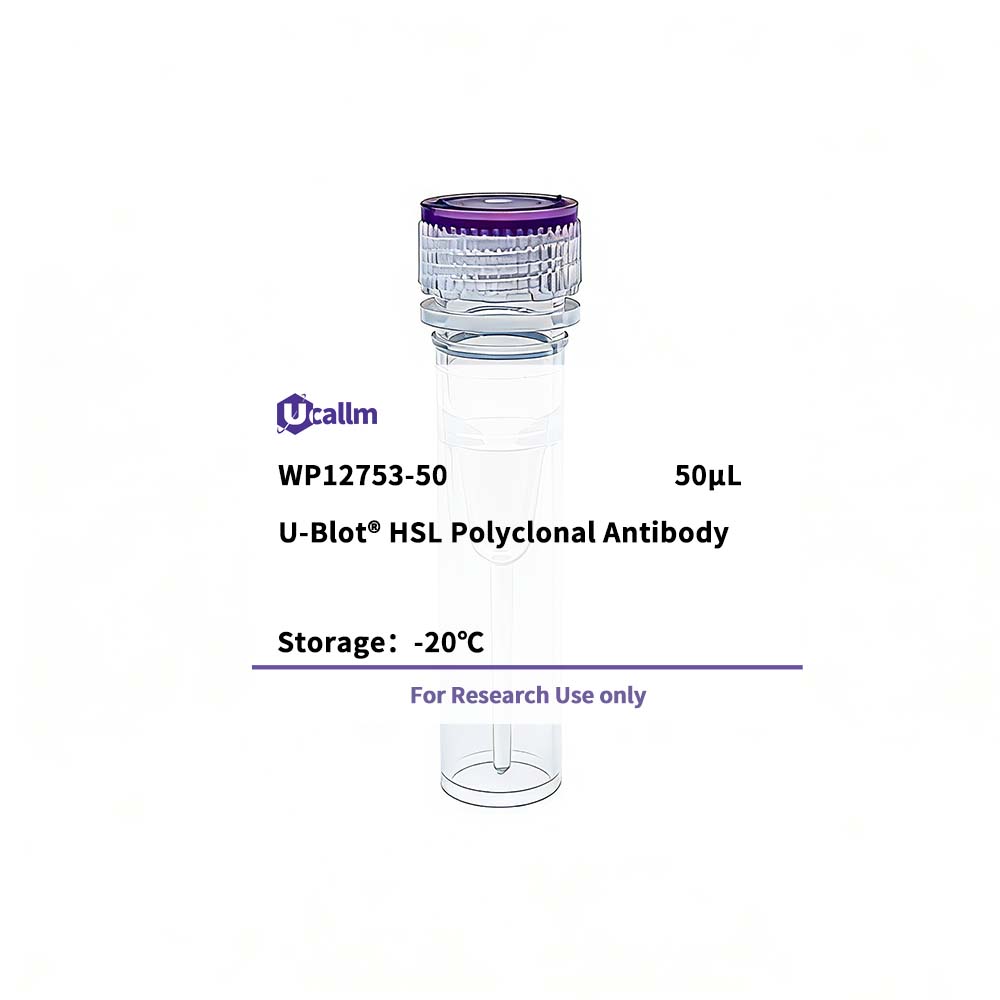
SKU: WP12753 Categories: ,

HSL Polyclonal Antibody

Price range: $268.00 through $328.00

SKU: WP12753-100
Enter the quantity you would like, or drag the panel to find the quantity and price that best for you
Bulk QuoteAuthorize OEM & ODM

Product details

Background:

The protein encoded by this gene has a long and a short form, generated by use of alternative translational start codons. The long form is expressed in steroidogenic tissues such as testis, where it converts cholesteryl esters to free cholesterol for steroid hormone production. The short form is expressed in adipose tissue, among others, where it hydrolyzes stored triglycerides to free fatty acids. [provided by RefSeq, Jul 2008],

Specifications

Size50μL/100μL
TargetHSL
ReactivityHuman, Mouse, Rat
ApplicationsWB, IHC, IF, ELISA
MW(Calculated)
MW(Observed)85kD
Host SpeciesRabbit
IsotypeIgG
Conjugate/ModificationUnmodified
Recommended Dilution RatioWB 1:500-1:2000; IHC 1:100-1:300; ELISA 1:5000; IF 1:50-200 / Note: For IHC, we suggest antigen retrieval with TE buffer pH 9.0 (Cat#WT1004)
FormulationLiquid in PBS containing 50% glycerol, 0.5% BSA and 0.02% sodium azide.
PurificationThe antibody was affinity-purified from rabbit antiserum by affinity-chromatography using epitope-specific immunogen.
Storage-15°C to -25°C/1 year(Do not lower than -25°C)
Concentration1 mg/ml
ClonalityPolyclonal
Clone Number
ImmunogenThe antiserum was produced against synthesized peptide derived from human HSL. AA range:518-567
SpecificityHSL Polyclonal Antibody detects endogenous levels of HSL protein.
Gene NameLIPE
Protein NameHormone-sensitive lipase
Other NameLIPE; / Hormone-sensitive lipase; / HSL
SpeciesHuman
Gene ID3991
UniprotQ05469,
Species.1Mouse
Gene ID.116890
Uniprot.1P54310,
Species.2Rat
Gene ID.225330
Uniprot.2P15304
Cellular LocalizationCell membrane . Membrane, caveola . Cytoplasm, cytosol . Lipid droplet . Found in the high-density caveolae. Translocates to the cytoplasm from the caveolae upon insulin stimulation (PubMed:17026959). Phosphorylation by AMPK reduces its translocation towards the lipid droplets (By similarity). .
Tissue ExpressionTestis.
Signaling_pathwayOrganismal Systems >> Endocrine system >> Insulin signaling pathway;Organismal Systems >> Endocrine system >> Aldosterone synthesis and secretion;Environmental Information Processing >> Signal transduction >> Apelin signaling pathway;Environmental Information Processing >> Signal transduction >> cAMP signaling pathway;Environmental Information Processing >> Signal transduction >> AMPK signaling pathway
Research Areas>>cAMP signaling pathway; / >>AMPK signaling pathway; / >>Apelin signaling pathway; / >>Thermogenesis; / >>Insulin signaling pathway; / >>Regulation of lipolysis in adipocytes; / >>Aldosterone synthesis and secretion
FunctionCatalytic activity:Diacylglycerol + H(2)O = monoacylglycerol + a carboxylate.,Catalytic activity:Monoacylglycerol + H(2)O = glycerol + a carboxylate.,Catalytic activity:Triacylglycerol + H(2)O = diacylglycerol + a carboxylate.,enzyme regulation:Rapidly activated by cAMP-dependent phosphorylation under the influence of catecholamines. Dephosphorylation and inactivation are controlled by insulin.,Function:In adipose tissue and heart, it primarily hydrolyzes stored triglycerides to free fatty acids, while in steroidogenic tissues, it principally converts cholesteryl esters to free cholesterol for steroid hormone production.,pathway:Glycerolipid metabolism; triacylglycerol degradation.,similarity:Belongs to the 'GDXG' lipolytic enzyme family.,subcellular location:Found in the high-density caveolae. Translocates to the cytoplasm from the caveolae upon insulin stimulation.,subunit:Interacts with PTRF in the adipocyte cytoplasm.,
Please login to post questions
Back to Top
Product has been added to your cart

