SKU: WP1509 Categories: ,

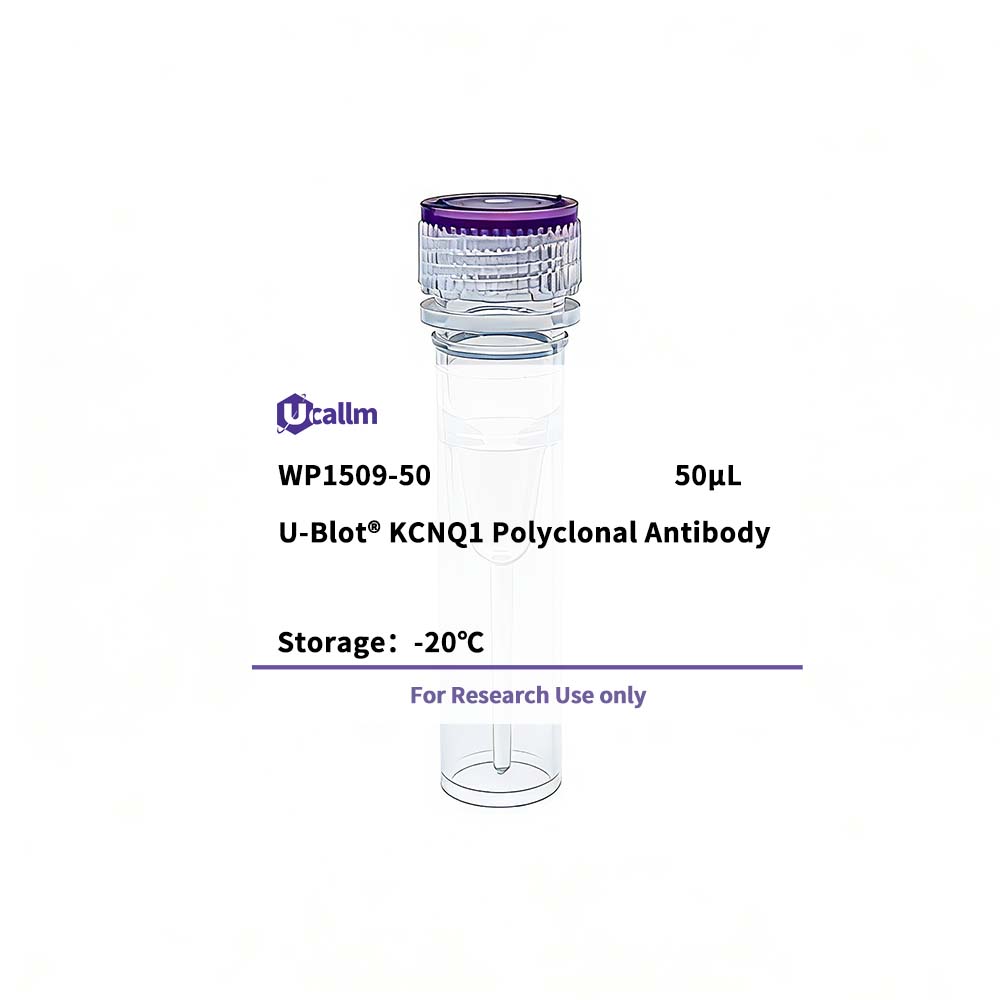
KCNQ1 Polyclonal Antibody

Price range: $268.00 through $328.00

SKU: WP1509-100
Enter the quantity you would like, or drag the panel to find the quantity and price that best for you
Bulk QuoteAuthorize OEM & ODM

Product details

Background:

This gene encodes a voltage-gated potassium channel required for repolarization phase of the cardiac action potential. This protein can form heteromultimers with two other potassium channel proteins, KCNE1 and KCNE3. Mutations in this gene are associated with hereditary long QT syndrome 1 (also known as Romano-Ward syndrome), Jervell and Lange-Nielsen syndrome, and familial atrial fibrillation. This gene exhibits tissue-specific imprinting, with preferential expression from the maternal allele in some tissues, and biallelic expression in others. This gene is located in a region of chromosome 11 amongst other imprinted genes that are associated with Beckwith-Wiedemann syndrome (BWS), and itself has been shown to be disrupted by chromosomal rearrangements in patients with BWS. Alternatively spliced transcript variants have been found for this gene. [provided by RefSeq,

Specifications

Size50μL/100μL
TargetKCNQ1
ReactivityHuman, Mouse, Rat
ApplicationsWB, ELISA
MW(Calculated)
MW(Observed)74kD
Host SpeciesRabbit
IsotypeIgG
Conjugate/ModificationUnmodified
Recommended Dilution RatioWB 1:500-2000; ELISA 1:5000-20000
FormulationLiquid in PBS containing 50% glycerol,0.5% BSA and 0.02% sodium azide.
PurificationThe antibody was affinity-purified from rabbit antiserum by affinity-chromatography using epitope-specific immunogen.
Storage-15°C to -25°C/1 year(Do not lower than -25°C)
Concentration1 mg/ml
ClonalityPolyclonal
Clone Number
ImmunogenSynthesized peptide derived from human protein . at AA range: 350-430
SpecificityKCNQ1 Polyclonal Antibody detects endogenous levels of protein.
Gene NameKCNQ1 KCNA8 KCNA9 KVLQT1
Protein NamePotassium voltage-gated channel subfamily KQT member 1 (IKs producing slow voltage-gated potassium channel subunit alpha KvLQT1) (KQT-like 1) (Voltage-gated potassium channel subunit Kv7.1)
Other Name
SpeciesHuman
Gene ID3784
UniprotP51787,
Species.1Mouse
Gene ID.1
Uniprot.1P97414,
Species.2Rat
Gene ID.2
Uniprot.2Q9Z0N7
Cellular LocalizationCell membrane; Multi-pass membrane protein . Cytoplasmic vesicle membrane . Early endosome . Membrane raft . Endoplasmic reticulum . Basolateral cell membrane . Colocalized with KCNE3 at the plasma membrane (PubMed:10646604). Upon 17beta-oestradiol treatment, colocalizes with RAB5A at early endosome (PubMed:23529131). Heterotetramer with KCNQ5 is highly retained at the endoplasmic reticulum and is localized outside of lipid raft microdomains (PubMed:24855057). During the early stages of epithelial cell polarization induced by the calcium switch it removed from plasma membrane to the endoplasmic reticulum where it retained and it is redistributed to the basolateral cell surface in a PI3K-dependent manner at a later stage (PubMed:21228319). .
Tissue ExpressionAbundantly expressed in heart, pancreas, prostate, kidney, small intestine and peripheral blood leukocytes. Less abundant in placenta, lung, spleen, colon, thymus, testis and ovaries.
Signaling_pathwayOrganismal Systems >> Circulatory system >> Adrenergic signaling in cardiomyocytes;Organismal Systems >> Nervous system >> Cholinergic synapse
Research Areas>>Adrenergic signaling in cardiomyocytes; / >>Cholinergic synapse; / >>Gastric acid secretion; / >>Pancreatic secretion; / >>Protein digestion and absorption; / >>Vibrio cholerae infection
FunctionAlternative products:Additional isoforms seem to exist,Disease:Defects in KCNQ1 are the cause of atrial fibrillation type 3 (ATFB3) [MIM:607554]. Atrial fibrillation is a common disorder of cardiac rhythm that is hereditary in a small subgroup of patients. It is characterized by disorganized atrial electrical activity, progressive deterioration of atrial electromechanical function and ineffective pumping of blood into the ventricles. It can be associated with palpitations, syncope, thromboembolic stroke, and congestive heart failure.,Disease:Defects in KCNQ1 are the cause of Jervell and Lange-Nielsen syndrome type 1 (JLNS1) [MIM:220400]. JLNS1 is an autosomal recessive disorder characterized by congenital deafness, prolongation of the QT interval, syncopal attacks due to ventricular arrhythmias, and a high risk of sudden death.,Disease:Defects in KCNQ1 are the cause of long QT syndrome type 1 (LQT1) [MIM:192500]; also known as Romano-Ward syndrome (RWS). Long QT syndromes are heart disorders characterized by a prolonged QT interval on the ECG and polymorphic ventricular arrhythmias. They cause syncope and sudden death in response to exercise or emotional stress. LQT1 inheritance is an autosomal dominant.,Disease:Defects in KCNQ1 are the cause of short QT syndrome type 2 (SQT2) [MIM:609621]. Short QT syndromes are heart disorders characterized by idiopathic persistently and uniformly short QT interval on ECG in the absence of structural heart disease in affected individuals. They cause syncope and sudden death.,Domain:The segment S4 is probably the voltage-sensor and is characterized by a series of positively charged amino acids at every third position.,Function:Probably important in cardiac repolarization. Associates with KCNE1 (MinK) to form the I(Ks) cardiac potassium current. Elicits a rapidly activating, potassium-selective outward current. Muscarinic agonist oxotremorine-M strongly suppresses KCNQ1/KCNE1 current in CHO cells in which cloned KCNQ1/KCNE1 channels were coexpressed with M1 muscarinic receptors. May associate also with KCNE3 (MiRP2) to form the potassium channel that is important for cyclic AMP-stimulated intestinal secretion of chloride ions, which is reduced in cystic fibrosis and pathologically stimulated in cholera and other forms of secretory diarrhea.,miscellaneous:Mutagenesis experiments were carried out by expressing in Xenopus oocytes or COS-7 cells KCNQ1 mutants either individually (homomultimers) or in combination with both wild-type KCNQ1 (mut/wt homomultimers) and minK (heteromultimers).,online information:Congenital long QT syndrome website,online information:KCNQ1 mutations page,online information:KvLQT1 entry,similarity:Belongs to the potassium channel family. KQT subfamily.,subunit:Heterotetramer with KCNE1 (MinK) or KCNE3 (MiRP2). Interacts with CALM.,tissue specificity:Abundantly expressed in heart, pancreas, prostate, kidney, small intestine and peripheral blood leukocytes. Less abundant in placenta, lung, spleen, colon, thymus, testis and ovaries.,
Please login to post questions
Back to Top
Product has been added to your cart
