SKU: WR4727 Categories: ,

U-Blot® KCTD21 Rabbit mAb

Price range: $268.00 through $328.00

SKU: WR4727-50
Enter the quantity you would like, or drag the panel to find the quantity and price that best for you
Bulk QuoteAuthorize OEM & ODM

Product details

Background:Enables cullin family protein binding activity; histone deacetylase binding activity; and identical protein binding activity. Involved in negative regulation of smoothened signaling pathway and ubiquitin-dependent protein catabolic process. [provided by Alliance of Genome Resources, Apr 2025]

Specifications

Size50μL/100μL
TargetKCTD21
ReactivityHuman, Mouse, Rat
ApplicationsWB, FC
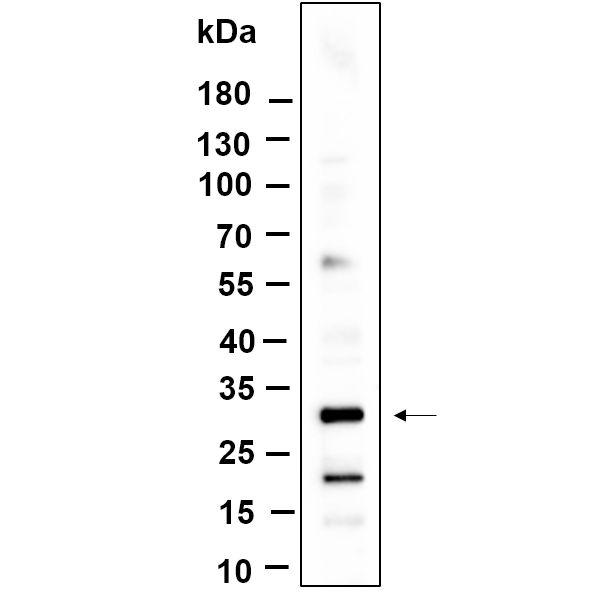
MW(Calculated)29kD
MW(Observed)29kD
Host SpeciesRabbit
IsotypeIgG,Kappa
Conjugate/ModificationUnmodified
Recommended Dilution RatioWB 1:1000-1:5000; FC 1:100-1:500;
FormulationPBS, 50% glycerol, 0.05% Proclin 300, 0.05%BSA
PurificationRecombinant Antibody expressed in animal component-free (ACF) media, purified via Protein A affinity chromatography.
Storage-15°C to -25°C/1 year(Do not lower than -25°C)
Concentration
ClonalityMonoclonal
Clone NumberRM1087R
ImmunogenThe specific immunogen used to produce this antibody is proprietary information.
SpecificityEndogenous
Gene NameKCTD21
Protein NameBTB/POZ domain-containing protein KCTD21 (KCASH2 protein) (Potassium channel tetramerization domain-containing protein 21)
Other Name
SpeciesHuman
Gene ID283219
UniprotQ4G0X4,
Species.1Mouse
Gene ID.1622320
Uniprot.1Q3URF8
Species.2
Gene ID.2
Uniprot.2
Cellular Localization
Tissue ExpressionTISSUE SPECIFICITY: Highly expressed in cerebellum and brain. Expression is down-regulated in medulloblastoma. {ECO:0000269|PubMed:21472142}.
Signaling_pathway
Research Areas
FunctionFUNCTION: Probable substrate-specific adapter of a BCR (BTB-CUL3-RBX1) E3 ubiquitin-protein ligase complex mediating the ubiquitination and subsequent proteasomal degradation of target proteins. Promotes the ubiquitination of HDAC1. Can function as antagonist of the Hedgehog pathway by affecting the nuclear transfer of transcription factor GLI1; the function probably occurs via HDAC1 down-regulation, keeping GLI1 acetylated and inactive. Inhibits cell growth and tumorigenicity of medulloblastoma (MDB) (PubMed:21472142). {ECO:0000269|PubMed:21472142}.
Please login to post questions

Back to Top
Product has been added to your cart

