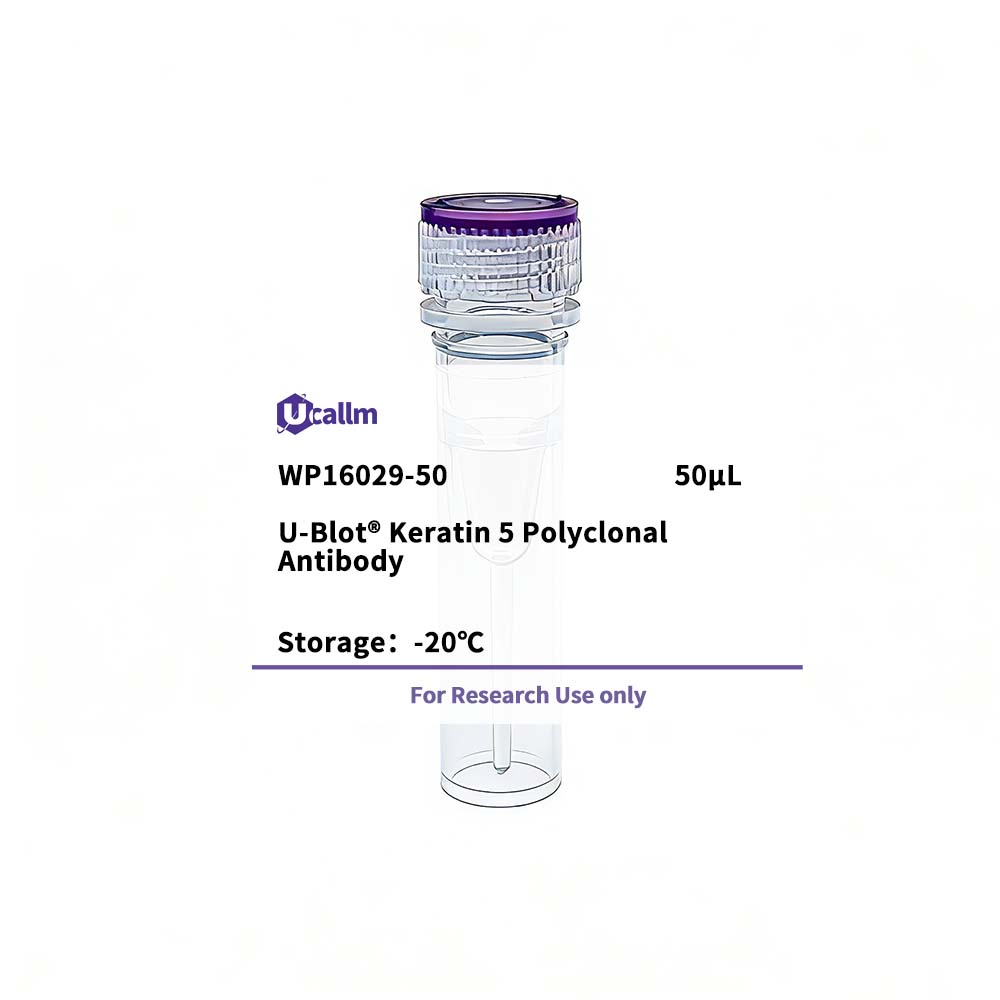
SKU: WP16029 Categories: ,

Keratin 5 Polyclonal Antibody

Price range: $268.00 through $328.00

SKU: WP16029-100
Enter the quantity you would like, or drag the panel to find the quantity and price that best for you
Bulk QuoteAuthorize OEM & ODM

Product details

Background:

keratin 5(KRT5) Homo sapiens The protein encoded by this gene is a member of the keratin gene family. The type II cytokeratins consist of basic or neutral proteins which are arranged in pairs of heterotypic keratin chains coexpressed during differentiation of simple and stratified epithelial tissues. This type II cytokeratin is specifically expressed in the basal layer of the epidermis with family member KRT14. Mutations in these genes have been associated with a complex of diseases termed epidermolysis bullosa simplex. The type II cytokeratins are clustered in a region of chromosome 12q12-q13. [provided by RefSeq, Jul 2008],


Specifications

Size50μL/100μL
TargetCytokeratin 5
ReactivityHuman, Mouse, Rat
ApplicationsWB, IHC
MW(Calculated)
MW(Observed)62kD
Host SpeciesRabbit
IsotypeIgG
Conjugate/ModificationUnmodified
Recommended Dilution RatioWB 1:500-2000; IHC 1:50-300 / Note: For IHC, we suggest antigen retrieval with TE buffer pH 9.0 (Cat#WT1004)
FormulationLiquid in PBS containing 50% glycerol, 0.5% BSA and 0.02% sodium azide.
PurificationThe antibody was affinity-purified from rabbit antiserum by affinity-chromatography using epitope-specific immunogen.
Storage-15°C to -25°C/1 year(Do not lower than -25°C)
Concentration1 mg/ml
ClonalityPolyclonal
Clone Number
ImmunogenSynthesized peptide derived from human Keratin 5 Polyclonal
SpecificityThis antibody detects endogenous levels of Keratin 5.
Gene NameKRT5
Protein NameKeratin, type II cytoskeletal 5 (58 kDa cytokeratin) (Cytokeratin-5) (CK-5) (Keratin-5) (K5) (Type-II keratin Kb5)
Other NameKeratin, type II cytoskeletal 5; / 58 kDa cytokeratin; / Cytokeratin-5; / CK-5; / Keratin-5; / K5; / Type-II keratin Kb5
SpeciesHuman
Gene ID3852
UniprotP13647,
Species.1Mouse
Gene ID.1110308
Uniprot.1Q922U2,
Species.2Rat
Gene ID.2369017
Uniprot.2Q6P6Q2
Cellular Localizationnucleus,cytoplasm,mitochondrion,cytosol,intermediate filament,plasma membrane,membrane,keratin filament,extracellular exosome,
Tissue ExpressionExpressed in corneal epithelium (at protein level).
Signaling_pathway
Research Areas
FunctionDisease:Defects in KRT5 are a cause of epidermolysis bullosa simplex Dowling-Meara type (DM-EBS) [MIM:131760]. DM-EBS is a severe form of intraepidermal epidermolysis bullosa characterized by generalized herpetiform blistering, milia formation, dystrophic nails, and mucous membrane involvement.,Disease:Defects in KRT5 are a cause of epidermolysis bullosa simplex Koebner type (K-EBS) [MIM:131900]. K-EBS is a form of intraepidermal epidermolysis bullosa characterized by generalized skin blistering. The phenotype is not fundamentally distinct from the Dowling-Meara type, althought it is less severe.,Disease:Defects in KRT5 are a cause of epidermolysis bullosa simplex Weber-Cockayne type (WC-EBS) [MIM:131800]. WC-EBS is a form of intraepidermal epidermolysis bullosa characterized by blistering limited to palmar and plantar areas of the skin.,Disease:Defects in KRT5 are the cause of Dowling-Degos disease (DDD) [MIM:179850]; also known as Dowling-Degos-Kitamura disease or reticulate acropigmentation of Kitamura. DDD is an autosomal dominant genodermatosis. Affected individuals develop a postpubertal reticulate hyperpigmentation that is progressive and disfiguring, and small hyperkeratotic dark brown papules that affect mainly the flexures and great skin folds. Patients usually show no abnormalities of the hair or nails.,Disease:Defects in KRT5 are the cause of epidermolysis bullosa simplex with migratory circinate erythema (EBSMCE) [MIM:609352]. EBSMCE is a form of intraepidermal epidermolysis bullosa characterized by unusual migratory circinate erythema. Skin lesions appear from birth primarily on the hands, feet, and legs but spare nails, ocular epithelia and mucosae. Lesions heal with brown pigmentation but no scarring. Electron microscopy findings are distinct from those seen in the DM-EBS, with no evidence of tonofilament clumping.,Disease:Defects in KRT5 are the cause of epidermolysis bullosa simplex with mottled pigmentation (MP-EBS) [MIM:131960]. MP-EBS is a form of intraepidermal epidermolysis bullosa characterized by blistering at acral sites and 'mottled' pigmentation of the trunk and proximal extremities with hyper- and hypopigmentation macules.,miscellaneous:There are two types of cytoskeletal and microfibrillar keratin: I (acidic; 40-55 kDa) and II (neutral to basic; 56-70 kDa).,similarity:Belongs to the intermediate filament family.,subunit:Heterotetramer of two type I and two type II keratins. Keratin-5 associates with keratin-14. Interacts with TCHP.,
Please login to post questions
Back to Top
Product has been added to your cart


