


MAFG Polyclonal Antibody
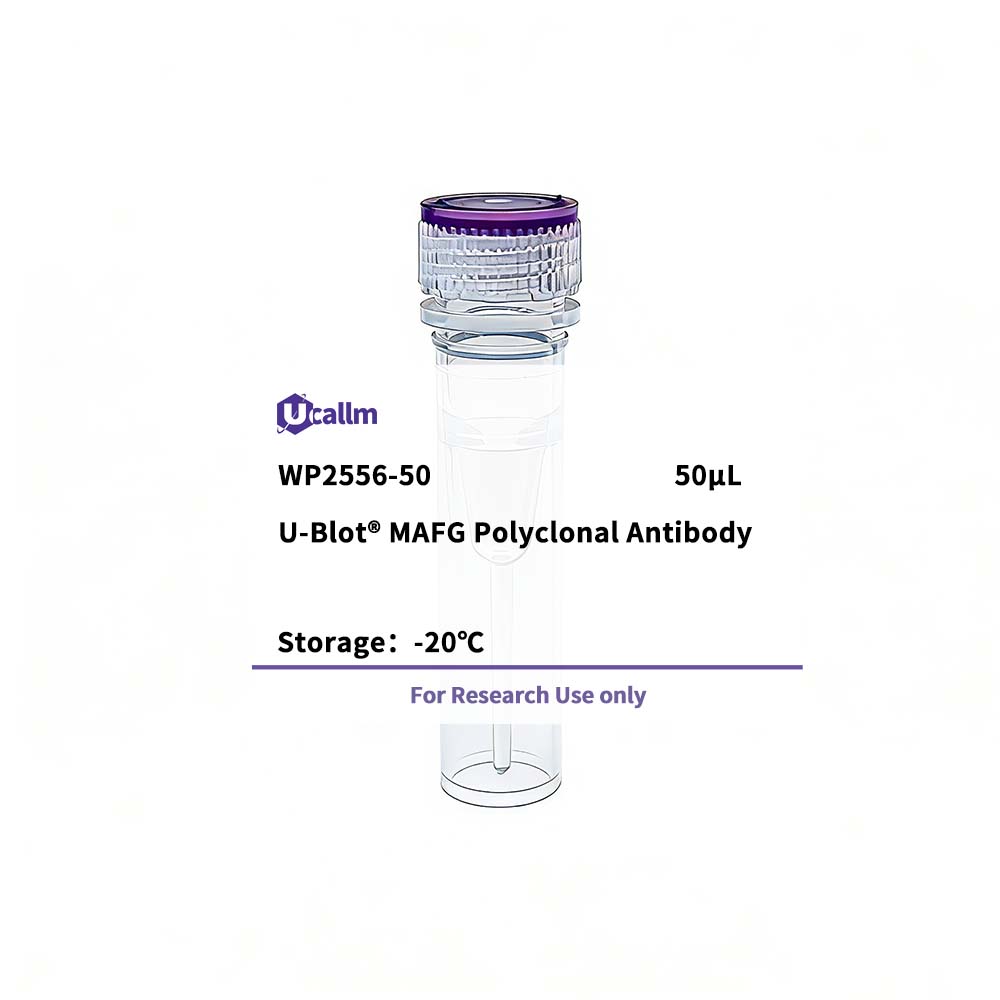
Ucallm_WP2556-50
Price range: $268.00 through $328.00
Product details
Background:
Globin gene expression is regulated through nuclear factor erythroid-2 (NFE2) elements located in enhancer-like locus control regions positioned many kb upstream of alpha- and beta-gene clusters (summarized by Blank et al., 1997 [PubMed 9166829]). NFE2 DNA-binding activity consists of a heterodimer containing a ubiquitous small Maf protein (MafF, MIM 604877; MafG; or MafK, MIM 600197) and the tissue-restricted protein p45 NFE2 (MIM 601490). Both subunits are members of the activator protein-1-like superfamily of basic leucine zipper (bZIP) proteins (see MIM 165160).[supplied by OMIM, Mar 2010],
Specifications
| Size | 50μL/100μL |
| Target | MAFG |
| Reactivity | Human, Mouse, Rat |
| Applications | WB, ELISA |
| MW(Calculated) | |
| MW(Observed) | 17kD |
| Host Species | Rabbit |
| Isotype | IgG |
| Conjugate/Modification | Unmodified |
| Recommended Dilution Ratio | WB 1:500-2000; ELISA 1:5000-20000 |
| Formulation | Liquid in PBS containing 50% glycerol,0.5% BSA and 0.02% sodium azide. |
| Purification | The antibody was affinity-purified from rabbit antiserum by affinity-chromatography using epitope-specific immunogen. |
| Storage | -15°C to -25°C/1 year(Do not lower than -25°C) |
| Concentration | 1 mg/ml |
| Clonality | Polyclonal |
| Clone Number | |
| Immunogen | Synthesized peptide derived from part region of human protein |
| Specificity | MAFG Polyclonal Antibody detects endogenous levels of protein. |
| Gene Name | MAFG |
| Protein Name | Transcription factor MafG (V-maf musculoaponeurotic fibrosarcoma oncogene homolog G) (hMAF) |
| Other Name | |
| Species | Human |
| Gene ID | 4097 |
| Uniprot | O15525, |
| Species.1 | Mouse |
| Gene ID.1 | |
| Uniprot.1 | O54790, |
| Species.2 | Rat |
| Gene ID.2 | |
| Uniprot.2 | Q76MX4 |
| Cellular Localization | Nucleus . |
| Tissue Expression | Highly expressed in skeletal muscle. Also expressed in heart and brain. |
| Signaling_pathway | |
| Research Areas | |
| Function | Function:Since they lack a putative transactivation domain, the small Mafs behave as transcriptional repressors when they dimerize among themselves. However, they seem to serve as transcriptional activators by dimerizing with other (usually larger) basic-zipper proteins and recruiting them to specific DNA-binding sites. Small Maf proteins heterodimerize with Fos and may act as competitive repressors of the NF-E2 transcription factor. Transcription factor, component of erythroid-specific transcription factor NF-E2. Activates globin gene expression when associated with NF-E2. May be involved in signal transduction of extracellular H(+).,PTM:Acetylated in erythroid cells by CREB-binding protein (CBP). Acetylation augments the DNA-binding activity of NFE2, but has no effect on binding NFE2.,PTM:Sumoylation at Lys-14 is required for active transcriptional repression.,similarity:Belongs to the bZIP family. Maf subfamily.,similarity:Contains 1 bZIP domain.,subunit:Homodimer or heterodimer. Homodimerization leads to transcriptional repression. Forms high affinity heterodimers with members of the CNC-bZIP family such as NFE2, NFE2L1/NRF1, NFE2L2/NRF2 and NFE2L3/NRF3. Interacts with NFE2; the interaction results in tranactivation activation. Interacts with CREBBP; the interaction leads to acetylation of the basic region of MAFG and stimulation of NFE2 transcriptional activity through increased DNA binding.,tissue specificity:Highly expressed in skeletal muscle. Also expressed in heart and brain., |
Please login to post questions
Related products





