

MAGE-C2 Polyclonal Antibody
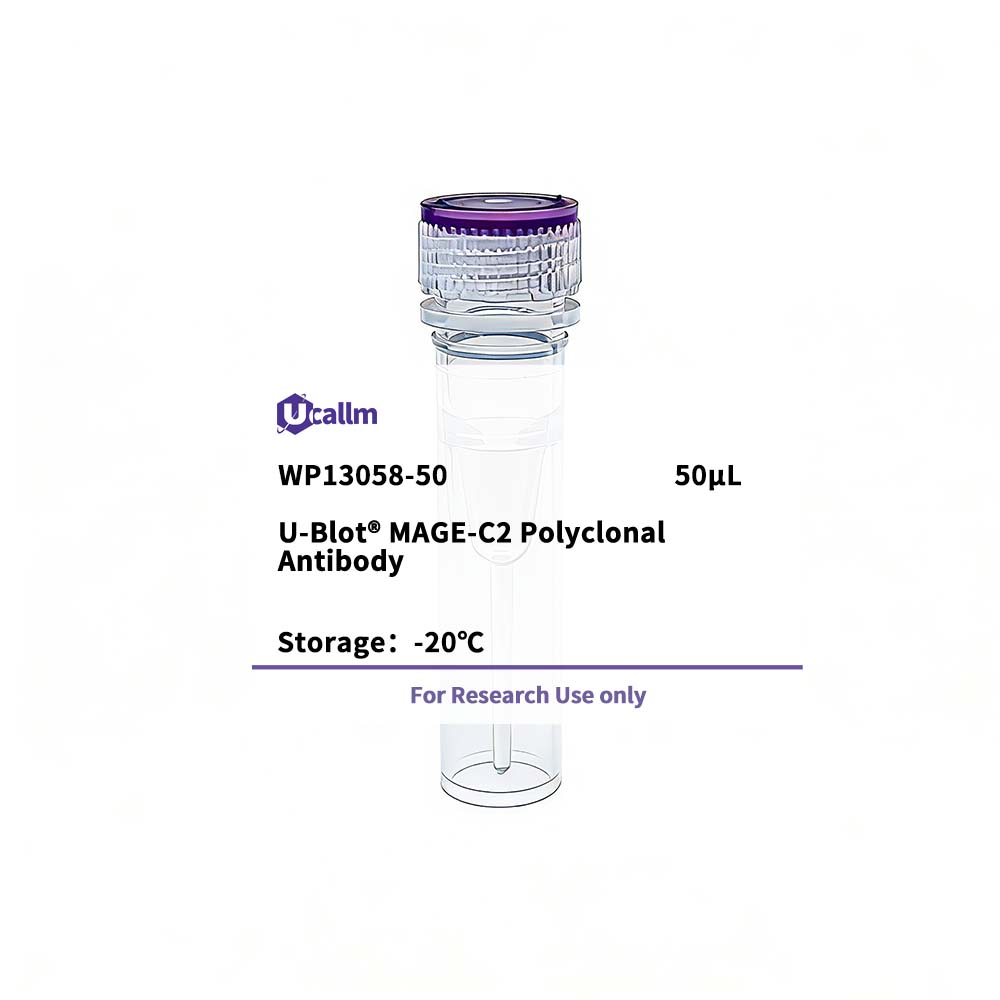
Ucallm_WP13058-50
Price range: $268.00 through $328.00
Product details
Background:
This gene is a member of the MAGEC gene family. It is not expressed in normal tissues, except for testis, and is expressed in tumors of various histological types. This gene and the other MAGEC genes are clustered on chromosome Xq26-q27. [provided by RefSeq, Oct 2009],
Specifications
| Size | 50μL/100μL |
| Target | MAGE-C2 |
| Reactivity | Human |
| Applications | WB, ELISA |
| MW(Calculated) | |
| MW(Observed) | 41kD |
| Host Species | Rabbit |
| Isotype | IgG |
| Conjugate/Modification | Unmodified |
| Recommended Dilution Ratio | WB 1:500-1:2000; ELISA 1:5000; Not yet tested in other applications. |
| Formulation | Liquid in PBS containing 50% glycerol, 0.5% BSA and 0.02% sodium azide. |
| Purification | The antibody was affinity-purified from rabbit antiserum by affinity-chromatography using epitope-specific immunogen. |
| Storage | -15°C to -25°C/1 year(Do not lower than -25°C) |
| Concentration | 1 mg/ml |
| Clonality | Polyclonal |
| Clone Number | |
| Immunogen | Synthesized peptide derived from MAGE-C2 . at AA range: 160-240 |
| Specificity | MAGE-C2 Polyclonal Antibody detects endogenous levels of MAGE-C2 protein. |
| Gene Name | MAGEC2 |
| Protein Name | Melanoma-associated antigen C2 |
| Other Name | MAGEC2; / HCA587; / MAGEE1; / Melanoma-associated antigen C2; / Cancer/testis antigen 10; / CT10; / Hepatocellular carcinoma-associated antigen 587; / MAGE-C2 antigen; / MAGE-E1 antigen |
| Species | Human |
| Gene ID | 51438 |
| Uniprot | Q9UBF1 |
| Species.1 | |
| Gene ID.1 | |
| Uniprot.1 | |
| Species.2 | |
| Gene ID.2 | |
| Uniprot.2 | |
| Cellular Localization | Cytoplasm . Nucleus . Nuclear in germ cells. Cytoplasmic in well-differentiated hepatocellular carcinoma, nuclear in moderately- and poorly-differentiated hepatocellular carcinoma. |
| Tissue Expression | Not expressed in normal tissues, except in germ cells in the seminiferous tubules and in Purkinje cells of the cerebellum. Expressed in various tumors, including melanoma, lymphoma, as well as pancreatic cancer, mammary gland cancer, non-small cell lung cancer and liver cancer. In hepatocellular carcinoma, there is an inverse correlation between tumor differentiation and protein expression, i.e. the lower the differentiation, the higher percentage of expression. |
| Signaling_pathway | |
| Research Areas | |
| Function | developmental stage:Strongly expressed in spermatogonia and primary spermatocytes. At later stages of maturation, expression gradually decreases and becomes undetectable in mature spermatids.,similarity:Contains 1 MAGE domain.,subcellular location:Nuclear in germ cells. Cytoplasmic in well-differentiated hepatocellular carcinoma, nuclear in moderately- and poorly-differentiated hepatocellular carcinoma.,tissue specificity:Not expressed in normal tissues, except in germ cells in the seminiferous tubules and in Purkinje cells of the cerebellum. Expressed in various tumors, including melanoma, lymphoma, as well as pancreatic cancer, mammary gland cancer, non-small cell lung cancer and liver cancer. In hepatocellular carcinoma, there is a inverse correlation between tumor differentiation and protein expression, i.e. the lower the differentiation, the higher percentage of expression., |
Please login to post questions
Related products





