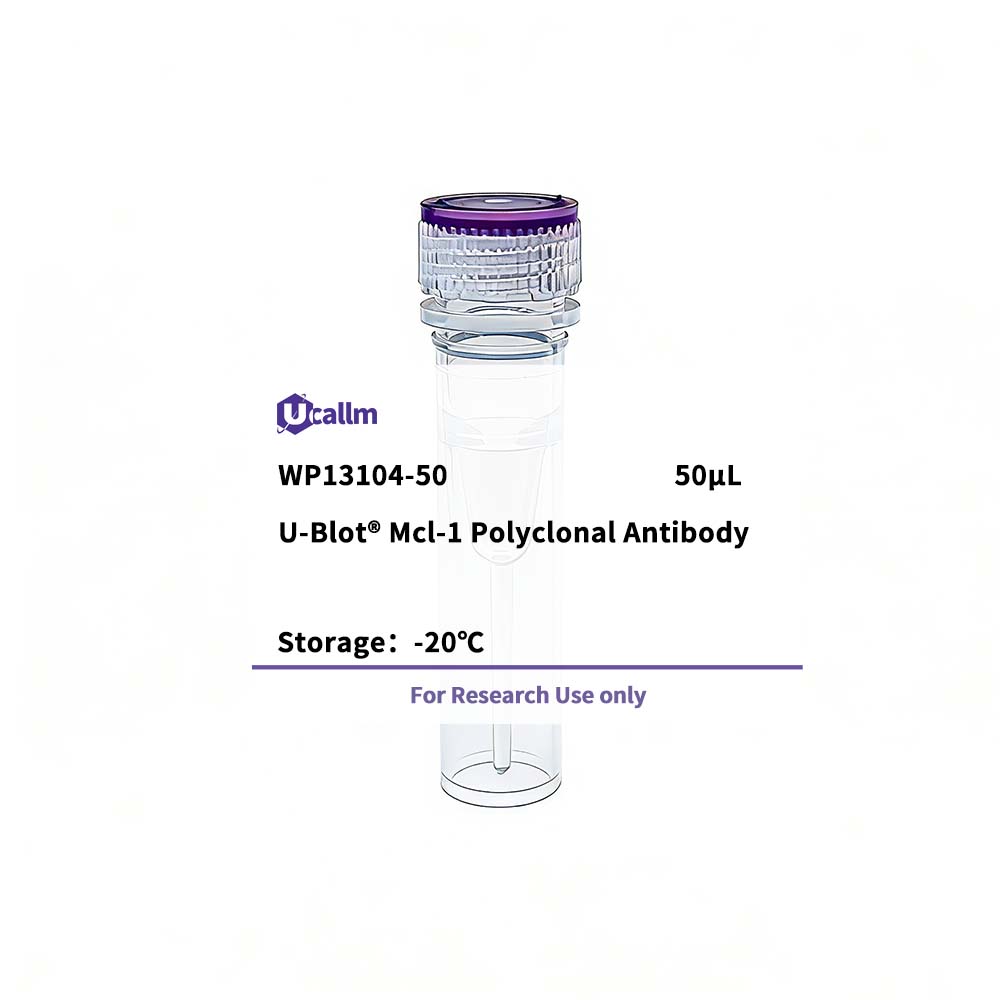
SKU: WP13104 Categories: ,

Mcl-1 Polyclonal Antibody

Price range: $268.00 through $328.00

SKU: WP13104-100
Enter the quantity you would like, or drag the panel to find the quantity and price that best for you
Bulk QuoteAuthorize OEM & ODM

Product details

Background:

This gene encodes an anti-apoptotic protein, which is a member of the Bcl-2 family. Alternative splicing results in multiple transcript variants. The longest gene product (isoform 1) enhances cell survival by inhibiting apoptosis while the alternatively spliced shorter gene products (isoform 2 and isoform 3) promote apoptosis and are death-inducing. [provided by RefSeq, Oct 2010],


Specifications

Size50μL/100μL
TargetMcl-1
ReactivityHuman, Mouse, Rat
ApplicationsWB, IHC, IF, ELISA
MW(Calculated)
MW(Observed)About 40kD in human,39kD in mouse and rat
Host SpeciesRabbit
IsotypeIgG
Conjugate/ModificationUnmodified
Recommended Dilution RatioWB 1:500-1:2000; IHC 1:100-1:300; ELISA 1:40000; IF 1:50-200 / Note: For IHC, we suggest antigen retrieval with TE buffer pH 9.0 (Cat#WT1004)
FormulationLiquid in PBS containing 50% glycerol, 0.5% BSA and 0.02% sodium azide.
PurificationThe antibody was affinity-purified from rabbit antiserum by affinity-chromatography using epitope-specific immunogen.
Storage-15°C to -25°C/1 year(Do not lower than -25°C)
Concentration1 mg/ml
ClonalityPolyclonal
Clone Number
ImmunogenThe antiserum was produced against synthesized peptide derived from human MCL1. AA range:91-140
SpecificityMcl-1 Polyclonal Antibody detects endogenous levels of Mcl-1 protein.
Gene NameMCL1
Protein NameInduced myeloid leukemia cell differentiation protein Mcl-1
Other NameMCL1; / BCL2L3; / Induced myeloid leukemia cell differentiation protein Mcl-1; / Bcl-2-like protein 3; / Bcl2-L-3; / Bcl-2-related protein EAT/mcl1; / mcl1/EAT
SpeciesHuman
Gene ID4170
UniprotQ07820,
Species.1Mouse
Gene ID.117210
Uniprot.1P97287,
Species.2Rat
Gene ID.260430
Uniprot.2Q9Z1P3
Cellular LocalizationMembrane; Single-pass membrane protein . Cytoplasm. Mitochondrion. Nucleus, nucleoplasm. Cytoplasmic, associated with mitochondria.
Tissue ExpressionEwing sarcoma,Mammary gland,Myeloid leukemia cell,Neuroblastoma,Placenta,Th
Signaling_pathwayCellular Processes >> Cell growth and death >> Apoptosis;Human Diseases >> Cancer: overview >> MicroRNAs in cancer;Environmental Information Processing >> Signal transduction >> JAK-STAT signaling pathway;Environmental Information Processing >> Signal transduction >> PI3K-Akt signaling pathway
Research Areas>>PI3K-Akt signaling pathway; / >>Apoptosis; / >>JAK-STAT signaling pathway; / >>MicroRNAs in cancer
FunctionFunction:Involved in the regulation of apoptosis versus cell survival, and in the maintenance of viability but not of proliferation. Mediates its effects by interactions with a number of other regulators of apoptosis. Isoform 1 inhibits apoptosis while isoform 2 promotes it.,induction:Expression increases early during phorbol-ester induced differentiation along the monocyte/macrophage pathway in myeloid leukemia cell lines ML-1. Rapidly up-regulated by CSF2 in ML-1 cells. Up-regulated by heat-shock induced differentiation. Expression increases early during retinoic acid-induced differentiation.,PTM:Cleaved by CASP3 during apoptosis. In intact cells cleavage occurs preferentially after Asp-127, yielding a pro-apoptotic 28 kDa C-terminal fragment.,PTM:Phosphorylated on Thr-163. Treatment with taxol or okadaic acid induces phosphorylation on additional sites.,PTM:Rapidly degraded in the absence of phosphorylation on Thr-163 in the PEST region.,similarity:Belongs to the Bcl-2 family.,subcellular location:Cytoplasmic, associated with mitochondria.,subunit:Interacts with BAD, BOK, BIK and BFM (By similarity). Interacts with PMAIP1. Isoform 1 interacts with BAX, BAK1, TPT1 and BCL2L11. Heterodimer of isoform 1 and isoform 2. Homodimers of isoform 1 or isoform 2 are not detected. Isoform 2 does not interact with pro-apoptototic BCL2-related proteins.,
Please login to post questions
Back to Top
Product has been added to your cart

