


U-Blot® MUC2 Rabbit mAb
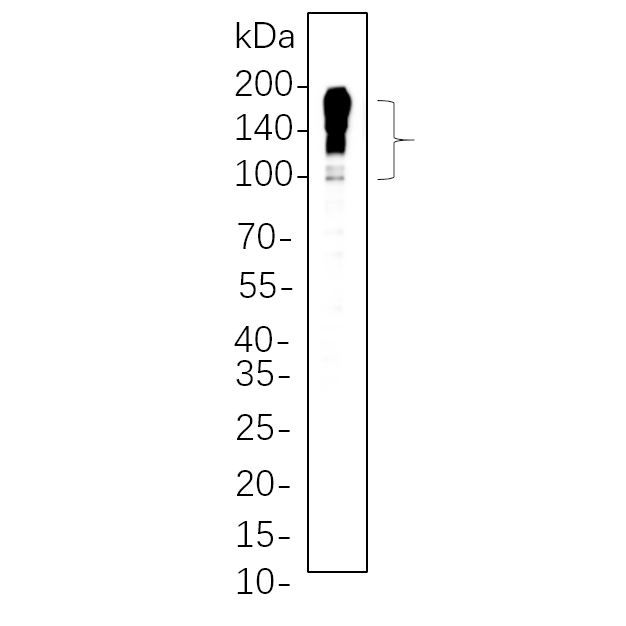
WR4440 Mouse colon cell lysates were separated by 4-20% SDS-PAGE, and the membrane was blotted with primary antibody 1:1000. The HRP-conjugated Goat anti-Rabbit IgG(H + L) antibody was used to detect the antibody.
Price range: $268.00 through $328.00
Product details
Background:This gene encodes a member of the mucin protein family. Mucins are high molecular weight glycoproteins produced by many epithelial tissues. The protein encoded by this gene is secreted and forms an insoluble mucous barrier that protects the gut lumen. The protein polymerizes into a gel of which 80% is composed of oligosaccharide side chains by weight. The protein features a central domain containing tandem repeats rich in threonine and proline that varies between 50 and 115 copies in different individuals. Alternatively spliced transcript variants of this gene have been described, but their full-length nature is not known. [provided by RefSeq, Jul 2008],
Specifications
| Size | 50μL/100μL |
| Target | MUC2 |
| Reactivity | Human, Mouse, Rat |
| Applications | WB, IHC, IF, ELISA |
| MW(Calculated) | 551kD |
| MW(Observed) | 140-170kD |
| Host Species | Rabbit |
| Isotype | IgG,Kappa |
| Conjugate/Modification | Unmodified |
| Recommended Dilution Ratio | IHC 1:1000-1:4000; WB 1:2000-1:10000; IF 1:200-1:1000; ELISA 1:5000-1:20000; / Note: For IHC, we suggest antigen retrieval with TE buffer pH 9.0 (Cat#WT1004) |
| Formulation | PBS, 50% glycerol, 0.05% Proclin 300, 0.05%BSA |
| Purification | Recombinant Antibody expressed in animal component-free (ACF) media, purified via Protein A affinity chromatography. |
| Storage | -15°C to -25°C/1 year(Do not lower than -25°C) |
| Concentration | |
| Clonality | Monoclonal |
| Clone Number | RM0660R |
| Immunogen | The specific immunogen used to produce this antibody is proprietary information. |
| Specificity | Endogenous |
| Gene Name | MUC2 SMUC |
| Protein Name | Mucin-2 (MUC-2) (Intestinal mucin-2) |
| Other Name | |
| Species | Human |
| Gene ID | 4583 |
| Uniprot | Q02817 |
| Species.1 | |
| Gene ID.1 | |
| Uniprot.1 | |
| Species.2 | |
| Gene ID.2 | |
| Uniprot.2 | |
| Cellular Localization | Secreted |
| Tissue Expression | Colon, small intestine, colonic tumors, bronchus, cervix and gall bladder. |
| Signaling_pathway | Human Diseases >> Cancer: specific types >> Gastric cancer |
| Research Areas | >>Amoebiasis; / >>Gastric cancer |
| Function | Function:Coats the epithelia of the intestines, airways, and other mucus membrane-containing organs. Thought to provide a protective, lubricating barrier against particles and infectious agents at mucosal surfaces. Major constituent of both the inner and outer mucus layers of the colon and may play a role in excluding bacteria from the inner mucus layer.,polymorphism:The number of repeats is highly polymorphic and varies among different alleles.,PTM:At low pH of 6 and under, undergoes autocatalytic cleavage in vitro in the N-terminal region of the fourth VWD domain. It is likely that this also occurs in vivo and is triggered by the low pH of the late secretory pathway.,PTM:May undergo proteolytic cleavage in the outer mucus layer of the colon, contributing to the expanded volume and loose nature of this layer which allows for bacterial colonization in contrast to the inner mucus layer which is dense and devoid of bacteria.,PTM:O-glycosylated.,similarity:Contains 1 CTCK (C-terminal cystine knot-like) domain.,similarity:Contains 1 TIL (trypsin inhibitory-like) domain.,similarity:Contains 2 VWFC domains.,similarity:Contains 4 VWFD domains.,subunit:Homotrimer; disulfide-linked. Dimerizes in the endoplasmic reticulum via its C-terminal region and polymerizes via its N-terminal region by disulfide-linked trimerization. Interacts with FCGBP.,tissue specificity:Colon, small intestine, colonic tumors, bronchus, cervix and gall bladder., |
Please login to post questions
Related products





