


U-Blot® Tyk 2 Rabbit mAb
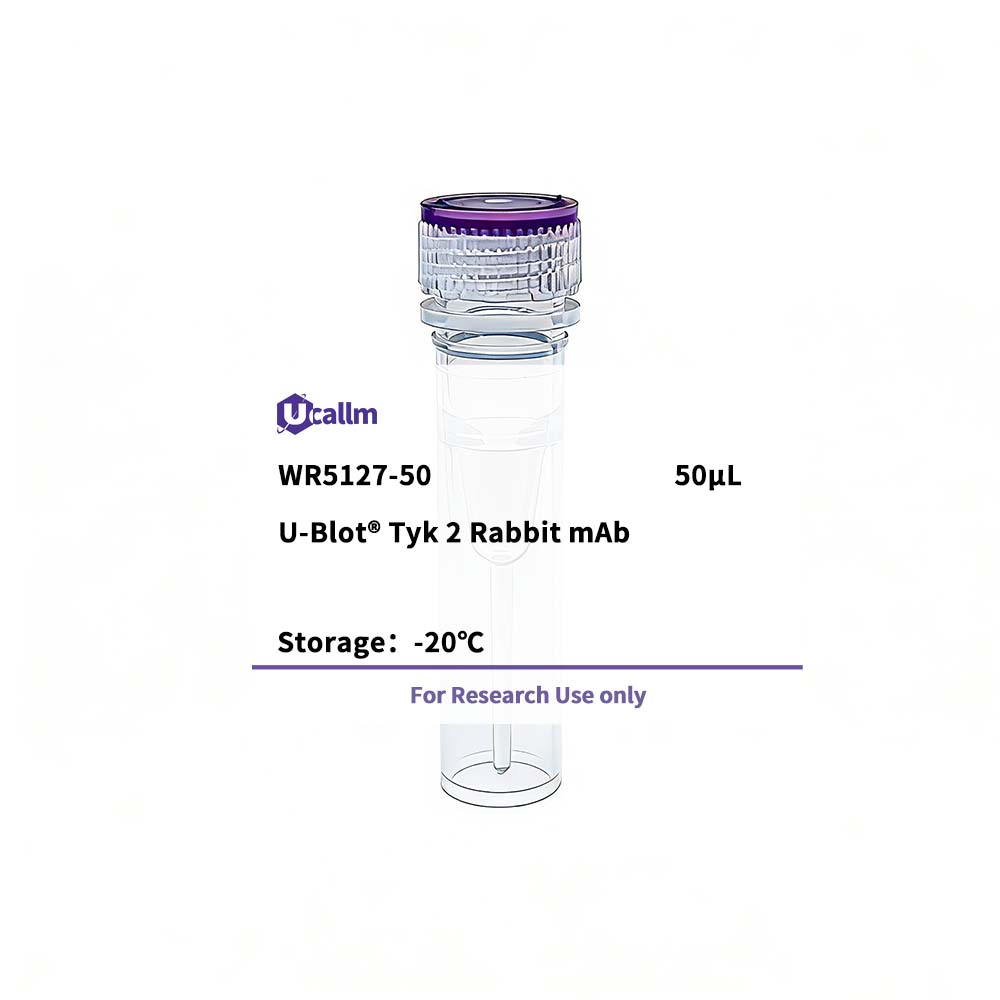
Ucallm_WR5127-50
Price range: $268.00 through $328.00
Product details
Background:tyrosine kinase 2(TYK2) Homo sapiens This gene encodes a member of the tyrosine kinase and, more specifically, the Janus kinases (JAKs) protein families. This protein associates with the cytoplasmic domain of type I and type II cytokine receptors and promulgate cytokine signals by phosphorylating receptor subunits. It is also component of both the type I and type III interferon signaling pathways. As such, it may play a role in anti-viral immunity. A mutation in this gene has been associated with hyperimmunoglobulin E syndrome (HIES) – a primary immunodeficiency characterized by elevated serum immunoglobulin E. [provided by RefSeq, Jul 2008],
Specifications
| Size | 50μL/100μL |
| Target | Tyk 2 |
| Reactivity | Human, Mouse, Rat |
| Applications | WB, IF, ELISA |
| MW(Calculated) | 134kD |
| MW(Observed) | 134kD |
| Host Species | Rabbit |
| Isotype | IgG,Kappa |
| Conjugate/Modification | Unmodified |
| Recommended Dilution Ratio | WB 1:2000-1:10000; IF 1:200-1:1000; ELISA 1:5000-1:20000; |
| Formulation | PBS, 50% glycerol, 0.05% Proclin 300, 0.05%BSA |
| Purification | Recombinant Antibody expressed in animal component-free (ACF) media, purified via Protein A affinity chromatography. |
| Storage | -15°C to -25°C/1 year(Do not lower than -25°C) |
| Concentration | |
| Clonality | Monoclonal |
| Clone Number | RM1348R |
| Immunogen | The specific immunogen used to produce this antibody is proprietary information. |
| Specificity | Endogenous |
| Gene Name | TYK2 |
| Protein Name | Non-receptor tyrosine-protein kinase TYK2 |
| Other Name | TYK2; / Non-receptor tyrosine-protein kinase TYK2 |
| Species | Human |
| Gene ID | 7297 |
| Uniprot | P29597, |
| Species.1 | Mouse |
| Gene ID.1 | |
| Uniprot.1 | Q9R117 |
| Species.2 | |
| Gene ID.2 | |
| Uniprot.2 | |
| Cellular Localization | nucleus,cytoplasm,cytosol,cytoskeleton,membrane,extrinsic component of cytoplasmic side of plasma membrane,extracellular exosome, |
| Tissue Expression | Observed in all cell lines analyzed. Expressed in a variety of lymphoid and non-lymphoid cell lines. |
| Signaling_pathway | Cellular Processes >> Cell growth and death >> Necroptosis;Organismal Systems >> Immune system >> Toll-like receptor signaling pathway;Organismal Systems >> Immune system >> NOD-like receptor signaling pathway;Organismal Systems >> Immune system >> Th1 and Th2 cell differentiation;Organismal Systems >> Immune system >> Th17 cell differentiation;Organismal Systems >> Development and regeneration >> Osteoclast differentiation;Environmental Information Processing >> Signal transduction >> JAK-STAT signaling pathway |
| Research Areas | >>Necroptosis; / >>Osteoclast differentiation; / >>NOD-like receptor signaling pathway; / >>JAK-STAT signaling pathway; / >>Th1 and Th2 cell differentiation; / >>Th17 cell differentiation; / >>Toxoplasmosis; / >>Hepatitis C; / >>Hepatitis B; / >>Measles; / >>Influenza A; / >>Human papillomavirus infection; / >>Kaposi sarcoma-associated herpesvirus infection; / >>Herpes simplex virus 1 infection; / >>Epstein-Barr virus infection; / >>Coronavirus disease - COVID-19 |
| Function | Catalytic activity:ATP + a [protein]-L-tyrosine = ADP + a [protein]-L-tyrosine phosphate.,Disease:Defects in TYK2 are the cause of protein-tyrosine kinase 2 deficiency (TYK2 deficiency) [MIM:611521]; also called autosomal recessive hyper-IgE syndrome (HIES) with atypical mycobacteriosis. The syndrome consists of a primary immunodeficiency characterized by recurrent skin abscesses, pneumonia, and highly elevated serum IgE.,Domain:The FERM domain mediates interaction with JAKMIP1.,Function:Probably involved in intracellular signal transduction by being involved in the initiation of type I IFN signaling. Phosphorylates the interferon-alpha/beta receptor alpha chain.,online information:TYK2 mutation db,similarity:Belongs to the protein kinase superfamily. Tyr protein kinase family. JAK subfamily.,similarity:Contains 1 FERM domain.,similarity:Contains 1 protein kinase domain.,similarity:Contains 1 SH2 domain.,subunit:Interacts with JAKMIP1.,tissue specificity:Observed in all cell lines analyzed. Expressed in a variety of lymphoid and non-lymphoid cell lines., |
Please login to post questions
Related products





