

NSE [PT2281] mouse mAb
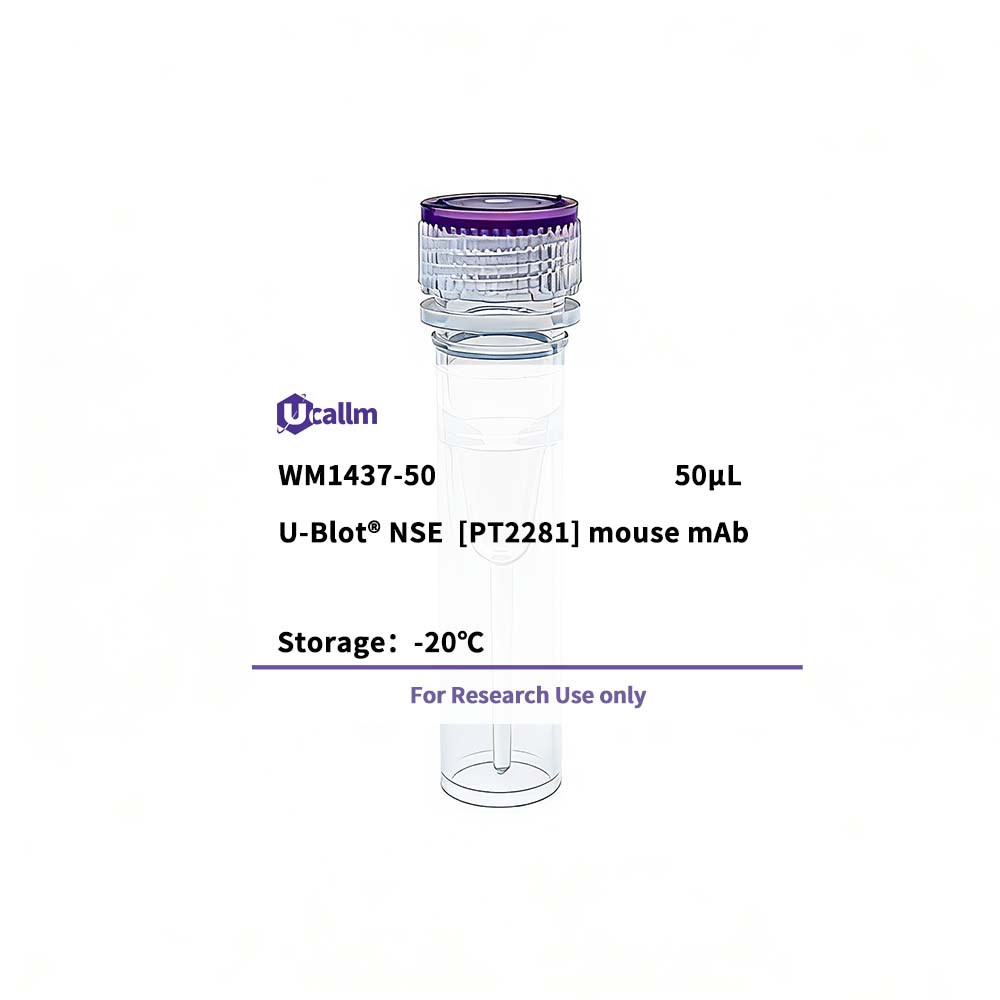
Ucallm_WM1437-50
Price range: $268.00 through $328.00
Product details
Background:
Neuron-specific enolase (NSE) has α、β、γ three subunits, mainly distributed in central nerve, peripheral nerve, neuroendocrine cells and tumor cells, can be used in the auxiliary diagnosis of neuroendocrine tumors. Some non neuroendocrine cells also express NSE, such as normal smooth muscle, myoepithelial cells, renal tubular cells, lymphocytes and so on. It should be combined with other antibodies in the study of neuroendocrine tumors.
Specifications
| Size | 50μL/100μL |
| Target | Enolase |
| Reactivity | Human, Mouse, Rat |
| Applications | IHC, WB, IF, ELISA |
| MW(Calculated) | 47kD |
| MW(Observed) | 47kD |
| Host Species | Mouse |
| Isotype | IgG1,Kappa |
| Conjugate/Modification | Unmodified |
| Recommended Dilution Ratio | IHC 1:200-1000; WB 1:500-2000; IF 1:100-500; ELISA 1:1000-5000 / Note: For IHC, we suggest antigen retrieval with TE buffer pH 9.0 (Cat#WT1004) |
| Formulation | PBS, 50% glycerol, 0.05% Proclin 300, 0.05%BSA |
| Purification | Recombinant Antibody expressed in animal component-free (ACF) media, purified via Protein G affinity chromatography. |
| Storage | -15°C to -25°C/1 year(Do not lower than -25°C) |
| Concentration | |
| Clonality | Monoclonal |
| Clone Number | RMM2281 |
| Immunogen | Synthesized peptide derived from human Neuron-Specific Enolase(NSE) AA range: 300-434 |
| Specificity | The antibody can specifically recognize human NSE protein. In western blotting of PC-12 cell lysate, the antibody can label a 47 kDa band corresponding to NSE. |
| Gene Name | ENO2 |
| Protein Name | Neuron-Specific Enolase(NSE) |
| Other Name | 2 phospho D glyceRate hydrolyase; / 2-phospho-D-glyceRate hydro-lyase; / Eno 2; / ENO2; / ENOG; / ENOG_HUMAN; / Enolase 2; / gamma, neuronal; / Enolase 2; / Enolase 2 gamma neuronal; / Enolase2; / Epididymis secretory protein Li 279; / Gamma enolase; / Gamma-enolase; / HEL S 279; / Neural enolase; / Neuron specific enolase; / Neuron specific gamma enolase; / Neuron-specific enolase; / neuronal enriched enolase; / Neurone specific enolase; / NSE |
| Species | Human |
| Gene ID | 2026 |
| Uniprot | P09104, |
| Species.1 | Mouse |
| Gene ID.1 | 13807 |
| Uniprot.1 | P17183, |
| Species.2 | Rat |
| Gene ID.2 | 24334 |
| Uniprot.2 | P07323 |
| Cellular Localization | Cytoplasmic |
| Tissue Expression | The alpha/alpha homodimer is expressed in embryo and in most adult tissues. The alpha/beta heterodimer and the beta/beta homodimer are found in striated muscle, and the alpha/gamma heterodimer and the gamma/gamma homodimer in neurons. |
| Signaling_pathway | Environmental Information Processing >> Signal transduction >> HIF-1 signaling pathway;Genetic Information Processing >> Folding, sorting and degradation >> RNA degradation |
| Research Areas | >>Glycolysis / Gluconeogenesis; / >>Metabolic pathways; / >>Carbon metabolism; / >>Biosynthesis of amino acids; / >>RNA degradation; / >>HIF-1 signaling pathway |
| Function | Catalytic activity:2-phospho-D-glycerate = phosphoenolpyruvate + H(2)O.,cofactor:Magnesium. Required for catalysis and for stabilizing the dimer.,developmental stage:During ontogenesis, there is a transition from the alpha/alpha homodimer to the alpha/beta heterodimer in striated muscle cells, and to the alpha/gamma heterodimer in nerve cells.,Function:Has neurotrophic and neuroprotective properties on a broad spectrum of central nervous system (CNS) neurons. Binds, in a calcium-dependent manner, to cultured neocortical neurons and promotes cell survival.,induction:Levels of ENO2 increase dramatically in cardiovascular accidents, cerebral trauma, brain tumors and Creutzfeldt-Jacob disease.,pathway:Carbohydrate degradation; glycolysis; pyruvate from D-glyceraldehyde 3-phosphate: step 4/5.,similarity:Belongs to the enolase family.,subcellular location:Can translocate to the plasma membrane in either the homodimeric (alpha/alpha) or heterodimeric (alpha/gamma) form.,subunit:Mammalian enolase is composed of 3 isozyme subunits, alpha, beta and gamma, which can form homodimers or heterodimers which are cell-type and development-specific.,tissue specificity:The alpha/alpha homodimer is expressed in embryo and in most adult tissues. The alpha/beta heterodimer and the beta/beta homodimer are found in striated muscle, and the alpha/gamma heterodimer and the gamma/gamma homodimer in neurons., |
Please login to post questions
Related products





