


Recombinant CD7 Fc-Fused Nanobody (VF0455)
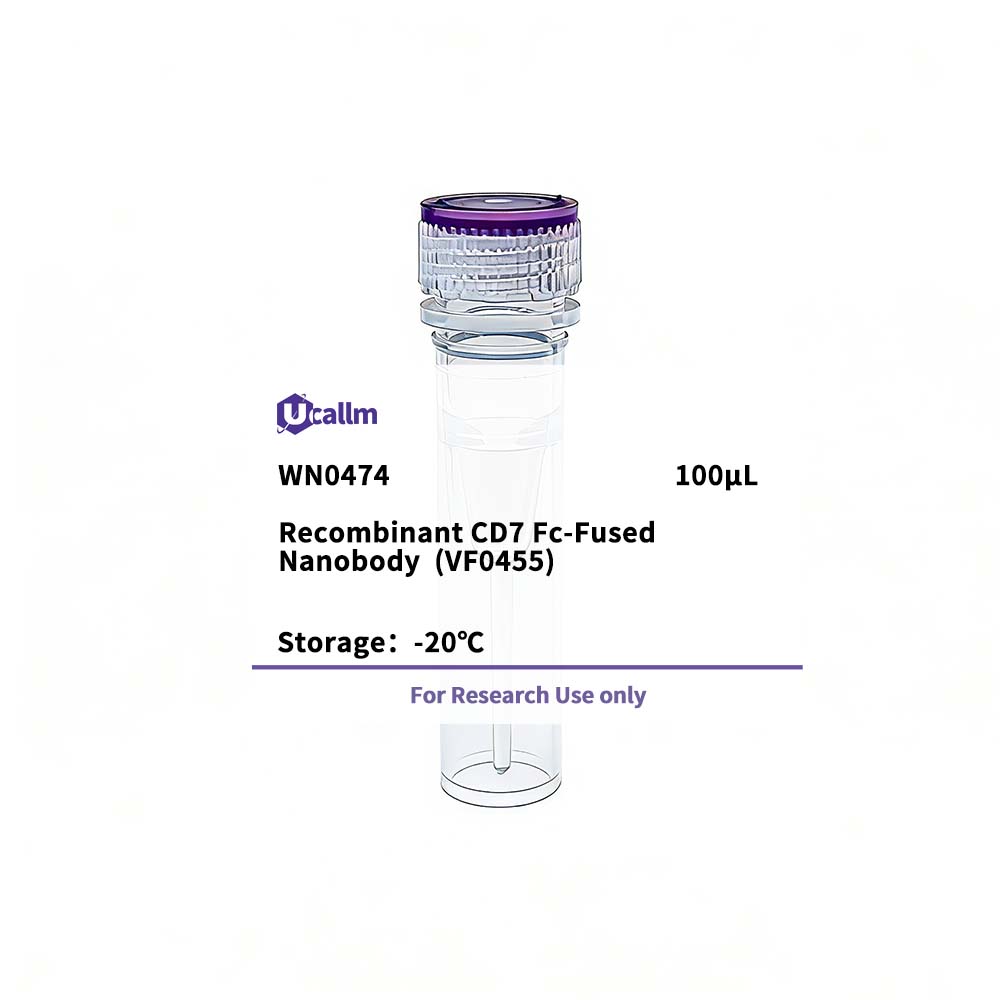
Ucallm_WN0474
$365.00
Product details
Background:This gene encodes a transmembrane protein which is a member of the immunoglobulin superfamily. This protein is found on thymocytes and mature T cells. It plays an essential role in T-cell interactions and also in T-cell/B-cell interaction during early lymphoid development. [provided by RefSeq, Jul 2008],
Specifications
| Size | 100μL |
| Target | CD7 |
| Reactivity | Human |
| Applications | ELISA, FC |
| MW(Calculated) | |
| MW(Observed) | |
| Host Species | |
| Isotype | IgG2a,Kappa |
| Conjugate/Modification | Unmodified |
| Recommended Dilution Ratio | ELISA 1:5000-100000 |
| Formulation | Phosphate-buffered solution |
| Purification | Recombinant Expression and Affinity purified |
| Storage | -15°C to -25°C/1 year(Avoid freeze / thaw cycles) |
| Concentration | Please check the information on the tube |
| Clonality | |
| Clone Number | VF0050 |
| Immunogen | Purified recombinant Human CD7 |
| Specificity | This recombinant monoclonal antibody can detects endogenous levels of CD7 protein. |
| Gene Name | CD7 |
| Protein Name | CD7 |
| Other Name | T-cell antigen CD7; / GP40; / T-cell leukemia antigen; / T-cell surface antigen Leu-9; / TP41; / CD antigen CD7; / CD7 nanobody |
| Species | Human |
| Gene ID | 924 |
| Uniprot | P09564 |
| Species.1 | |
| Gene ID.1 | |
| Uniprot.1 | |
| Species.2 | |
| Gene ID.2 | |
| Uniprot.2 | |
| Cellular Localization | Membrane; Single-pass type I membrane protein. |
| Tissue Expression | Highly expressed by blood monocytes and tissue macrophages. Also expressed in lymphocytes, fibroblasts and endothelial cells. Expressed in many tumor cell lines which could allow them to attach to selectins on vascular endothelium, facilitating their dissemination to secondary sites. |
| Signaling_pathway | Organismal Systems >> Immune system >> Hematopoietic cell lineage |
| Research Areas | >>Hematopoietic cell lineage |
| Function | Function:Not yet known.,similarity:Contains 1 Ig-like (immunoglobulin-like) domain.,subunit:Interacts with SECTM1., |
Please login to post questions
Related products





