

Product details
Background:
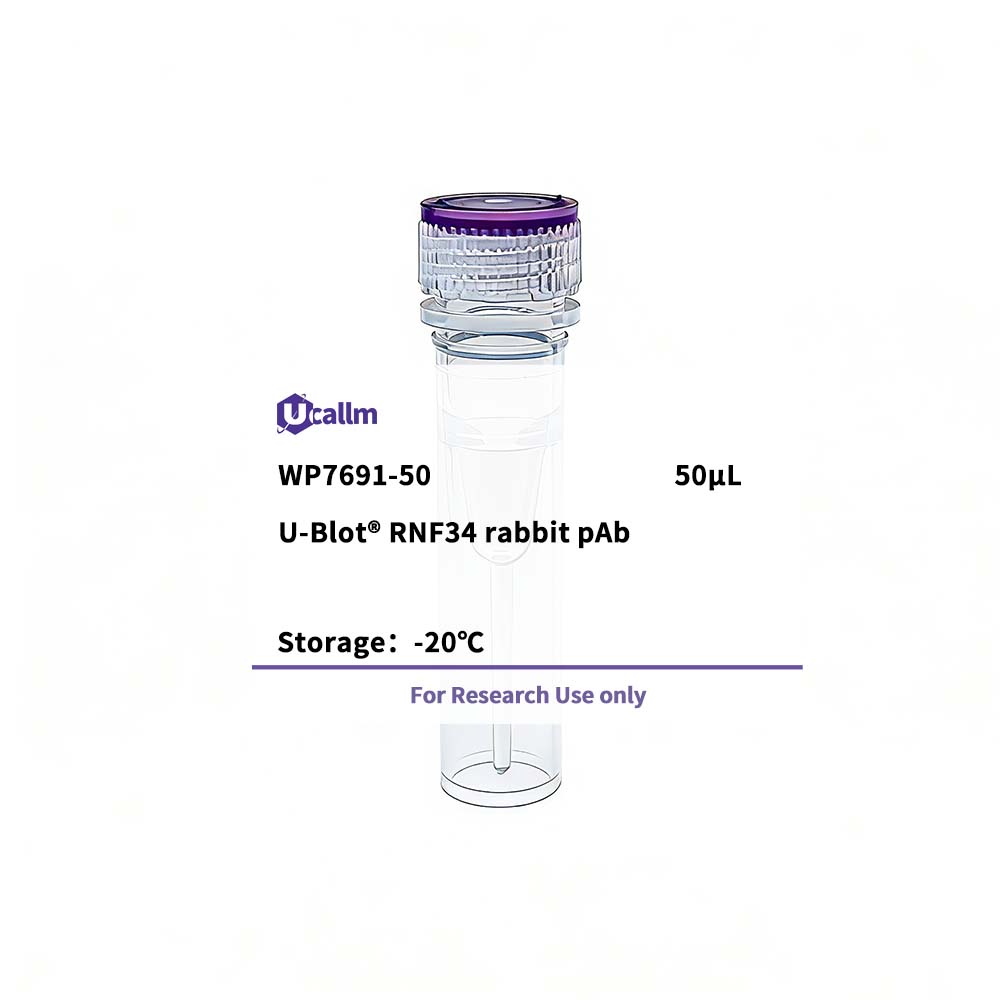
Price range: $268.00 through $328.00
Background:
| Size | 50μL/100μL |
| Target | RNF34 |
| Reactivity | Human, Mouse, Rat |
| Applications | WB |
| MW(Calculated) | 41kD |
| MW(Observed) | |
| Host Species | Rabbit |
| Isotype | IgG |
| Conjugate/Modification | Unmodified |
| Recommended Dilution Ratio | WB 1:500-2000 |
| Formulation | Liquid in PBS containing 50% glycerol, 0.5% BSA and 0.02% sodium azide. |
| Purification | The antibody was affinity-purified from rabbit antiserum by affinity-chromatography using epitope-specific immunogen. |
| Storage | -15°C to -25°C/1 year(Do not lower than -25°C) |
| Concentration | 1 mg/ml |
| Clonality | Polyclonal |
| Clone Number | |
| Immunogen | Synthesized peptide derived from human RNF34 |
| Specificity | This antibody detects endogenous levels of RNF34 at Human, Mouse,Rat |
| Gene Name | RNF34 |
| Protein Name | E3 ubiquitin-protein ligase RNF34 (Caspase regulator CARP1) (Caspases-8 and -10-associated RING finger protein 1) (CARP-1) (FYVE-RING finger protein Momo) (Human RING finger homologous to inhibitor of apoptosis protein) (hRFI) (RING finger protein 34) (RING finger protein RIFF) |
| Other Name | |
| Species | Human |
| Gene ID | 80196 |
| Uniprot | Q969K3, |
| Species.1 | Mouse |
| Gene ID.1 | 80751 |
| Uniprot.1 | Q99KR6, |
| Species.2 | Rat |
| Gene ID.2 | 282845 |
| Uniprot.2 | Q6AYH3 |
| Cellular Localization | Cell membrane; Peripheral membrane protein . Endomembrane system; Peripheral membrane protein . Nucleus . Nucleus speckle . Cytoplasm, cytosol . |
| Tissue Expression | Ubiquitous. Detected in heart, brain, liver, skeletal muscle, kidney, pancreas, spleen, thymus, prostate, testis, ovary, colon and leukocytes. |
| Signaling_pathway | |
| Research Areas | |
| Function | E3 ubiquitin-protein ligase that regulates several biological processes through the ubiquitin-mediated proteasomal degradation of various target proteins. Ubiquitinates the caspases CASP8 and CASP10, promoting their proteasomal degradation, to negatively regulate cell death downstream of death domain receptors in the extrinsic pathway of apoptosis . May mediate 'Lys-48'-linked polyubiquitination of RIPK1 and its subsequent proteasomal degradation thereby indirectly regulating the tumor necrosis factor-mediated signaling pathway (Ref.13). Negatively regulates p53/TP53 through its direct ubiquitination and targeting to proteasomal degradation . Indirectly, may also negatively regulate p53/TP53 through ubiquitination and degradation of SFN . Mediates PPARGC1A proteasomal degradation probably through ubiquitination thereby indirectly regulating the metabolism of brown fat cells . Possibly involved in innate immunity, through 'Lys-48'-linked polyubiquitination of NOD1 and its subsequent proteasomal degradation . |





